Drip Irrigation Fittings Selection for Garden Layouts
Drip irrigation fittings selection depends on tubing size, connection points, garden layout shape, and future reconfiguration needs. The fitting choice starts by identifying where water lines need to run, branch, turn, adapt, or stop. This approach helps match fitting roles to layout requirements before considering a fitting kit or connector assortment.

A simple garden layout with a direct tubing path may need different fittings from a layout with multiple branches, turns, or garden zones. Branch points can require tees, direction changes can require elbows, and transition points can require adapters based on the connected components. The number of connection points and the layout shape influence which fittings may be suitable for the system design.
The selection process moves from layout planning to compatibility checks and then to the appropriate buying format. Checking tubing size, fitting roles, and connection conditions can help reduce poor fit risks or missing parts. The drip irrigation fittings hub provides the broader category context before evaluating individual selection factors.
A suitable selection approach considers layout needs, compatibility conditions, and buying format together instead of choosing fittings based only on quantity or appearance.
- A layout with branches may need tees or related connectors to support split tubing paths.
- A layout with turns may need elbows to redirect tubing while matching connection conditions.
- A layout with different tubing sections may require adapters depending on compatibility requirements.
- A layout with endpoints may need end closures or related fitting roles for line control.
- A layout with changing requirements may require a fitting kit, connector assortment, or separate fittings based on included parts and future adjustments.
Layout Requirements That Determine Fitting Choices
Layout requirements determine drip irrigation fittings selection before comparing kits or individual parts. The layout shape, line direction, connection points, and future changes influence which fitting roles may be needed. A clear view of the tubing path helps connect each layout condition with the fitting need and selection effect.
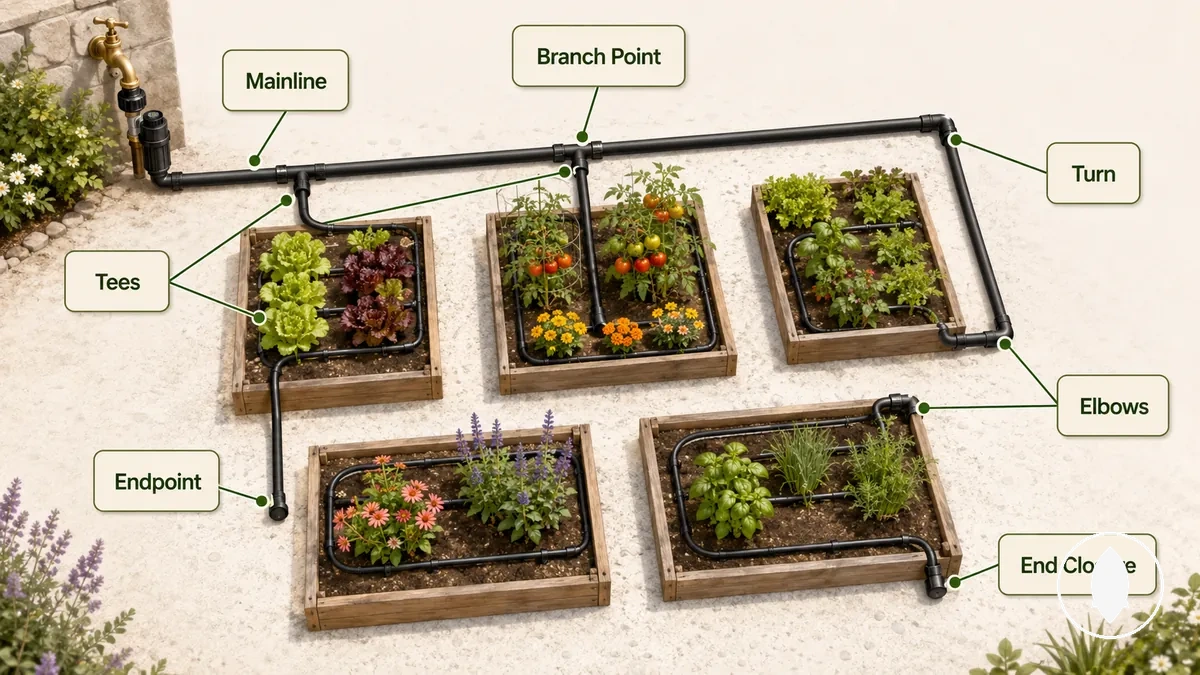
A simple garden bed with straight runs may need a different fitting mix from a segmented layout with multiple garden zones. Straight runs can influence the need for joining connectors, while branches may require tees and feeder lines. Turns can create a need for elbows, and endpoints may require end closures or access points depending on the layout design.
Bed grouping, line direction, and access points help define how drip irrigation fittings should be selected for a specific layout. Considering these conditions before choosing a fitting kit or connector assortment can help reduce missing-part risks and compatibility issues. The layout placement for fittings section provides further context on how connection locations relate to fitting choices.
- Line path: Straight runs may need joining fittings or connectors that match the tubing path.
- Branch count: Multiple branches or garden zones may require tees and related connection points.
- Turns: Corners and direction changes may require elbows based on the tubing route.
- Endpoint control: Endpoints may need end closures, end caps, or shutoff points for layout control.
- Future access: Layouts expected to change may need fittings selected with reconfiguration needs in mind.
Straight runs, branches, turns, and end closures
Straight runs, branch points, turns, and endpoints create local fitting needs within a drip irrigation layout. A straight run may need a coupler for a tubing extension, while a branch point may need a tee to create a split in the mainline or feeder line. Turns and endpoints change the fitting role by introducing direction changes or closure needs.
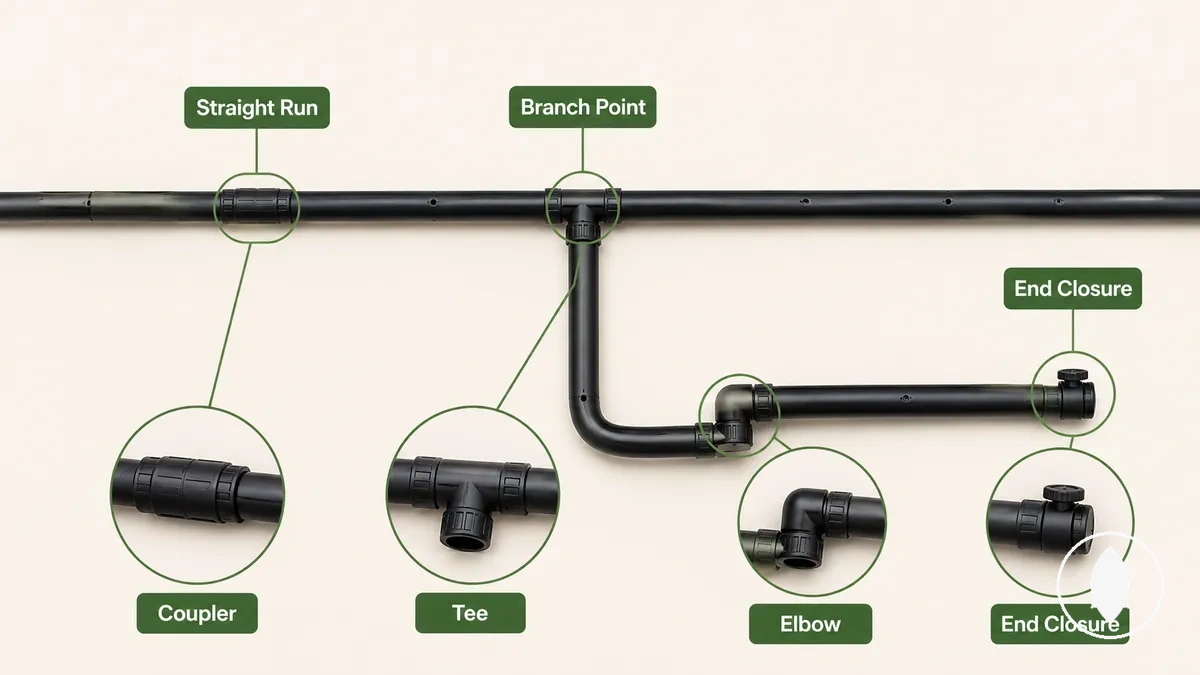
Each layout point connects to a fitting role, but the final fit can depend on tubing dimensions and fitting style. A coupler may support a line extension, a tee may support a branch connection, an elbow may redirect a corner, and a cap or valve may close an endpoint depending on the layout requirement. The same layout can require several fitting roles because each connection point serves a different purpose.
- Straight run: A coupler may support a tubing extension where the line path needs to continue.
- Branch point: A tee may support a split connection where a feeder line branches from the mainline.
- Turn: An elbow may redirect tubing where a corner changes the direction of the line.
- Endpoint: A cap or valve may provide an end closure or access point depending on the layout need.
Raised beds and grouped garden zones
Raised beds and grouped garden zones can change drip irrigation fittings selection because bed count, spacing, and layout grouping affect fitting quantity and type mix. A single raised bed with a simple tubing path may need a different combination of fittings from multiple beds connected through separate feeder lines. As grouped zones increase, the number of connection points may change the fitting roles required for the layout.
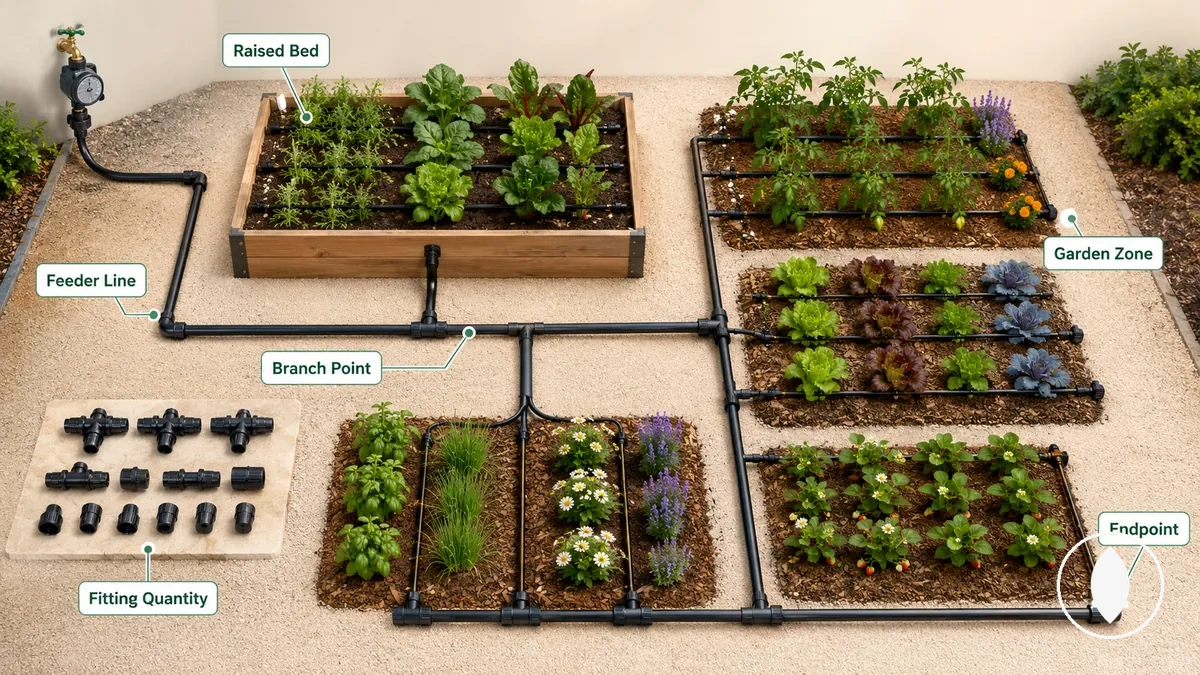
Feeder lines, branch points, and endpoint control influence fitting choices across grouped layouts. Multiple garden beds may create additional connection needs, while spacing between zones can affect tubing paths, tees, adapters, and end closures. Spare fittings may be considered when future changes or layout adjustments are possible.
A one-bed layout may involve fewer fitting roles, while a multi-bed or grouped-zone layout may require a wider type mix because of additional connections and layout conditions.
- Bed count: More raised beds may increase fitting quantity when each area requires separate connection points.
- Spacing: Greater spacing between garden beds may affect tubing paths and the fittings needed for connections.
- Grouped zones: Multiple zones may require tees, feeder lines, and different fitting roles.
- Endpoint control: Additional endpoints may require caps or valves depending on the layout requirements.
Fitting Roles to Match to Connection Points
Fitting roles define the connection jobs that each drip irrigation fitting part performs within a layout. A coupler, adapter, tee, elbow, end cap, or shutoff point matches a specific connection point based on its layout use. Understanding these roles helps identify the fitting part needed for each connection job before comparing fitting styles.
A connection point can require a specific fitting role because each location serves a different purpose in the layout. A coupler may support a tubing join on a straight run, while an adapter may support a transition between different connection ends. A tee may create a branch connection, and a missing fitting role can affect the layout because the intended connection job may remain incomplete.
Role matching focuses on the function of a fitting part, while fitting-style comparison focuses on differences between connection methods. The selection risk comes from choosing a fitting without confirming the connection point, layout use, and required role.
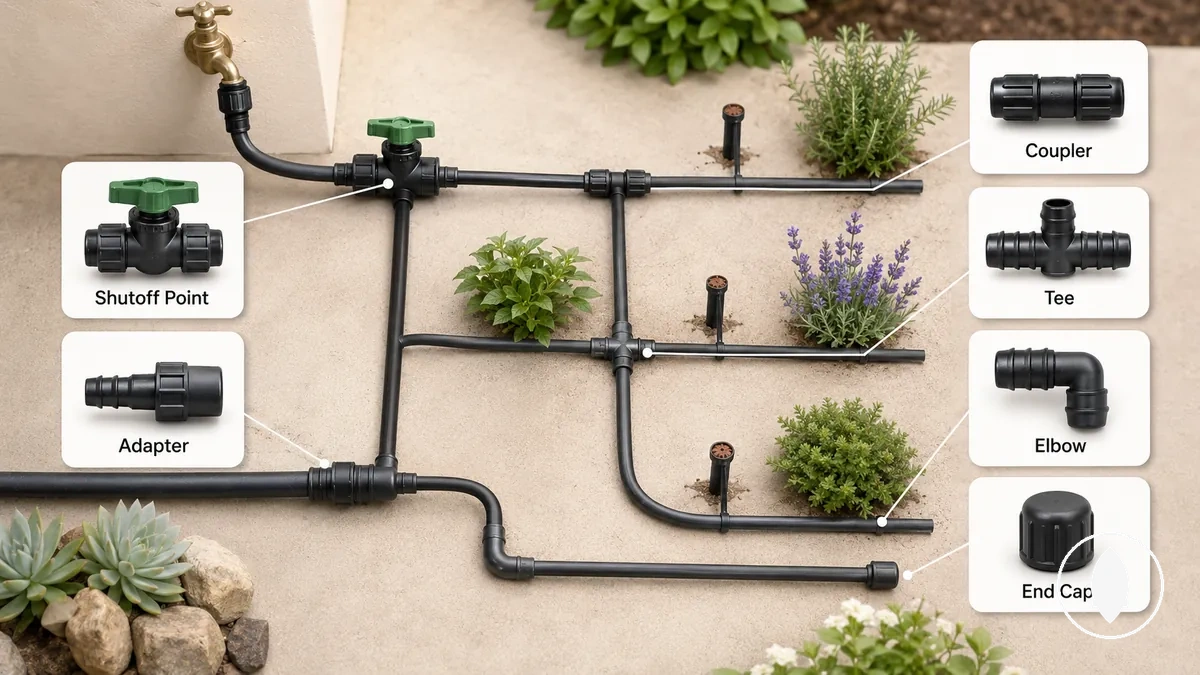
| Fitting role | Connection point | Layout use | Selection risk |
|---|---|---|---|
| Coupler | Straight run connection | Supports tubing joins or extensions | May not suit the connection if tubing conditions differ |
| Adapter | Transition connection | Links different connection ends | Requires matching the intended transition conditions |
| Tee | Branch point | Creates a split for feeder lines | Missing the branch role may prevent the intended connection |
| Elbow | Turn or corner | Redirects tubing direction | Fit depends on tubing and fitting conditions |
| End cap | Line endpoint | Provides a closure point | May not match the required endpoint function |
| Shutoff point | Control location | Provides control at a selected connection point | Selection depends on the intended layout use |
Couplers and adapters for line transitions
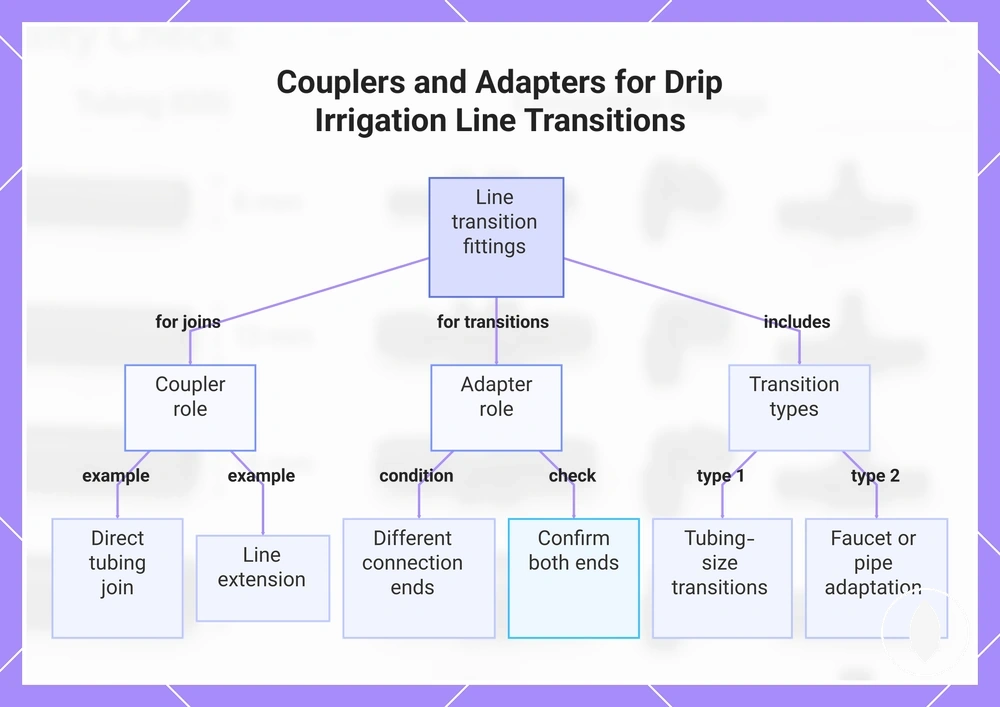
Couplers and adapters are needed when drip irrigation lines need to join, extend, or transition between different connection ends. Couplers can support tubing-to-tubing joins or extensions, while adapters can support line transitions where different connection conditions need to meet. The fitting role depends on whether the connection requires a join, extension, or transition.
Line transitions can include tubing-to-tubing joins, tubing-size transitions, mainline-to-micro transitions, or faucet and pipe adaptation. A coupler may suit a direct tubing join, while an adapter may suit a transition between connection ends that require matching. Adapter selection depends on confirming both ends of the connection before choosing the fitting part.
This chart shows the roles of couplers and adapters, the types of line transitions, and the key selection step for drip irrigation fittings.
Tees and elbows for branches and turns
Tees split water direction at a branch point, while elbows redirect a line when a turn or corner changes the tubing path. Tee fittings support branches by creating a split connection, while elbow fittings support turns by changing the direction of the line.
Branch count, turns, and space limitations can influence whether a tee or elbow matches the connection need. A higher branch count may require more tee roles for feeder lines, while limited space or corner turns may require elbow roles to suit the tubing path. The selection outcome depends on the fitting shape, layout action, and connection conditions.
| Fitting shape | Layout action |
|---|---|
| Tee | Splits water direction for a branch connection |
| Elbow | Redirects a line for a turn or corner direction change |
End caps and shutoff points for layout control
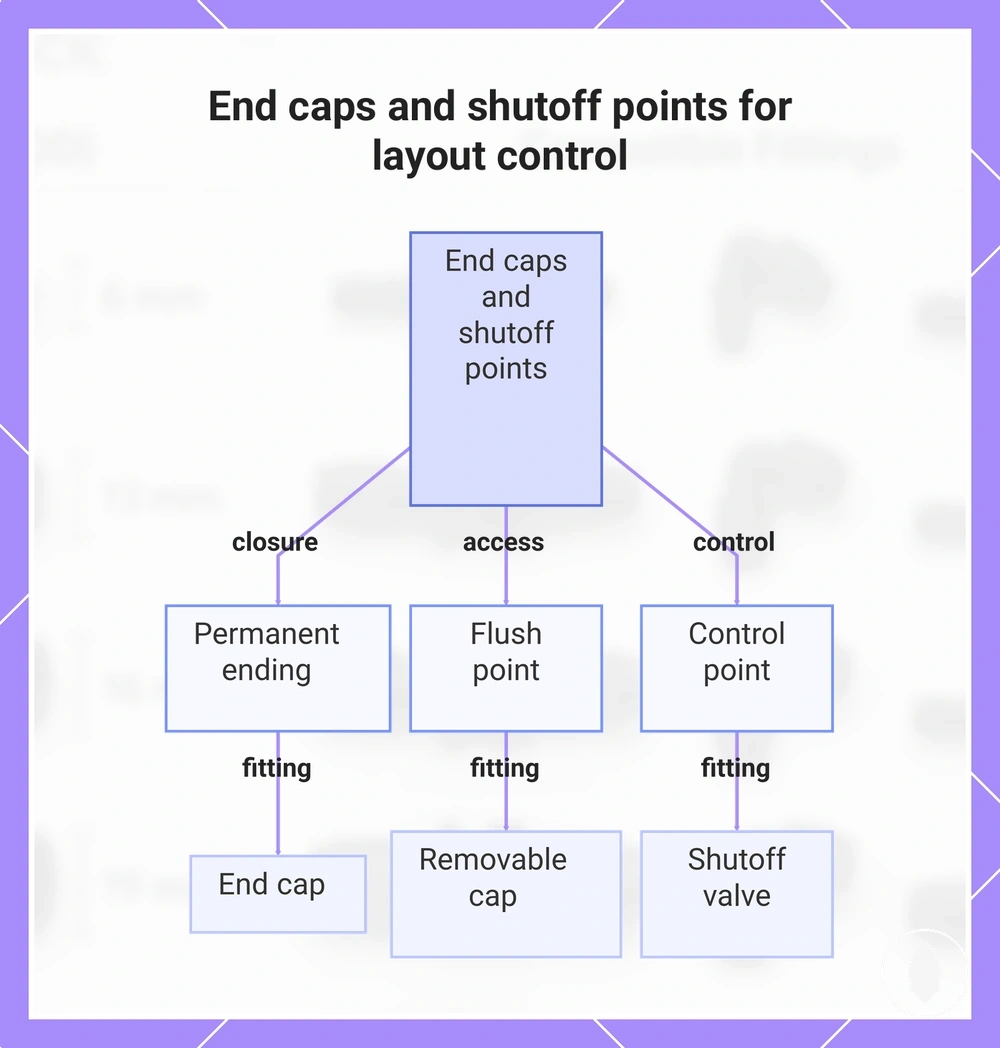
End caps and shutoff points are endpoint-control fittings that close or control drip irrigation lines. End caps can provide end closures for tubing lines, while shutoff valves can provide a control point where layout control is needed. The fitting role depends on whether the endpoint requires closure, access, or control.
Endpoint options can vary based on the layout requirement. End caps may suit permanent line endings, while removable caps can support access at selected flush points. Shutoff points and shutoff valves can provide control at specific locations, but the selection depends on the layout design and connection conditions. Accessible endpoints may influence fitting choice when future changes or access needs are part of the layout.
- End closures: End caps can close a tubing line where a permanent ending is needed.
- Flush points: Removable caps can provide access where an endpoint may need opening later.
- Control points: Shutoff valves can support layout control where a controllable endpoint is required.
This chart shows the three main endpoint functions of end caps and shutoff valves in drip irrigation systems: closure, access, and control.
Tubing Size Compatibility Before Selection
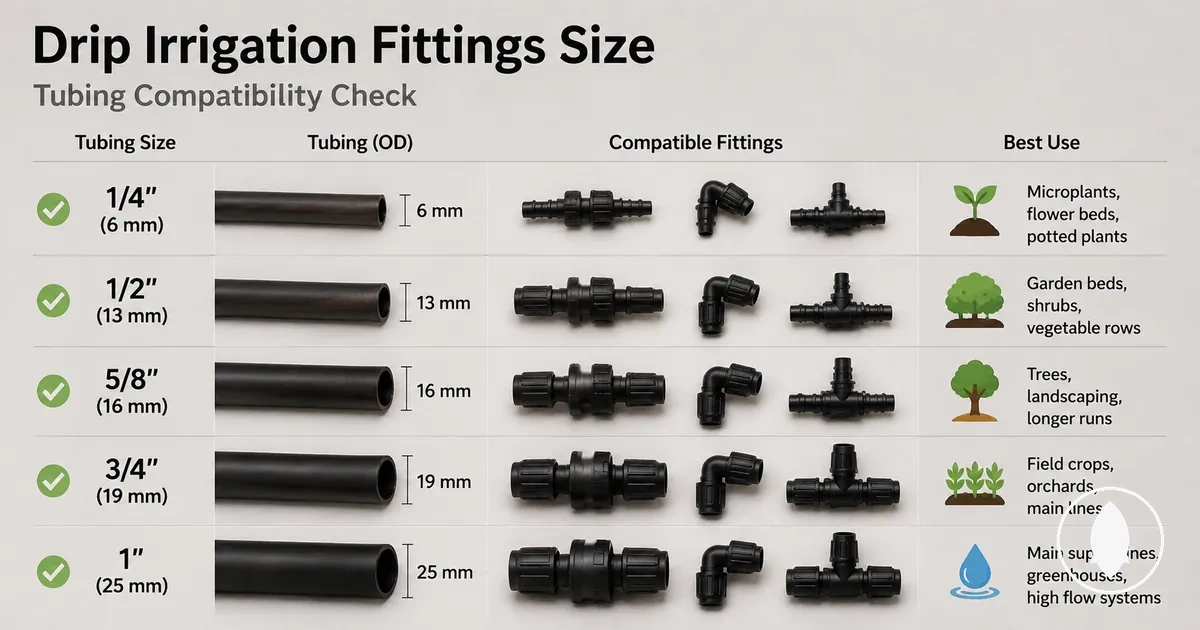
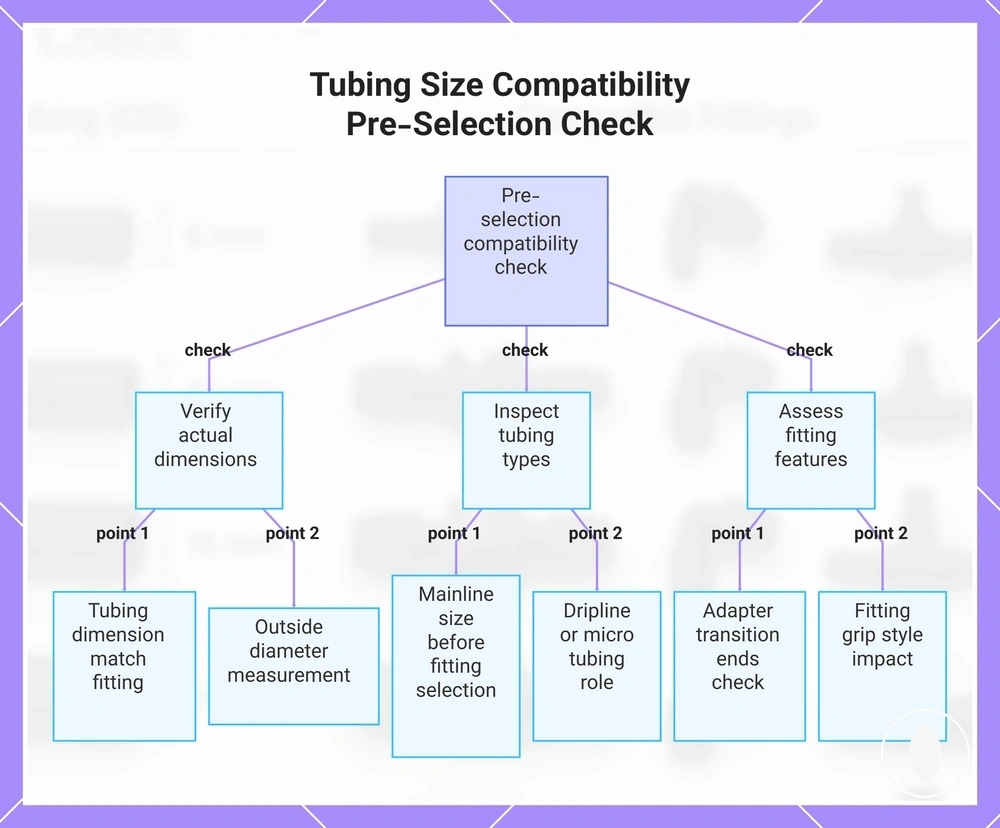
Tubing size compatibility depends on actual tubing dimensions and fitting style, not only the label shown on packaging. Checking the tubing size, outside diameter, and fitting grip style before selection can help determine whether a fitting match is suitable for the connection.
Compatibility checks should consider the mainline size, dripline, micro tubing, and any adapter transitions involved in the layout. Nominal labels may describe a general size category, but actual dimensions and connection ends can vary by tubing and fitting conditions. A mismatch can increase the risk of loose connections or unusable parts when the fitting and tubing do not match.
This section focuses on the pre-selection compatibility check rather than the full range of tubing size relationships. For a deeper explanation of size matching, check tubing compatibility covers the broader size-compatibility topic.
- Tubing size: The tubing dimension should match the fitting requirement for the intended connection.
- Outside diameter: The actual tube measurement can affect how the fitting connects.
- Mainline size: The mainline connection should be considered before selecting related fittings.
- Dripline and micro tubing: The tubing type can affect which fitting role is suitable.
- Adapter transitions: Both connection ends should be confirmed before selecting a transition fitting.
- Fitting grip style: The connection method can influence the fitting match and fit outcome.
This chart shows the key checks to perform before selecting fittings to ensure tubing size compatibility and prevent mismatches.
Mainline tubing, dripline, and micro tubing
Mainline tubing, dripline, and micro tubing are tubing categories that influence fitting choice based on their connection role in a layout. Each tubing category may require a different fitting approach for joining, feeding, or transitioning between lines. The selected fitting depends on the tubing specification and the intended connection point.
Mainline tubing can connect to distribution sections, while dripline and micro tubing can require different transition points within the layout. A mainline-to-smaller-tubing transition may require an adapter when the connection ends need to change between tubing categories. Confirming the tubing category helps define the adapter need and the fitting selection implication.
- Mainline tubing: Supports primary distribution connections, where the fitting role depends on the mainline connection requirement.
- Dripline: Connects as an emitter line category, where fitting selection depends on the dripline connection role and layout conditions.
- Micro tubing: Connects as a smaller tubing category, where an adapter need may occur for transitions to other tubing sections.
Nominal sizes and outside-diameter differences
Nominal size labels can be misleading when selecting drip irrigation fittings because a printed size name may not represent the actual outside diameter of the tubing. A labeled match can still require verification when the diameter, fitting style, or tubing specification differs. Checking the actual connection conditions helps reduce the risk of selecting a fitting that does not suit the tube.
Outside diameter, wall thickness, brand variation, and fitting tolerance can affect the fit outcome. A nominal size may describe a general category, but the actual diameter and connection conditions can vary between tubing products and fitting styles. The fitting choice should be qualified by the tubing specification rather than relying only on a size label.
Caution: Verify the printed size against the actual outside diameter, tubing specification, and fitting style before relying on a labeled match.
| Printed label | Measured outside diameter |
|---|---|
| Nominal size | May describe a general category but may not represent the actual diameter of the tubing. |
| Outside diameter | Shows the physical tube dimension that can affect the fitting match and fit outcome. |
Fitting Style Tradeoffs for Layout Needs
Fitting style should match layout stress, removability, and transition needs rather than being selected as a universal option. Barbed, compression or lock-style, and threaded adapters each provide different connection approaches based on stability, removability, cost, and mainline changes.
The main tradeoff between fitting styles involves connection stability, access for future changes, and transition requirements. Barbed fittings may suit tubing connections where a direct grip is needed, while compression or lock-style fittings may be considered when removability or a different hold method is important. Threaded adapters are mainly used where a connection end transition is required, such as a change between tubing or pipe connection types.
This comparison is a selection summary for layout decisions, not a complete fitting type taxonomy.
| Fitting style | Key attribute | Tradeoff | Best use case |
|---|---|---|---|
| Barbed | Tubing grip | May support a direct tubing connection but may be less focused on frequent removability. | Suitable when a straightforward tubing connection is needed. |
| Compression or lock-style | Stability and removability | May provide a balance between secure hold and access for future changes depending on the layout. | Useful when connection access or mainline changes are considered. |
| Threaded adapters | Connection transition | Selection depends on matching the connection end and transition requirement. | Used when a tubing or pipe transition requires an adapter role. |
For a broader comparison of connector categories, compare fitting types first.
Barbed fittings for stable low-cost connections
Barbed fittings can be a practical choice when a layout needs a direct tubing connection with a simple connection approach. Barbed fittings use tubing grip and insertion force to create a connection point, which may suit low-cost connections in distribution lines or micro tubing layouts. The suitability of a barbed fitting depends on tubing size, tubing condition, and the required connection role.
Barbed fittings rely on tubing grip and insertion force, so fit quality depends on the tubing specification and condition. They may suit layouts where removability is less important, while frequent reuse or changes can create a different tradeoff. A barbed connection should be evaluated according to the tubing type, connection requirements, and future access needs.
- Tubing grip: Barbed fittings may suit connections where the barb grip matches the tubing condition and fitting requirements.
- Low-cost connections: Barbed fittings may be a practical choice for simpler distribution lines or micro tubing layouts where a direct connection is needed.
- Removability: Barbed fittings may have limitations when reuse or frequent removal is an important requirement.
Compression and lock-style fittings for mainline changes
Compression fittings and lock-style fittings can be useful for mainline changes when a layout requires a stronger hold, reconfiguration options, or a different connection approach. These fitting styles should match the tubing specifications, connection requirements, and intended use rather than being treated as a universal solution.
Compression fittings and lock-style fittings can provide different balances between stronger hold, reconfiguration, and tool-free handling. Mainline changes may require consideration of pressure sensitivity, tubing stiffness, and fitting specifications to determine whether the connection approach is suitable. A stronger hold does not guarantee compatibility unless the tubing and fitting specifications match.
- Hold need: Compression fittings and lock-style fittings may suit layouts where a stronger connection approach is required.
- Tubing match: Fitting specifications should match the tubing condition, size, and connection requirements.
- Reconfiguration need: Lock-style fittings may be considered where future changes or reuse are part of the layout.
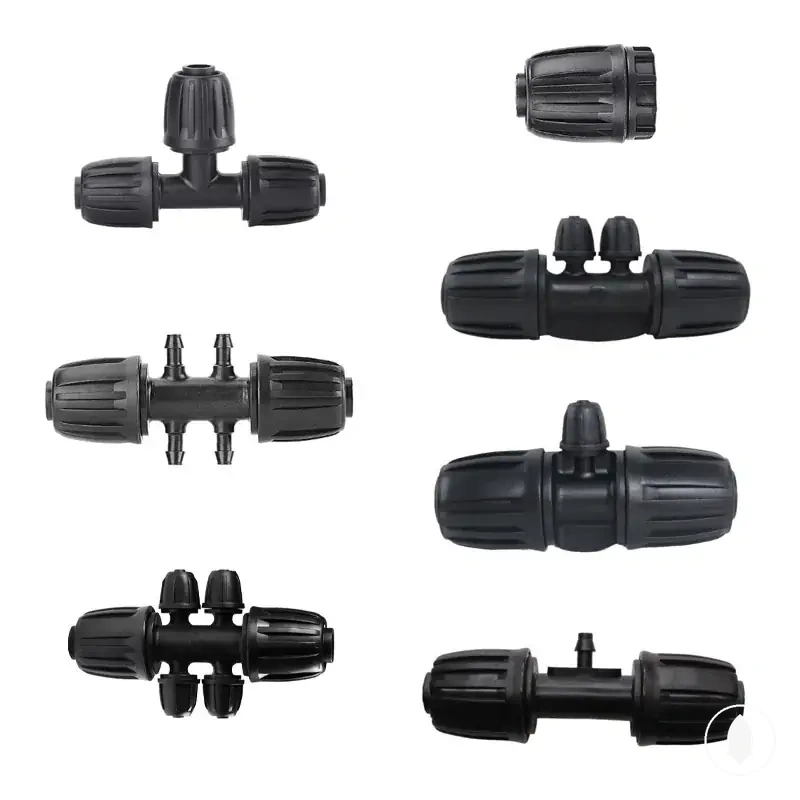
Threaded adapters for faucet and pipe transitions
Threaded adapters support transition points where a drip irrigation layout connects to threaded components such as faucets, pipes, or filter-regulator connections. A threaded adapter matches the connection side with a tubing adapter end so the transition can suit the intended connection condition. The selection depends on the adapter side, transition location, and required connection purpose.
Threaded adapters may use a male thread or female thread depending on the connection side being matched. The tubing adapter end should match the tubing connection condition, while a faucet transition or pipe transition depends on the available connection ends. In a filter-regulator or pressure-regulation context, the transition location and component specifications should be confirmed before selecting the adapter.
- Thread side: Confirm whether the connection requires a male thread or female thread before selecting the threaded adapter.
- Tubing side: Match the tubing adapter end to the tubing connection condition and required fitting role.
- Transition purpose: Identify whether the adapter supports a faucet transition, pipe transition, or filter-regulator connection point.
Kit, Assortment, or Individual Fittings
The fitting kit, connector assortment, and individual fittings each suit different layout conditions based on certainty, quantity, and spare-part needs. A fitting kit may suit a known small layout, a connector assortment may suit changing or branching layouts, and individual fittings may suit layouts where specific parts and adapters are already identified.
Layout certainty and the number of connection points influence the most suitable buying format. Small layouts may require fewer common fittings, while raised beds and branching layouts can create additional needs for tees, adapters, and spare fittings. A connector assortment may reduce missing-part risk when the required fitting mix is less certain, but included parts and tubing compatibility still need consideration. Individual fittings may suit a known layout where the required connection roles are already clear.
The decision table below compares each buying format by layout condition, fitting mix, advantage, and potential risk. These criteria help separate convenience from the need for specific fitting roles and adapter requirements.
| Buying format | Best layout condition | Main advantage | Main risk |
|---|---|---|---|
| Fitting kit | Small layouts with known common fitting needs | Groups common fittings into a single selection format | Included parts may not match every connection requirement |
| Connector assortment | Branching layouts or layouts with changing fitting needs | Provides a mixed assortment of connector roles and spare options | May include unused parts or still require specific missing components |
| Individual fittings | Known layouts requiring specific fittings or adapters | Allows selection of the required fitting roles | Requires clearer knowledge of connection points and fitting needs |
The suitable buying format depends on layout certainty, fitting quantity, and the required connection roles. A fitting kit, connector assortment, or individual fittings may each suit different situations, but selection should consider spare fittings, adapters, and missing-part risk.
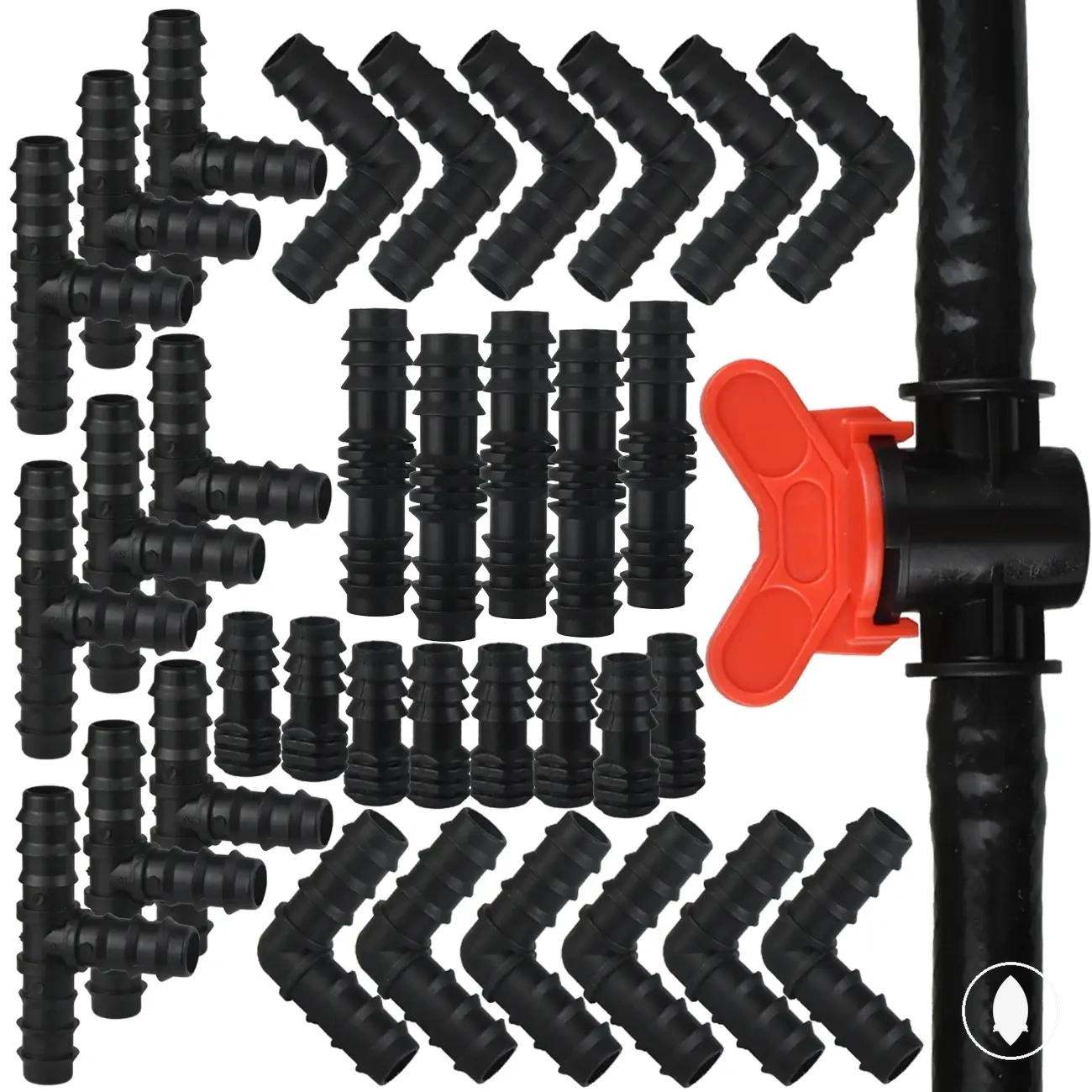
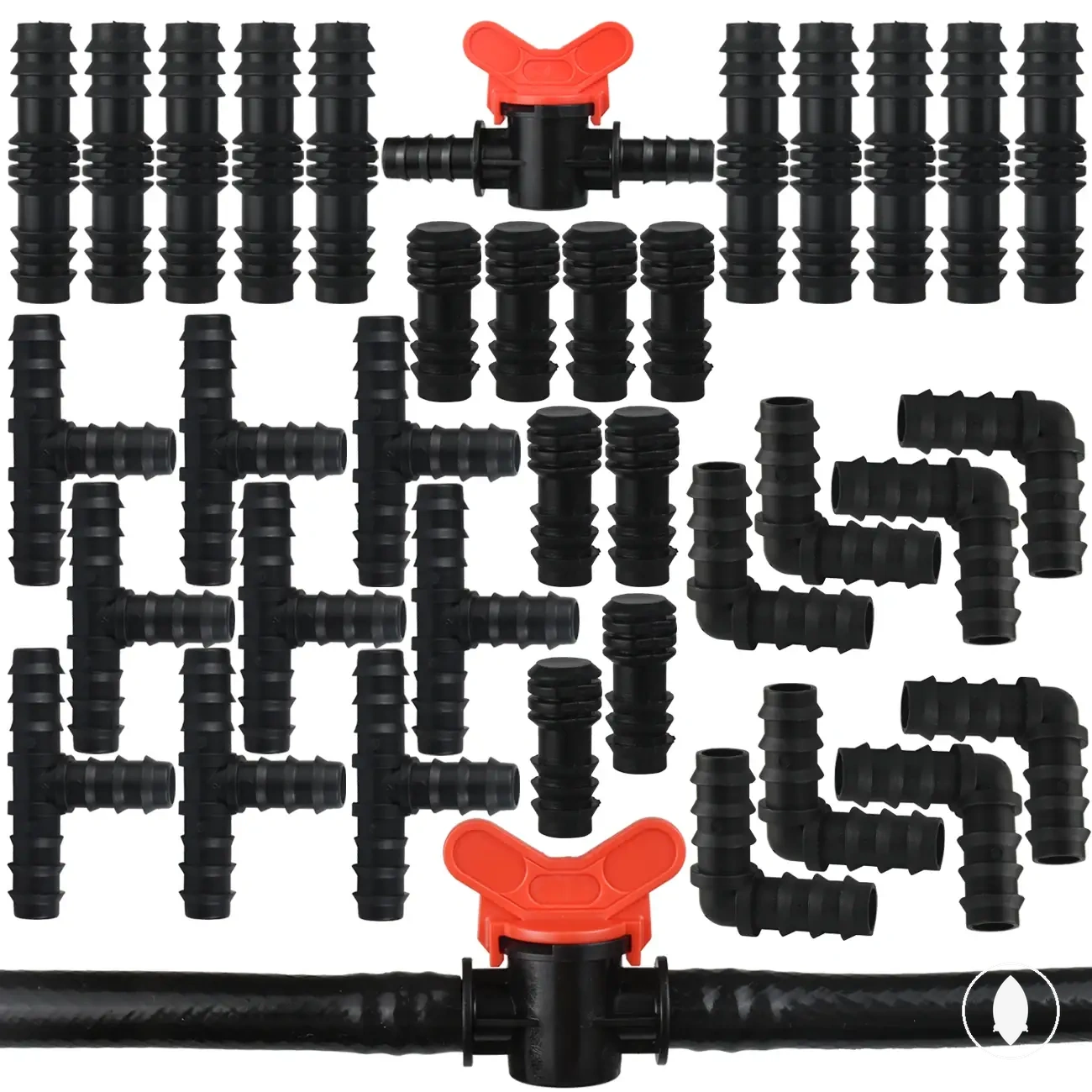
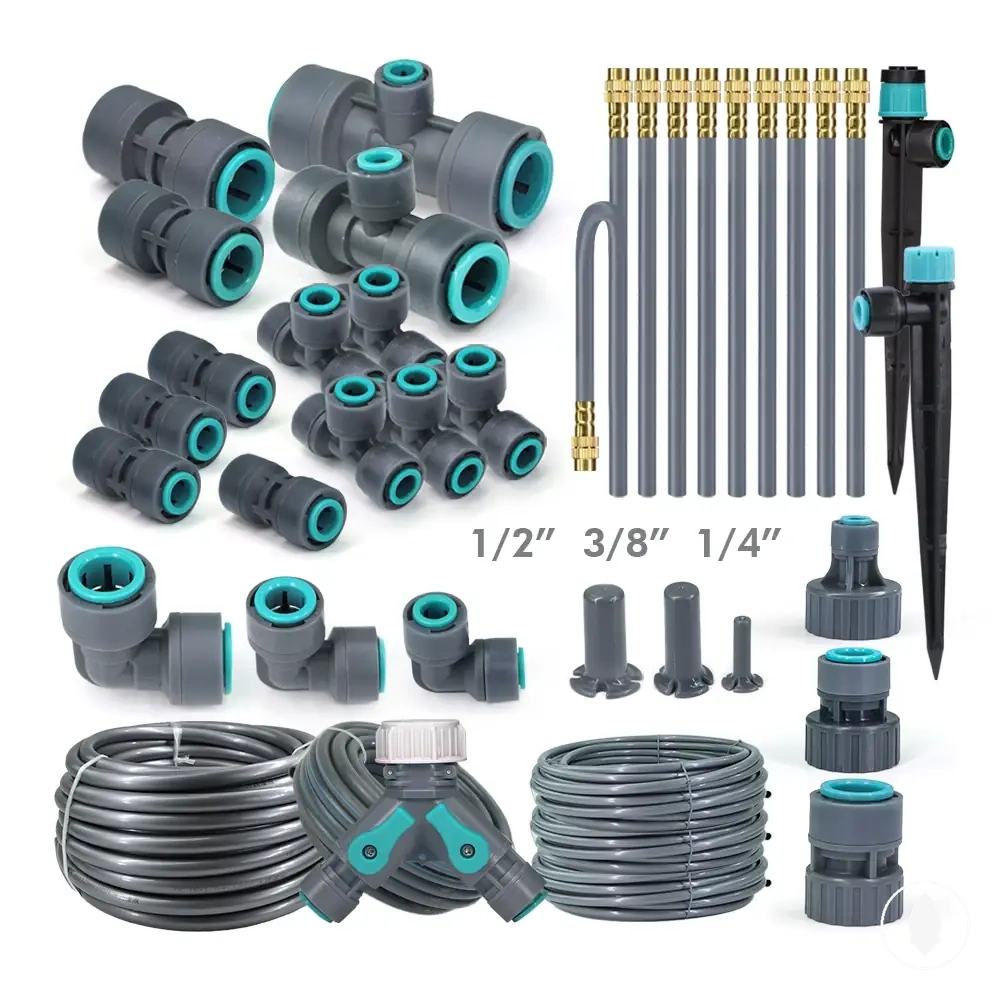
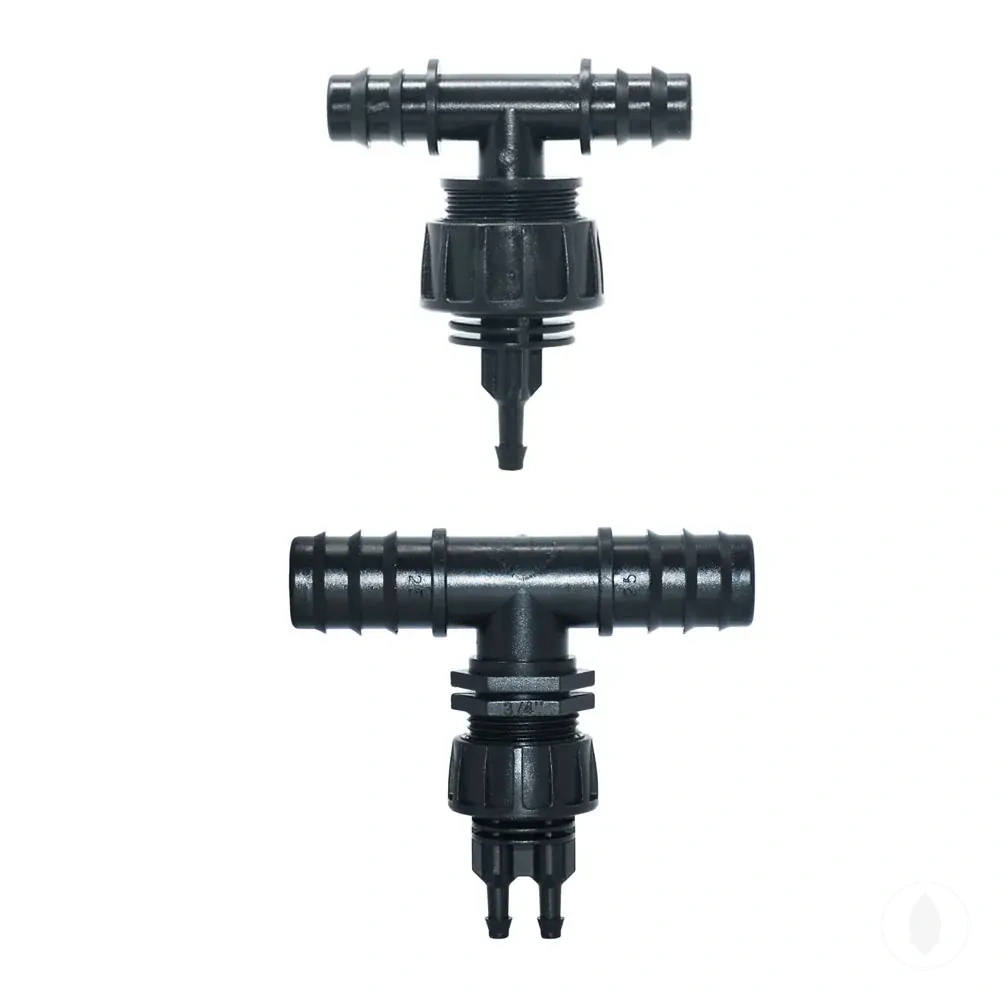
The products below are useful examples for comparing available options. Before buying, check that the compatibility criteria, key features, and product details match your needs.
Small garden and raised-bed kit situations
A raised-bed fitting kit can be enough when a small garden has a limited bed count, predictable line paths, and a known set of connection needs. A kit-based choice may suit layouts where common fittings such as tees, elbows, end closures, and basic adapters match the planned tubing connections.
The suitability of a raised-bed fitting kit depends on the included fittings and tubing match rather than the layout size alone. A small layout may still require separate parts if the connection points, adapters, or tubing specifications differ from the included fittings.
- Limited bed count: A small garden with fewer connection points may need only a basic fitting mix.
- Predictable line paths: A layout with clear tubing routes may suit a fitting kit with matching connection roles.
- Tees and elbows: A kit may be sufficient when the required branch and turn fittings match the planned layout.
- End closures: A kit may suit layouts where the required line endings match the included end closures.
- Basic adapters: A kit may be suitable when included adapters match the tubing transition requirements.
Larger layouts and connector assortment situations
Larger layouts may need a connector assortment or separately selected fittings when connection-point count, mixed tubing transitions, or uncommon adapters create more complex fitting requirements. A connector assortment can support layouts with varied connection roles, while separately selected fittings may suit layouts where specific parts are already identified.
Mixed tubing transitions and future changes can increase the need for different fitting options. Spare connectors may reduce missing-fitting risk when reconfiguration is planned, but the required fitting mix still depends on the layout conditions and connection requirements. For example, a layout with multiple branch points and different transition types may need a wider selection of fittings than a simpler arrangement.
- Connection-point count: Larger layouts with many connection points may require a connector assortment or separately selected fittings to cover different roles.
- Mixed tubing transitions: Layouts with different tubing connections may require separate fittings or uncommon adapters for specific transition points.
- Uncommon adapters: Less typical transition needs may require individually selected fittings rather than only common connectors.
- Spare connectors: Planned reconfiguration or future changes may justify keeping additional connector options available.
- Multiple branches: Layouts with several branches may require a wider fitting mix to match the connection structure.
Selection Criteria for Layout Reliability
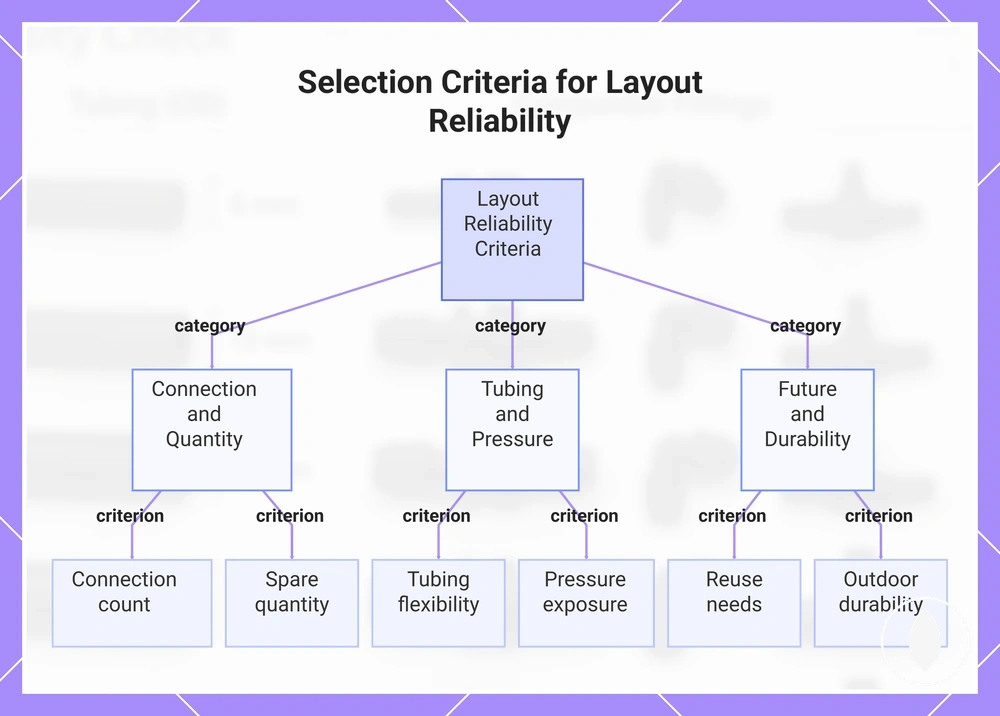
Layout reliability depends on combining fit, quantity, pressure suitability, tubing condition, and future changes rather than relying on one selection factor. Selection criteria should be considered together because each condition can affect fitting reliability and the final decision effect.
Connection count, spare quantity, tubing flexibility, pressure exposure, and reuse needs can influence fitting suitability depending on the layout conditions. A higher connection count may increase missing-part risk when fitting roles are not identified, while tubing condition can affect fitting hold. Pressure exposure and reuse needs should be qualified by the fitting specifications and intended layout requirements.
The following checklist organizes reliability criteria, including durability and material signals as part of the selection check. These criteria help assess how fitting choices may suit different outdoor conditions.
- Connection count: A higher number of connection points may require clearer planning to reduce missing parts and improve the decision effect.
- Spare quantity: Spare fittings may support future changes when reconfiguration needs are expected.
- Tubing flexibility: Tubing flexibility and tubing condition can affect fitting hold and connection suitability.
- Pressure exposure: Pressure exposure should be considered with fitting specifications to qualify connection suitability.
- Reuse needs: Reuse needs can affect whether a fitting choice supports future layout changes.
- Outdoor durability: Material signals and outdoor conditions can be considered when assessing long-term fitting suitability.
Selection criteria work together to support a more reliable fitting choice based on the actual layout. After reviewing these factors, a buying checklist before price checking can help organize the final selection process.
The products below are useful examples for comparing available options. Before buying, check that the compatibility criteria, key features, and product details match your needs.
This chart organizes the key criteria for evaluating fitting reliability in outdoor layouts, grouped into three categories: connection and quantity, tubing and pressure, and future and durability.
Connection-point count and spare fitting quantity
Connection-point count helps prevent missing fittings by showing how many branches, turns, transitions, endpoints, and repair points need to be considered. Planning spare fitting quantity with this count can improve layout reliability while reducing the risk of overbuying unnecessary parts.
The fitting count depends on the layout structure and the connection roles required. Each branch, turn, transition, endpoint, and repair point can affect the fitting needs for the layout. Spare connectors can provide a qualified buffer for future changes, but the required spare fitting quantity varies by layout conditions.
- Branch: Count each branch connection because branches can affect tee requirements and fitting quantity.
- Turn: Count each direction change because turns can affect elbow requirements and fitting needs.
- Transition: Count each transition point because adapters may be needed where connection types change.
- Endpoint: Count each endpoint because caps or closure fittings can affect the final fitting count.
- Spare fitting quantity: Add a suitable buffer for repair points or future reconfiguration without assuming every layout requires the same spare amount.
Pressure, tubing flexibility, and reconfiguration needs
Pressure, tubing flexibility, and reconfiguration needs affect fitting choice through fit conditions and operating requirements rather than as single guarantees of performance. These factors help qualify whether a fitting approach may suit the current layout, expected operating stress, and future changes.
Pressure conditions can influence fitting suitability when operating stress places different requirements on the connection. Tubing flexibility and tubing stiffness can affect fitting grip and secure hold depending on the tubing condition and connection method. Reconfiguration needs and reuse needs can influence whether a fitting style supports future changes without being selected only for the initial layout.
- Current fit: Tubing flexibility and connection condition can affect how suitable a fitting choice is for the existing layout.
- Operating stress: Pressure exposure can qualify fitting suitability when operating conditions place additional stress on the connection.
- Later changes: Reconfiguration needs, seasonal movement, and reuse needs can influence whether a fitting choice supports future layout adjustments.
This section focuses on pre-selection risk factors that influence fitting choice before installation, not post-installation repair or troubleshooting.
Selection Mistakes That Create Poor Fit or Missing Parts
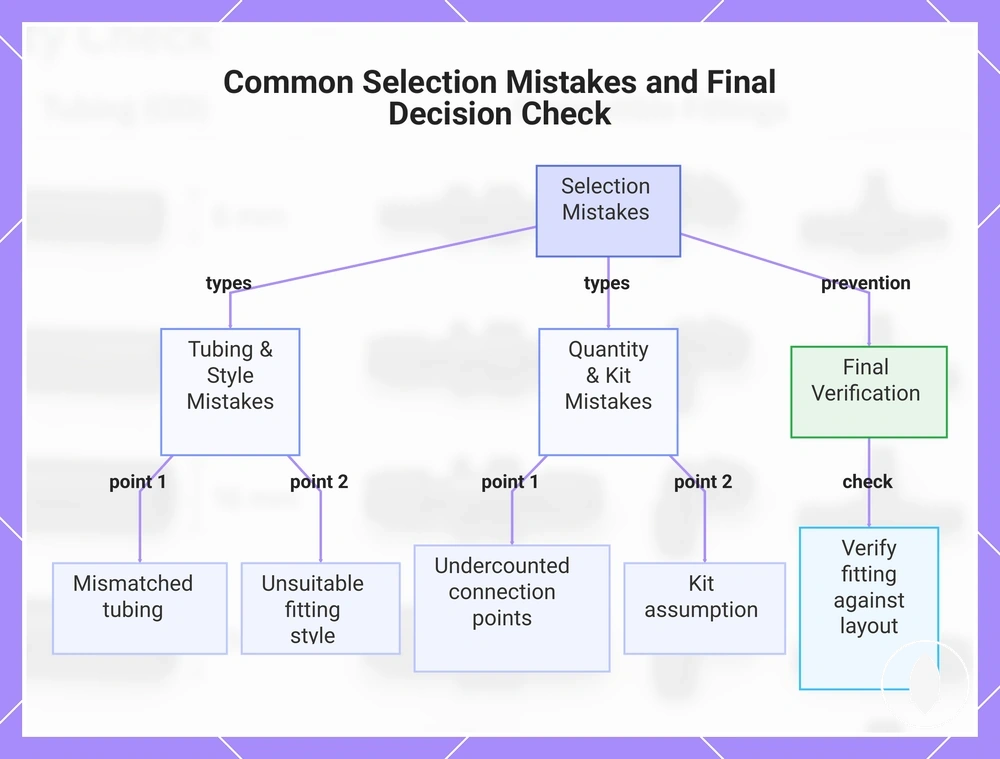
Selection mistakes often come from mismatched tubing, undercounted connection points, or choosing a fitting kit before mapping the layout. These mistakes can lead to poor fit, missing parts, or layout rework when the selected fittings do not match the actual connection requirements.
Common selection errors can involve compatibility, quantity planning, fitting roles, and buying format decisions. Mismatched tubing can create poor fit risks, while undercounted connection points can increase the chance of missing parts. Missing adapters, unsuitable fitting style choices, or assuming all kits fit all layouts can create avoidable selection issues before installation.
A final decision check should verify the fitting selection against the planned layout before purchase. Reviewing tubing requirements, connection roles, and included fitting needs can help correct selection mistakes before they lead to unnecessary changes.
- Mismatched tubing: Verify tubing compatibility before selecting fittings to reduce poor fit risk.
- Undercounted connection points: Check branches, turns, transitions, and endpoints to reduce missing parts.
- Missing adapters: Confirm transition points where adapters may be needed for different connection conditions.
- Too few end closures: Review endpoints to ensure required end closures are included in the selection.
- Unsuitable fitting style: Match the fitting style to the layout conditions and connection requirements.
- No spare connectors: Consider spare connectors where future changes or repair points may create additional fitting needs.
- Kit assumption: Avoid assuming all kits fit all layouts; compare included fittings with the planned tubing and layout.
This chart shows the main types of selection mistakes that lead to poor fit or missing parts, and the final verification step to prevent them.