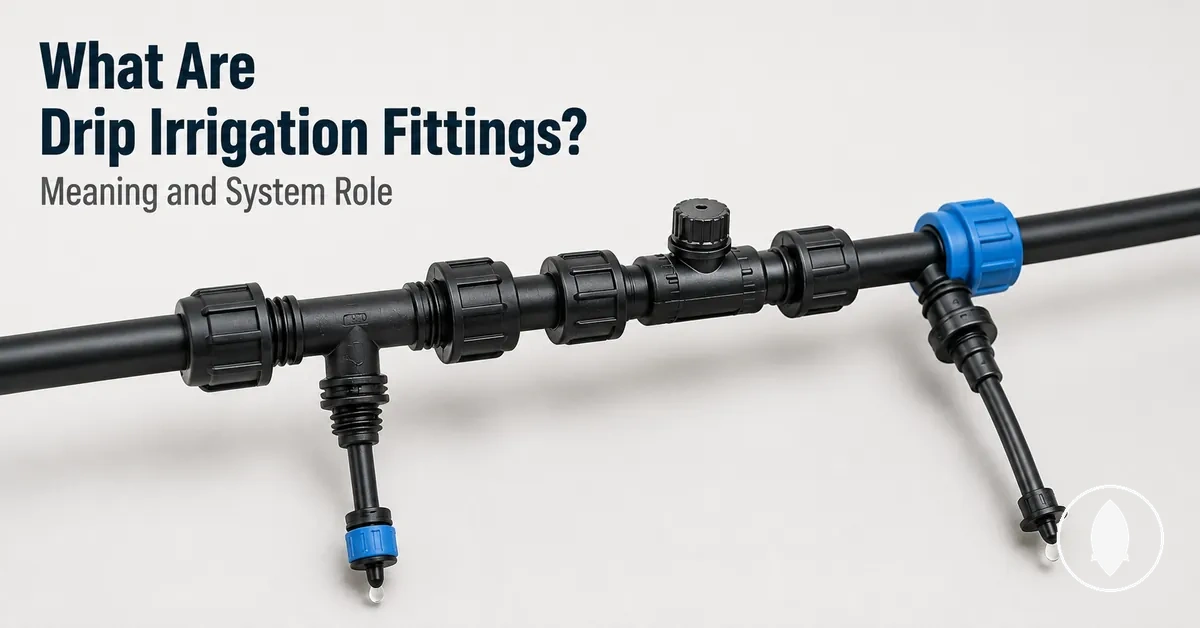
Drip Irrigation Fittings: Meaning and Role in a Drip System
Drip irrigation fittings are connection components used to join, branch, turn, adapt, or close tubing lines within a drip system. They support the connection structure that guides water flow through irrigation lines. Their role is to help connect different parts of a drip system according to the layout of the tubing.
Drip irrigation fittings matter because tubing lines often need connection points to maintain a continuous water path through different areas of a system. A connector can join tubing sections, while fittings such as a tee, elbow, coupler, adapter, or end cap can support different line conditions. The role of each fitting depends on where a connection is needed within the tubing layout. This page focuses on the basic meaning and system role of fittings, while detailed types, sizing, installation, and troubleshooting require separate consideration.

Drip irrigation fittings can be understood through basic ideas of connection, direction, adaptation, and closure. A coupler may connect a straight line, a tee may create a branch, an elbow may help change a corner direction, and an end cap may close a tubing endpoint. For broader coverage of connection parts and related options, see the drip irrigation fittings hub.
What Drip Irrigation Fittings Are
Drip irrigation fittings are connection components used with drip tubing or pipe in a low-volume watering system. They help create connections between tubing sections and support the water path through a drip system. A fitting provides a connection point where a line may join, branch, turn, adapt, or close.
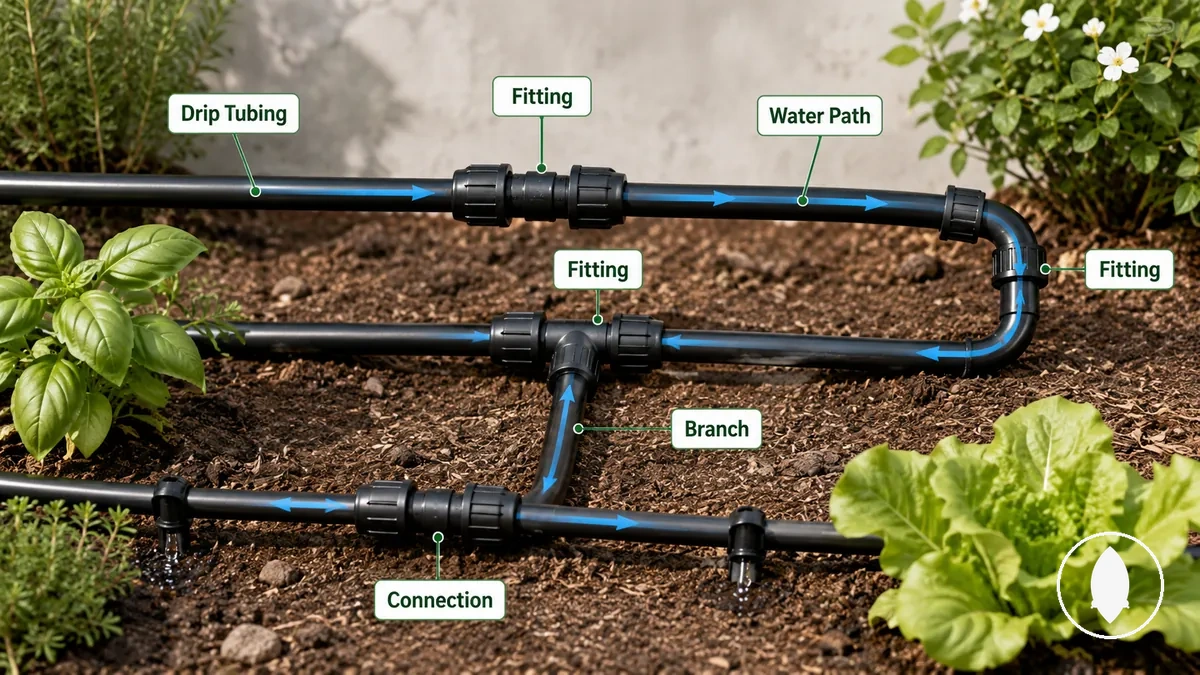
Drip irrigation fittings help maintain line continuity by supporting how tubing sections connect within a watering system. A connector can join two pieces of drip tubing, while other connection parts may allow a line to branch, turn at a corner, or close at an endpoint. The specific role of a fitting depends on the tubing layout and system design. For example, a fitting may be used to join two tubing pieces or help redirect a line where the route changes.
How Fittings Join, Redirect, and Close Tubing Lines
Drip irrigation fittings control how tubing lines connect, change direction, and maintain a continuous water path through a drip system. They support different connection actions based on where a line needs to join, branch, turn, adapt, or close. The fitting role depends on how the tubing route is arranged.
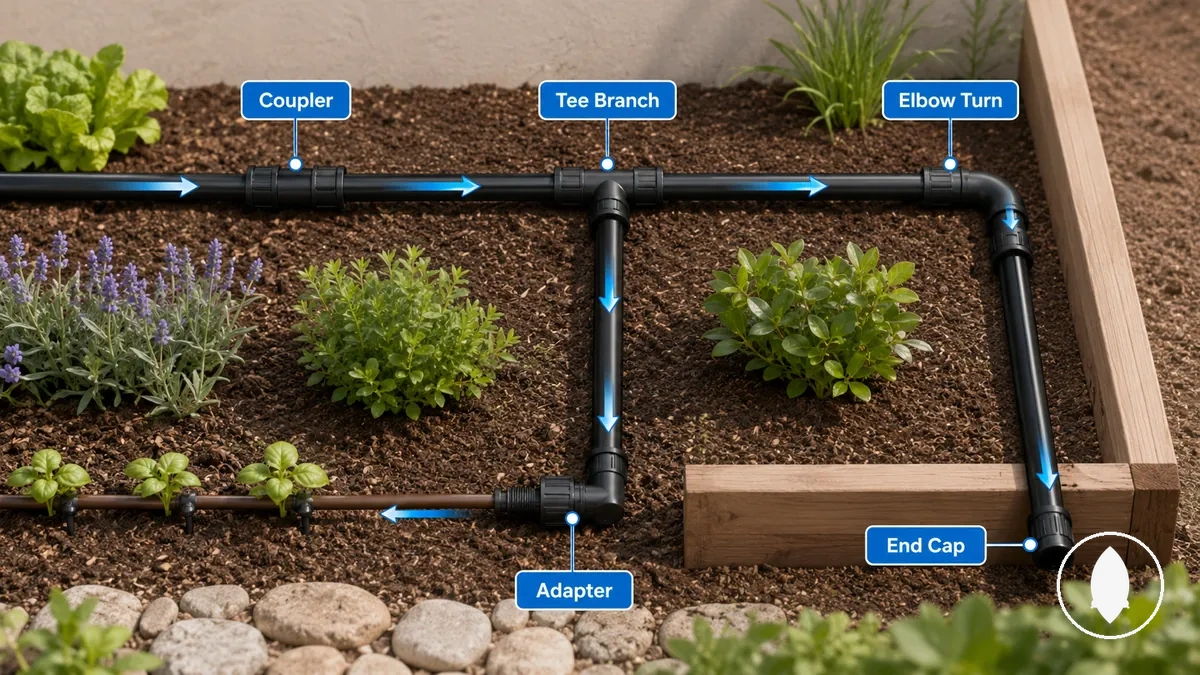
A straight tubing line may need a coupler to join sections, while a branch point may need a tee to split the route. A corner connection may use an elbow to redirect the line, and an endpoint may use a closing component to finish the water path. An adapter may help connect different connection points when the layout requires a transition between parts. These roles describe how fittings support line continuity rather than a step-by-step installation process.
Drip irrigation fittings can be understood through a simple relationship: fitting role, connection action, line condition, and effect on water movement. A coupler supports a joined straight line, a tee supports a branch connection, an elbow supports a corner change, and a closing fitting supports an endpoint. The layout point determines the role a fitting may serve. For a deeper explanation of the individual connection parts, see fitting parts and roles.
Drip irrigation fittings organize tubing line functions through different connection roles:
- Join: A coupler can connect tubing sections in a straight line, helping maintain line continuity between connected parts.
- Branch: A tee can create a branch point where a tubing line splits into another route within the layout.
- Turn: An elbow can redirect a tubing line at a corner where the route changes direction.
- Adapt: An adapter can support a transition between connection points when the system layout requires it.
- Close: An end cap can close a tubing endpoint and complete that part of the water path.
Fittings, Connectors, and Adapters as Related Terms
Fittings, connectors, and adapters are related terms that can overlap in common use, but they describe different connection roles within a tubing system. A fitting is the broader connection component term, while a connector often describes a joining role and an adapter often describes a transition role. The exact terminology can vary by system context and manufacturer language.
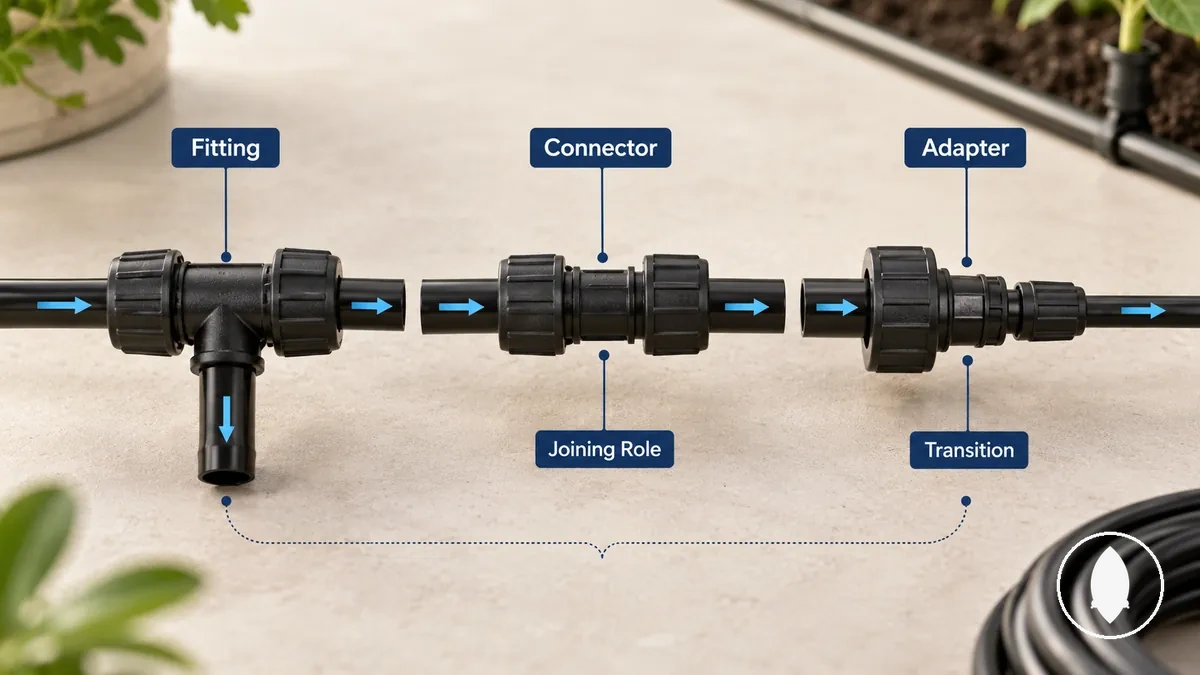
A fitting can refer to a connection component used to support tubing connections. A tubing connector usually focuses on joining tubing sections, while an adapter can support a transition between different connection formats or sizes. These terms describe related functions rather than fixed universal definitions.
This section clarifies terminology and usage differences between related connection terms rather than providing a full fitting-type taxonomy.
Fittings, connectors, and adapters can be compared by their general role:
| Term | Basic meaning | When it is usually used | Boundary note |
|---|---|---|---|
| Fitting | A broader connection component | Used when referring to a part that supports tubing connections | The term can include different connection roles |
| Connector | A connection part with a joining role | Used when linking tubing sections or connection points | The joining function depends on the system context |
| Adapter | A transition connection component | Used when a connection needs a different format or size | The exact role depends on the tubing system |
Basic Fitting Forms in a Drip Irrigation System
Fitting forms are the basic shapes of connection components that support different line-routing needs in a drip irrigation system. The form of a fitting relates to its connection shape, such as joining a straight tubing line, creating a branch, making a transition, or closing an endpoint. These forms act as layout attributes because their shape influences how tubing lines can be arranged.
A tubing route may need different fitting forms depending on the direction or connection condition involved. A coupler can support a straight join between tubing sections, a tee can support a branch split, an elbow can support a corner direction change, an adapter can support a transition between connection formats, and an end cap can provide closure at a tubing endpoint. These examples show why fitting form matters without treating one form as universally preferred. The basic forms can be organized by their connection shape, common line condition, and layout effect:
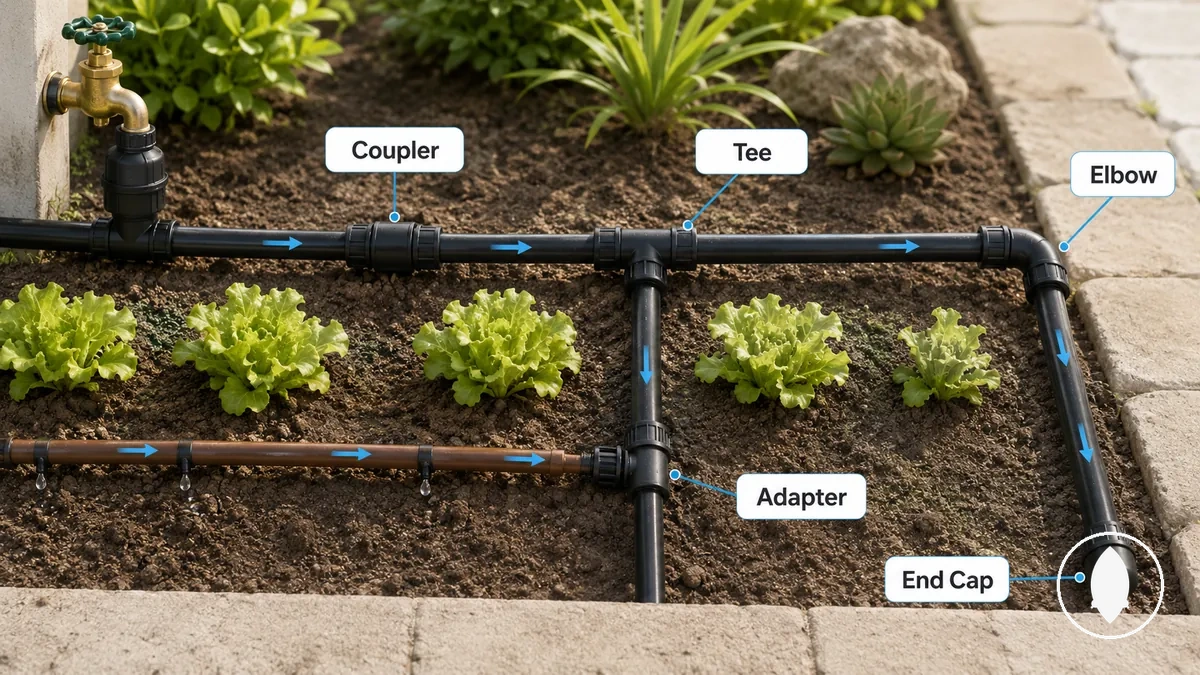
| Fitting form | Connection shape | Common line condition | Layout effect |
|---|---|---|---|
| Coupler | Straight join | Connecting tubing sections in a straight line | Supports continuity between tubing parts |
| Tee | Branch connection | Creating a split from a tubing route | Allows a branch line within the layout |
| Elbow | Direction change | Turning a tubing line at a corner | Changes the line route direction |
| Adapter | Transition connection | Changing between connection formats | Supports a connection transition |
| End cap | Closure point | Closing a tubing endpoint | Finishes the end of a line path |
For deeper coverage of recognized fitting categories and their uses, see main fitting types.
Couplers, Tees, Elbows, and End Closures at a Basic Level
Couplers, tees, elbows, and end closures are examples of fitting forms that perform common line-shaping roles within a tubing layout. Each form supports a different connection action and typical line position. These local examples show how fitting forms relate to routing needs.
A coupler and tee have different connection roles: a coupler joins a straight line, while a tee creates a branch. The following examples show the basic action of each form:
- Coupler: A coupler joins tubing sections in a straight line, connecting parts of a tubing route.
- Tee: A tee creates a branch connection where a tubing line splits into another route.
- Elbow: An elbow turns a tubing line at a corner, changing the direction of the route.
- End closure: An end cap closes a tubing endpoint, providing line closure at the end of a route.
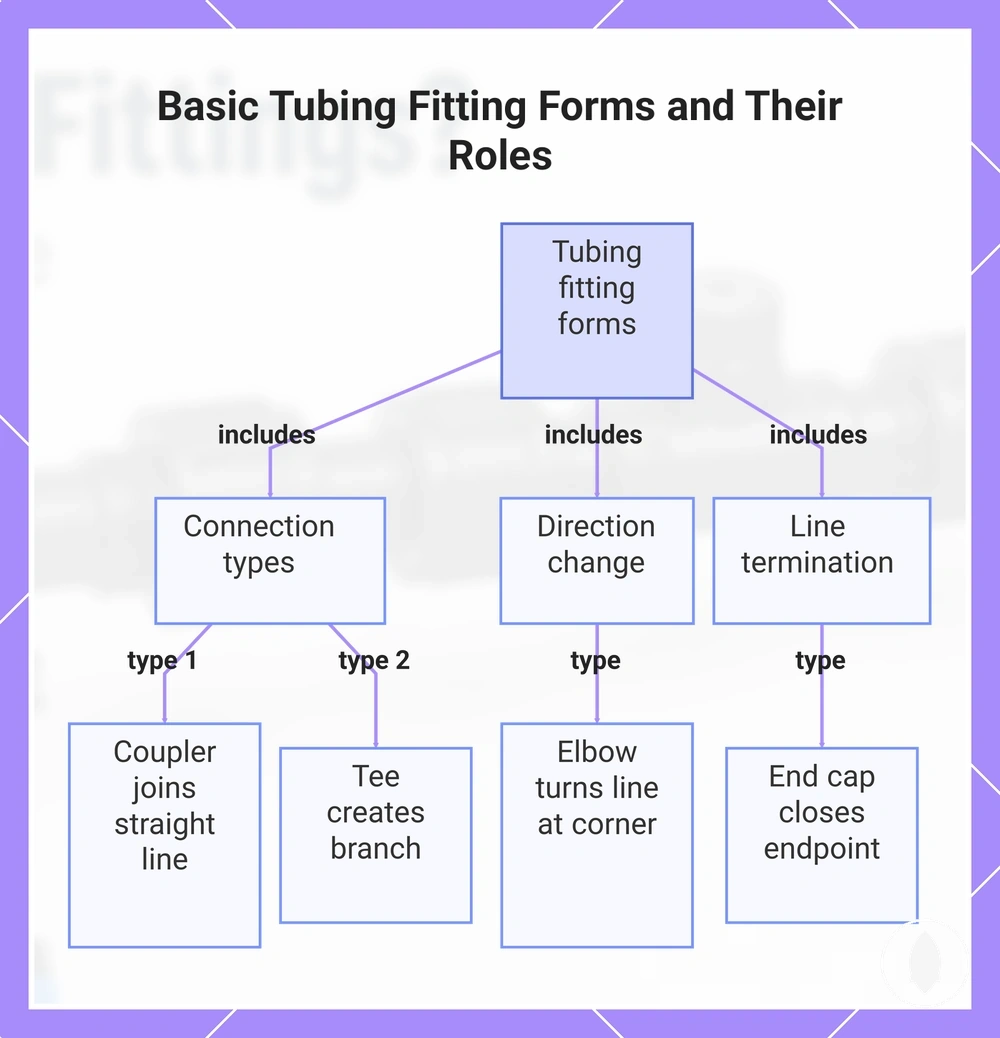
This chart groups the basic tubing fitting forms by their line-shaping roles: connection, direction change, and line termination.
Tubing Fit and Connection Style Basics
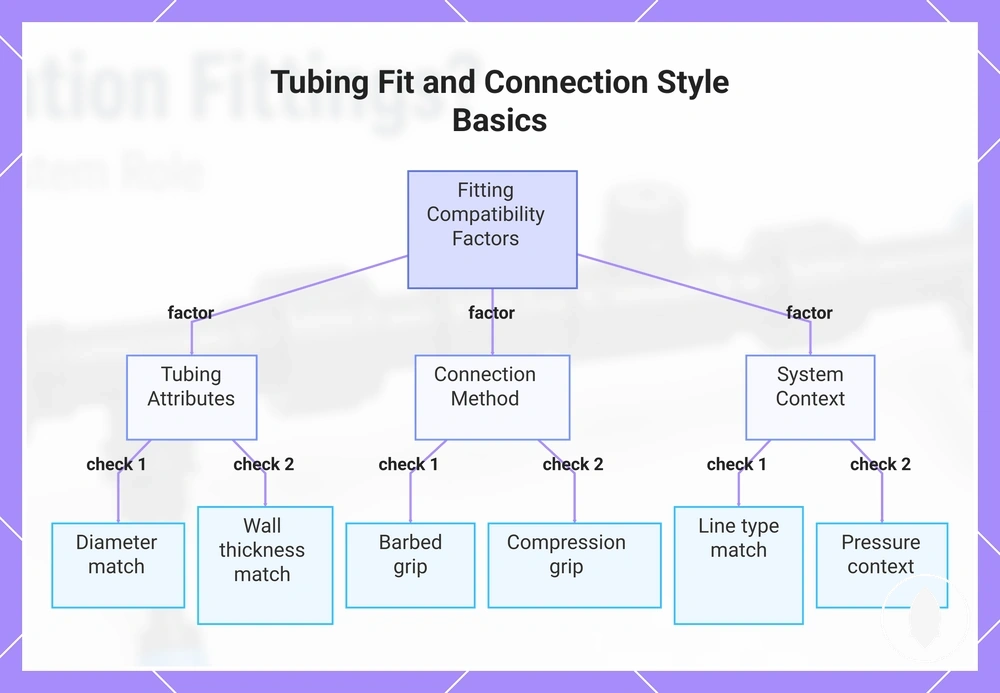
Drip irrigation fittings must match the tubing fit and connection style used in a system rather than working universally across all drip lines. The fitting connection depends on tubing characteristics and system conditions. A suitable match can support a more secure connection, while poor matching may contribute to loose connections or leaks.
Tubing fit depends on factors such as diameter, wall thickness, and connection style. The fitting grip method may vary between barbed, compression, and locking connections, with each style interacting with tubing in a different way. Mainline tubing, micro tubing, and other drip formats may require different connection approaches based on their design. These factors help determine whether a fitting is suitable for a particular tubing setup.
Pressure context can also influence how a tubing connection behaves within a drip system. A fitting that matches the tubing and connection style may support the intended line condition, while mismatched components may create connection issues depending on the system conditions. Detailed diagnosis of leaks or connection failures requires separate troubleshooting information. The basic compatibility factors can be summarized through tubing fit basics.
Checking these criteria can help clarify basic tubing compatibility:
- Tubing diameter: Consider whether the fitting connection matches the tubing diameter required by the system.
- Wall thickness: Check whether the tubing structure supports the intended fitting grip style.
- Connection style: Match the fitting method, such as barbed, compression, or locking, with the tubing connection needs.
- Line type: Consider whether the fitting is intended for mainline tubing, micro tubing, or another drip format.
- Pressure context: Consider the system conditions that may influence the connection between fitting and tubing.
- Fitting purpose: Confirm that the fitting role matches the connection condition within the tubing layout.
This chart shows the key factors that determine whether a drip irrigation fitting is compatible with the tubing, including tubing dimensions, connection method, and system conditions.
Barbed, Compression, and Locking Connections at a Basic Level
Barbed, compression, and locking are connection styles that describe how fittings grip or hold tubing. Each style uses a different holding method, and suitability depends on tubing size, tubing material, and system design. The connection style affects how a fitting attaches to tubing and how connection security should be considered.
These connection styles can be compared by their holding method and basic fit considerations:
| Connection style | How it holds tubing | Basic fit consideration | What to qualify |
|---|---|---|---|
| Barbed | Uses a grip method that holds the tubing connection point | Depends on tubing size, material, and fit | Connection security may vary with system conditions |
| Compression | Uses an outer hold method around the tubing connection | Depends on tubing fit and connection requirements | Suitability may vary by tubing and system design |
| Locking | Uses a locking method to hold the tubing connection | Depends on tubing compatibility and connection style | Connection security depends on fit conditions |
Where Drip Irrigation Fittings Are Used in a Layout
Drip irrigation fittings appear at different layout points where tubing routes need connection components. A fitting role depends on how the tubing route is arranged and where the system requires a connection point. These positions help explain why fittings appear in specific areas of a watering system.
A main line may use fittings where tubing routes continue, while a branch line may use connection components where the route splits. A corner may require a fitting role that turns the tubing path, a transition point may use an adapter to connect different conditions, and an endpoint may require a closure role. The specific placement can vary with the tubing route, system size, and watering-system context.
These layout points can be organized by their fitting role, line condition, and watering-system effect:
| Layout point | Fitting role | Line condition | System effect |
|---|---|---|---|
| Main line | Connection support | Continuing a primary tubing route | Maintains the connection path within the system |
| Branch line | Branch connection | Splitting a tubing route into another line path | Creates another route within the watering system |
| Corner | Direction change | Turning a tubing path | Changes the direction of the route |
| Transition | Adapter role | Connecting between different tubing conditions or formats | Supports a change between connection points |
| Endpoint | Closure role | Finishing the end of a tubing route | Completes the endpoint condition of the line |
Main Lines, Branch Lines, Corners, and End Points
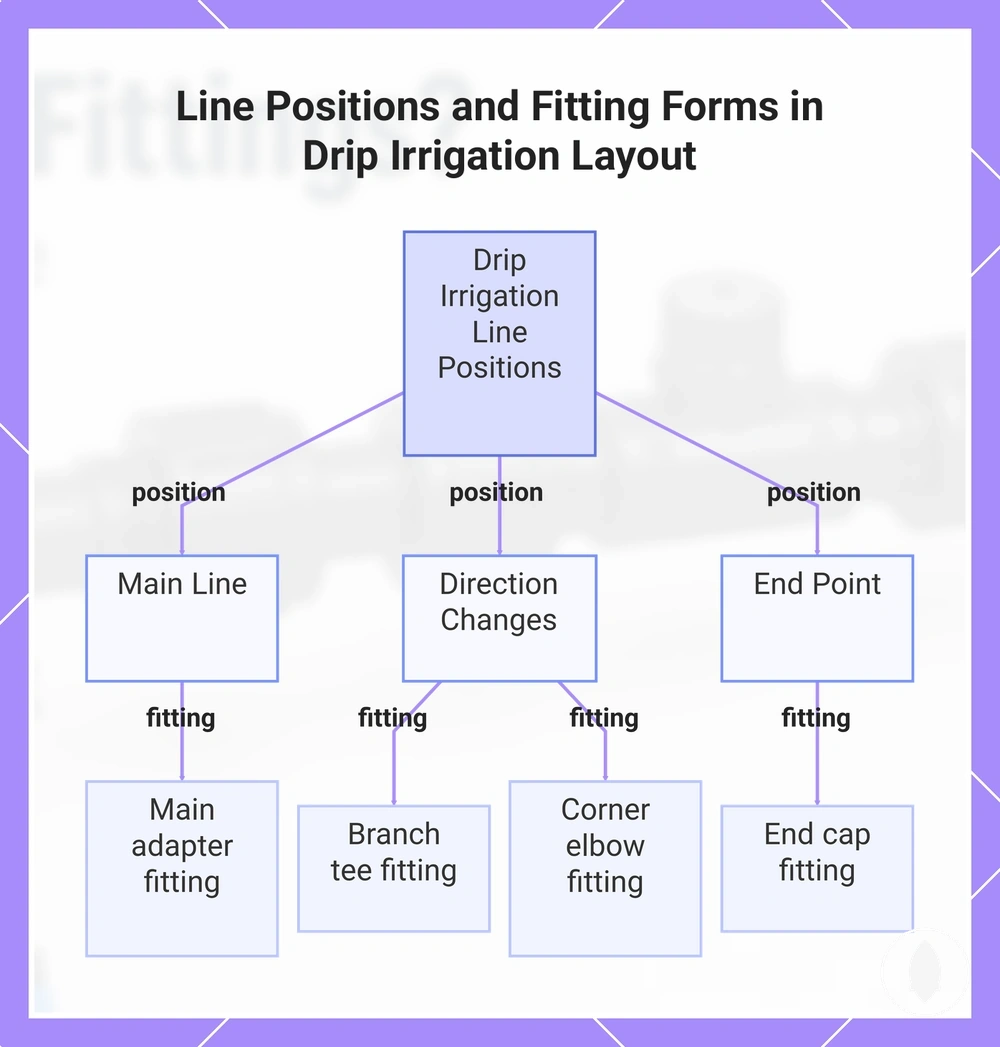
Line position changes the connection need within a drip irrigation layout. Main lines, branch lines, corners, and end points are common placement points where a fitting form may support the tubing path. These examples show how a local position can relate to a fitting role.
- Main line: A main line connects the primary tubing route, with a fitting form such as an adapter depending on the tubing path and connection need.
- Branch line: A branch line creates a split in the tubing path, with a fitting form such as a tee depending on the route position and watering-system context.
- Corner: A corner turns the tubing path, with a fitting form such as an elbow depending on the direction change required by the layout.
- End point: An end point closes the tubing path, with a fitting form such as an end cap depending on the system conditions and closure need.
This chart shows how the position of a line (main, branch, corner, end) determines the type of fitting needed in a drip irrigation system.
What Belongs Outside a Basic Fittings Definition
Detailed decision and support topics sit outside a basic definition of drip irrigation fittings because they require additional criteria, methods, or support logic. A basic definition focuses on meaning and system role, while deeper topics involve separate decision logic or process logic. This boundary keeps the explanation focused on what fittings are and why they are used.
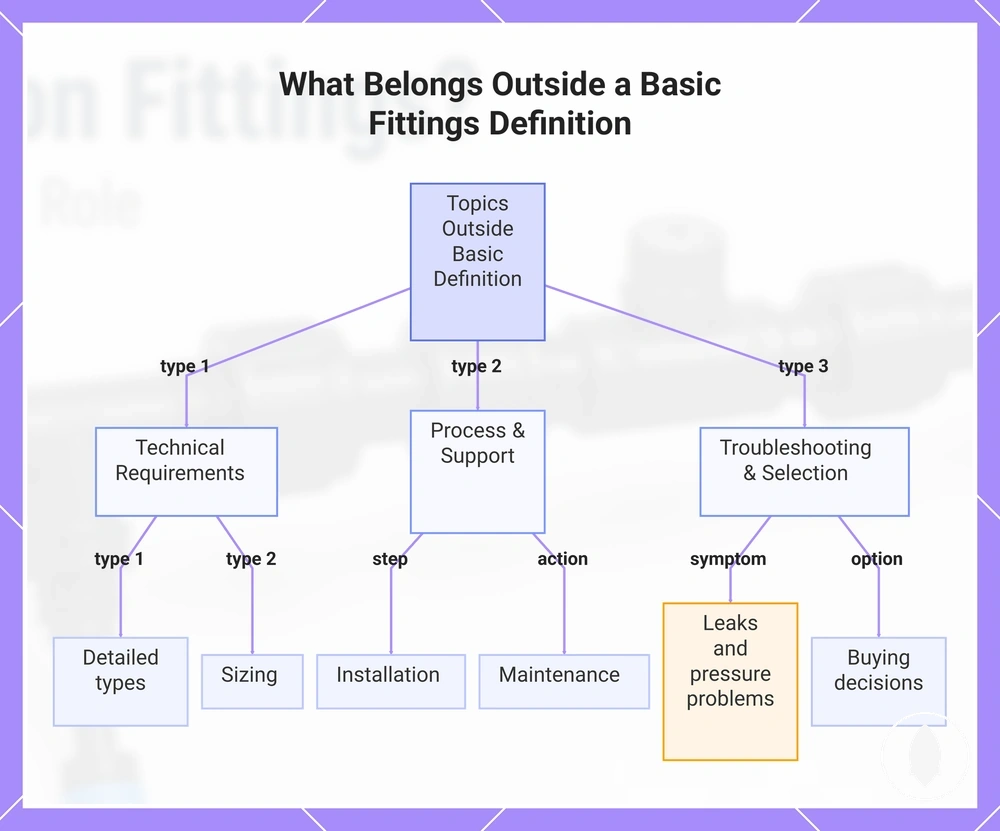
Some adjacent topics require separate treatment because they depend on additional conditions or evaluation methods beyond a definition-level explanation. These deeper topics should be considered separately rather than expanding the current scope into broader support areas. The main topics outside this basic definition scope include:
- Detailed types: Requires separate criteria for understanding different fitting forms and roles.
- Sizing: Requires compatibility criteria related to tubing and fitting requirements.
- Installation: Requires process logic and methods beyond basic meaning and role.
- Leaks: Requires troubleshooting support logic beyond a definition.
- Pressure problems: Requires separate evaluation of system conditions and possible causes.
- Maintenance: Requires ongoing support logic beyond identifying fitting purpose.
- Buying decisions: Requires selection and evaluation criteria beyond a basic definition.
This chart shows the main categories of topics that fall outside the scope of a basic definition of drip irrigation fittings, organized by the type of additional logic they require.
Detailed Types, Sizes, Installation, Leaks, and Pressure Problems
Detailed types, sizes, installation, leaks, and pressure problems are adjacent topics that are not expanded in this definition section. These areas require their own criteria, processes, or troubleshooting logic beyond the basic scope.
- Detailed types: Requires type selection criteria beyond the basic definition scope.
- Sizes: Requires size compatibility criteria beyond the basic definition scope.
- Installation: Requires an installation method and process logic beyond the basic definition scope.
- Leaks: Requires troubleshooting logic beyond the basic definition scope.
- Pressure problems: Requires consideration of pressure behavior and system conditions beyond the basic definition scope.
Common Basic Questions About Drip Irrigation Fittings
What are drip irrigation fittings?
Drip irrigation fittings are connection parts used to join, adapt, branch, turn, or close tubing within a drip system. They support the basic use and layout of a watering system by connecting different tubing sections. Their specific role depends on the connection point and system conditions.
Are connectors and adapters the same as drip irrigation fittings?
Connectors and adapters are related terms within the broader drip irrigation fittings category. A connector often refers to a joining role, while an adapter can describe a transition between connection formats. Terminology can vary depending on the system context.
Do drip irrigation fittings fit all tubing?
Drip irrigation fittings do not fit all tubing universally because fit depends on the tubing and connection style. Tubing compatibility can vary based on the tubing type and the fitting method used.
Where are drip irrigation fittings used in a layout?
Drip irrigation fittings are used at layout points where tubing needs a connection role. They can appear at branch points, transitions, and end points depending on the tubing route and drip system structure.
Can drip irrigation fittings support different basic uses?
Drip irrigation fittings can support different basic uses within a drip system, such as connecting tubing sections or supporting changes in a water line. The suitable fitting role depends on the layout condition and connection need.
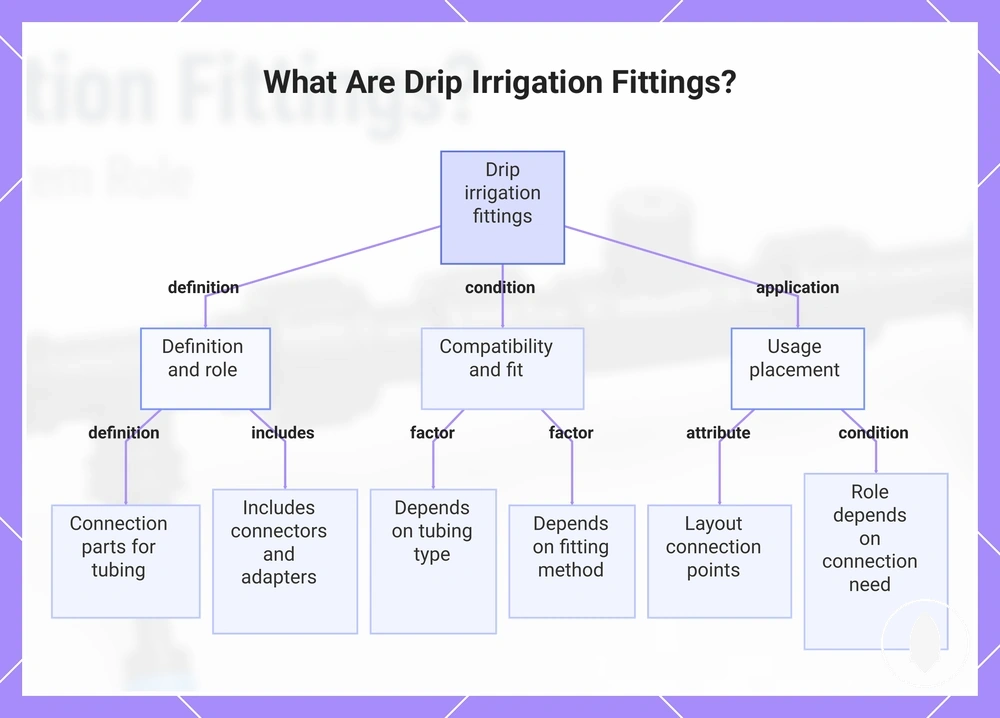
This chart shows the definition, compatibility factors, and typical placement of drip irrigation fittings in a watering system.