
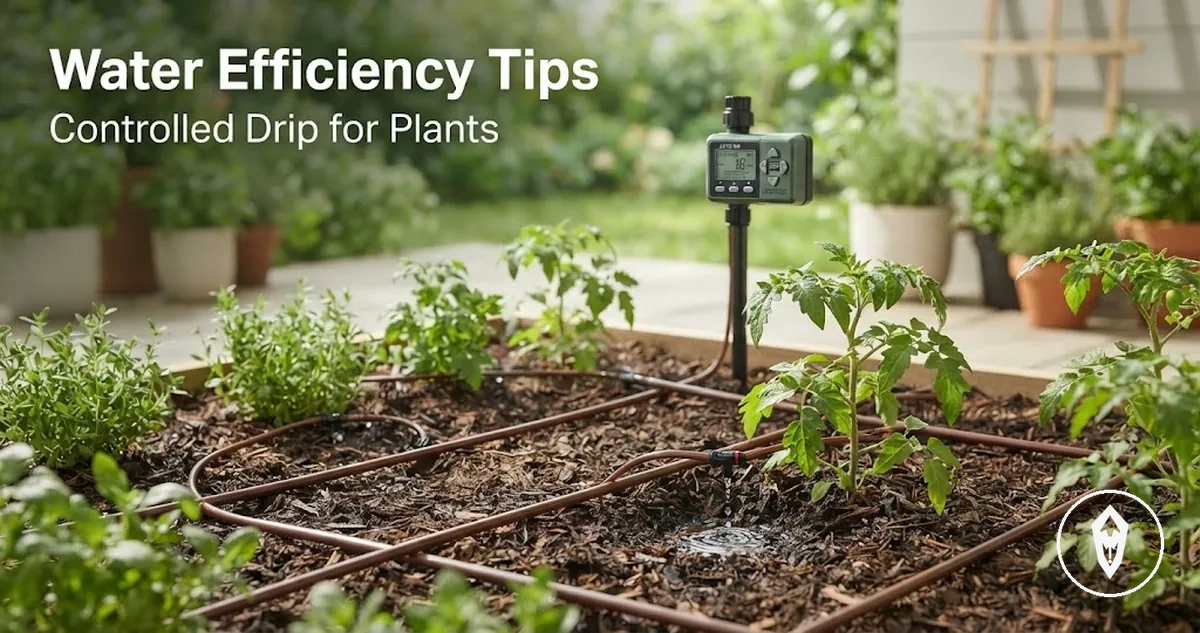
Water-efficient use of automatic watering kits
Automatic watering kits are controlled watering systems that deliver water through components such as tubing, emitters, and timers to support targeted plant watering. Their water efficiency depends on setup quality, including the delivery method, plant demand, soil response, water pressure, and maintenance condition.
automatic watering kits use scheduled delivery and controlled flow to place water more consistently around plants.
automatic watering kits use scheduled delivery and controlled flow to place water more consistently around plants. A timer controls watering periods, while flow control, emitter output, and pressure conditions influence how water is distributed. Controlled watering can support efficient water use when the schedule matches plant demand, but it does not guarantee water savings in every setup.
Water waste can occur when a watering kit is not aligned with the growing environment.
Water waste can occur when a watering kit is not aligned with the growing environment. Incorrect delivery placement, unsuitable schedules, excessive flow, or poor soil response can contribute to runoff, evaporation exposure, or overwatering conditions. Matching drip irrigation delivery with plant requirements helps direct water closer to the areas where plants need it.
Matching drip irrigation delivery with plant requirements helps direct water closer to the areas where plants need it.
Efficient use of an automatic watering system comes from balancing timing, flow, coverage, and plant requirements together. Reviewing timer settings, emitter output, pressure conditions, and soil response helps maintain controlled watering based on the specific setup and environmental conditions.
Table of Contents
How automatic watering kits reduce water waste
Automatic watering kits reduce water waste by delivering water more consistently and closer to the plant root zone through controlled delivery. This approach helps limit unnecessary runoff, evaporation exposure, and missed watering when the watering setup matches plant requirements.
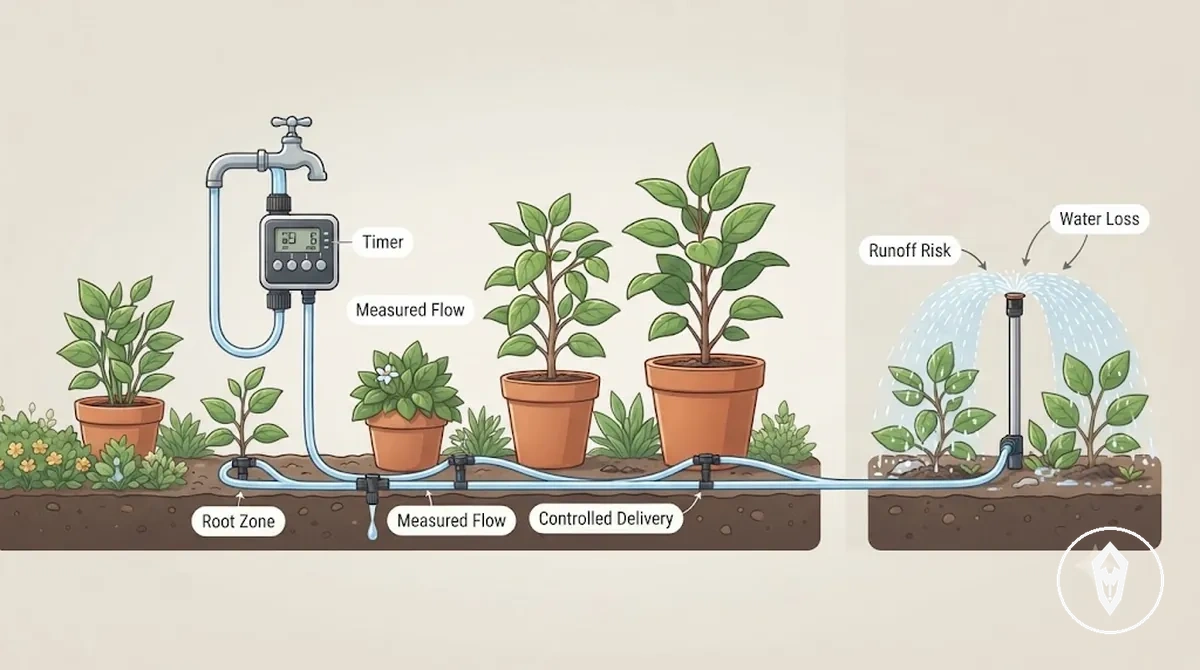
Automatic watering kits use controlled delivery methods such as drip setups, tubing, and timers to direct water toward plant target areas. Root-zone watering reduces the amount of water exposed outside the intended area, while timer consistency supports repeatable watering schedules. The efficiency result still depends on measured flow, system layout, and correct settings.
The most effective setup is the one where water delivery and plant demand remain aligned.
Broad watering can expose more water to runoff, overspray, and evaporation before plants use it. Controlled delivery changes the water path by focusing output near the plant area, but incorrect flow settings or unsuitable schedules can reduce the benefit. The most effective setup is the one where water delivery and plant demand remain aligned.
| Watering behaviour | Water-efficiency effect |
|---|---|
| Controlled root-zone delivery | Places water closer to the plant target area and reduces unnecessary exposure away from the root zone. |
| Broad watering | Creates a wider delivery area that may increase runoff risk and evaporation exposure when water reaches unused areas. |
| Timer consistency | Creates a repeatable schedule, while the outcome depends on matching timing with plant demand and conditions. |
| Measured flow | Controls water output, but efficiency depends on appropriate settings, outlet placement, and system balance. |
Direct root-zone watering and reduced evaporation
Root-zone watering places water closer to the plant base through a drip emitter, reducing exposed water on surrounding soil surfaces. This direct delivery approach shows how emitter placement influences evaporation risk, runoff, and plant uptake.
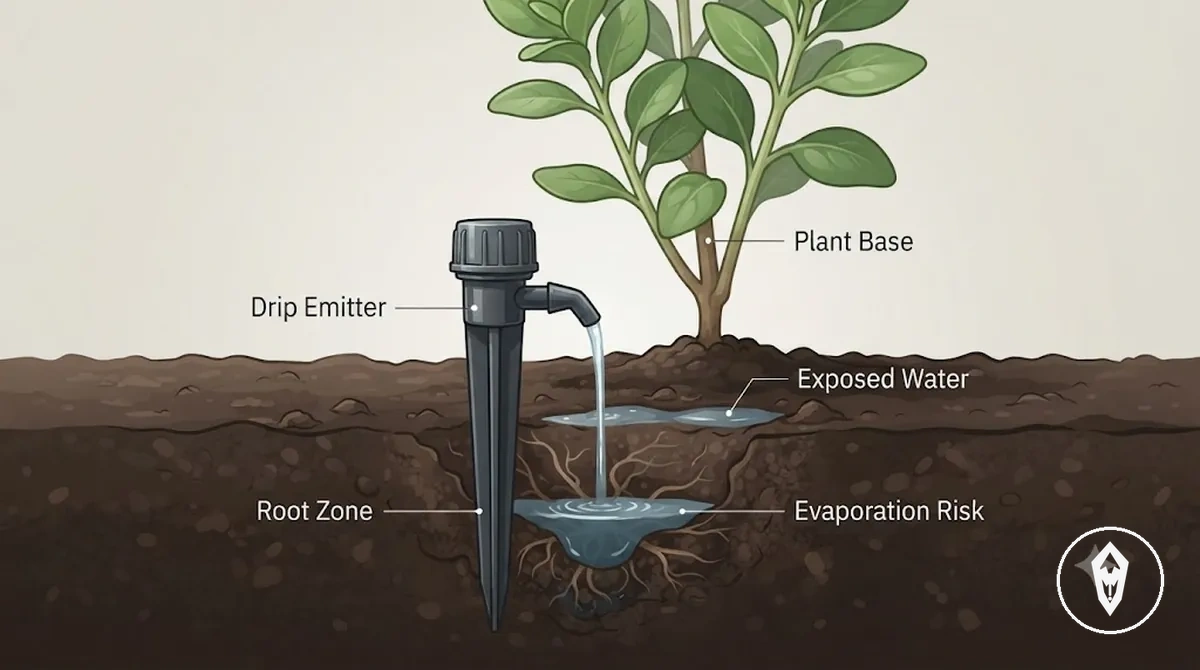
A drip emitter delivers water at a focused delivery point instead of spreading water across a wider surface area. When water is directed near the root zone, less surrounding soil surface is exposed to evaporation, although the effect changes with heat, wind, sun exposure, soil surface condition, and emitter position.
- Emitter placement: The drip emitter position determines where water enters the soil and whether delivery reaches the intended root-zone area.
- Exposed water: Water remaining on open soil surfaces has greater evaporation exposure than water delivered closer to the plant base.
- Surface wetting: Wider surface wetting can increase runoff and water loss risk when water reaches areas outside the plant target zone.
Controlled delivery compared with broad watering
Controlled delivery and broad watering differ by how water is distributed across the plant area. This comparison focuses on controlled delivery and broad watering by examining delivery area, runoff risk, overspray, evaporation exposure, and repeatability.
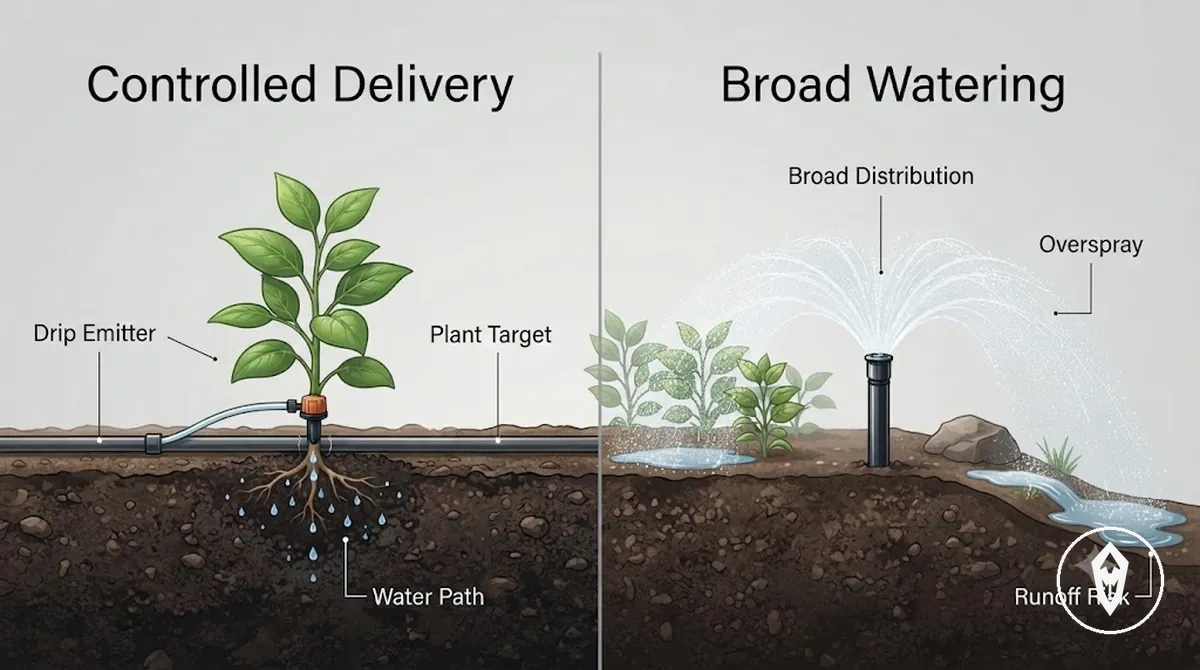
Controlled delivery directs water toward a plant target area through a focused path, while broad watering spreads water across a wider area. The water-use effect depends on factors such as placement, pressure conditions, surface type, flow settings, and watering technique.
| Watering behaviour | Water-efficiency effect |
|---|---|
| Controlled delivery | Creates a focused delivery area that supports plant-targeted output and repeatable watering conditions. |
| Broad watering | Creates wider coverage that can increase overspray and runoff risk when water reaches areas outside the plant target. |
| Controlled output | Measured flow supports consistent delivery, while the result depends on suitable settings and system layout. |
| Wide coverage exposure | Greater exposed water area can increase evaporation exposure depending on surface conditions and the watering environment. |
Plant demand and coverage conditions for efficient watering
Efficient watering depends on matching automatic watering kit output with plant demand and layout conditions. Plant need, container size, soil moisture, drainage, weather exposure, outlet placement, and coverage balance determine whether delivered water reaches useful areas or contributes to water loss.
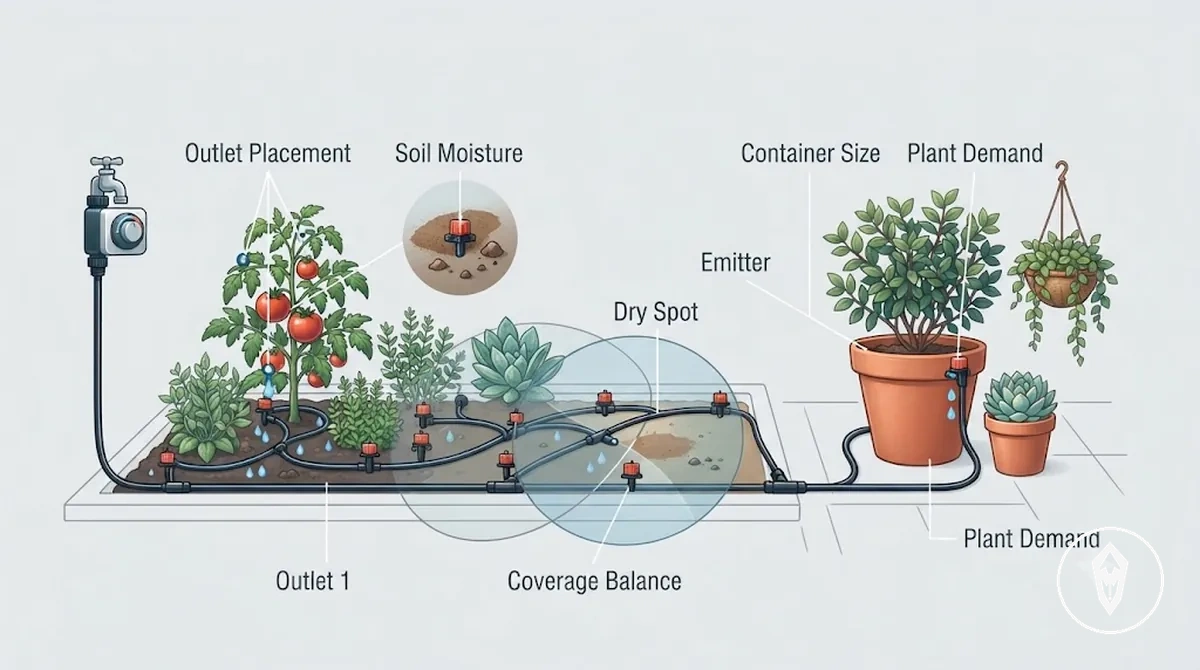
Container plants, garden beds, and mixed plant groups can require different coverage decisions because plant demand and layout conditions change how water is distributed. Checking the relationship between kit output and the watering zone helps identify whether outlet placement matches the intended coverage area.
| Entity or part | Attribute or criterion | Value or condition | Effect or decision |
|---|---|---|---|
| Plant | Plant demand | Water requirement changes with plant type, growth stage, and growing conditions. | Kit output should be matched to plant need rather than treated as a fixed amount. |
| Container | Container size | Container volume affects soil area and moisture retention conditions. | Outlet placement should match the container layout and watering zone. |
| Soil | Soil moisture and drainage | Moisture retention and drainage speed influence water availability near the root area. | Settings should account for whether water remains available or moves away from the target area. |
| Environment | Weather exposure | Heat, wind, rain, and shade conditions change moisture and water-loss conditions. | Coverage decisions should be reviewed when environmental conditions change. |
| Outlet layout | Outlet placement and coverage balance | Emitter position affects dry spots, overlap areas, and watering-zone coverage. | Balanced placement helps align delivery with plant target areas. |
The capacity and coverage settings should be considered alongside plant demand and layout conditions. Matching coverage to the watering area helps evaluate whether kit output supports the intended use without relying on universal schedules.
Plant type, growth stage, and container size
Plant type, growth stage, and container size influence whether an automatic watering kit setting matches plant demand. These conditions affect how watering duration and emitter output should be evaluated for the plant and container environment.
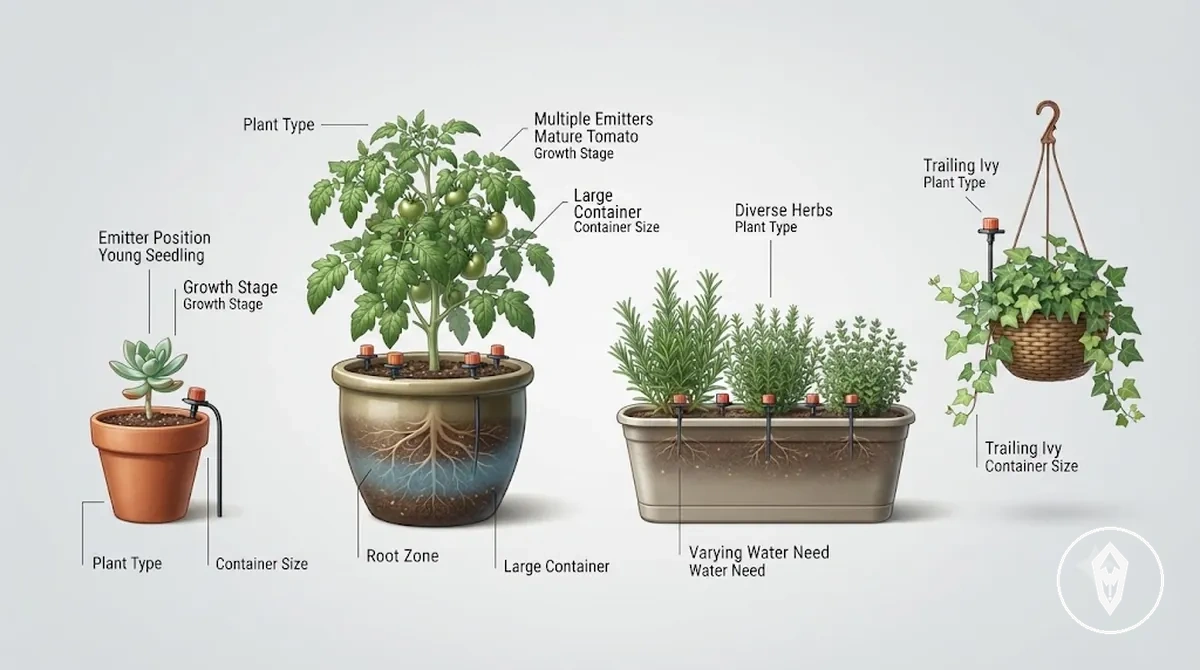
Container plants with different pot volumes and growth stages may respond differently to the same watering output. Checking plant characteristics helps determine whether the emitter position and watering duration align with the root zone and water-holding capacity of the container.
- Plant type: Plant type affects water demand, so emitter output should be evaluated according to the plant need and growing condition.
- Growth stage: Growth stage influences water demand changes, which can guide adjustments to watering duration and output.
- Container size: Container size and pot volume affect available soil area and water-holding capacity, influencing how moisture remains available.
- Root depth: Root depth affects where water should reach, so emitter placement should align with the intended root zone.
Soil moisture, drainage, and weather conditions
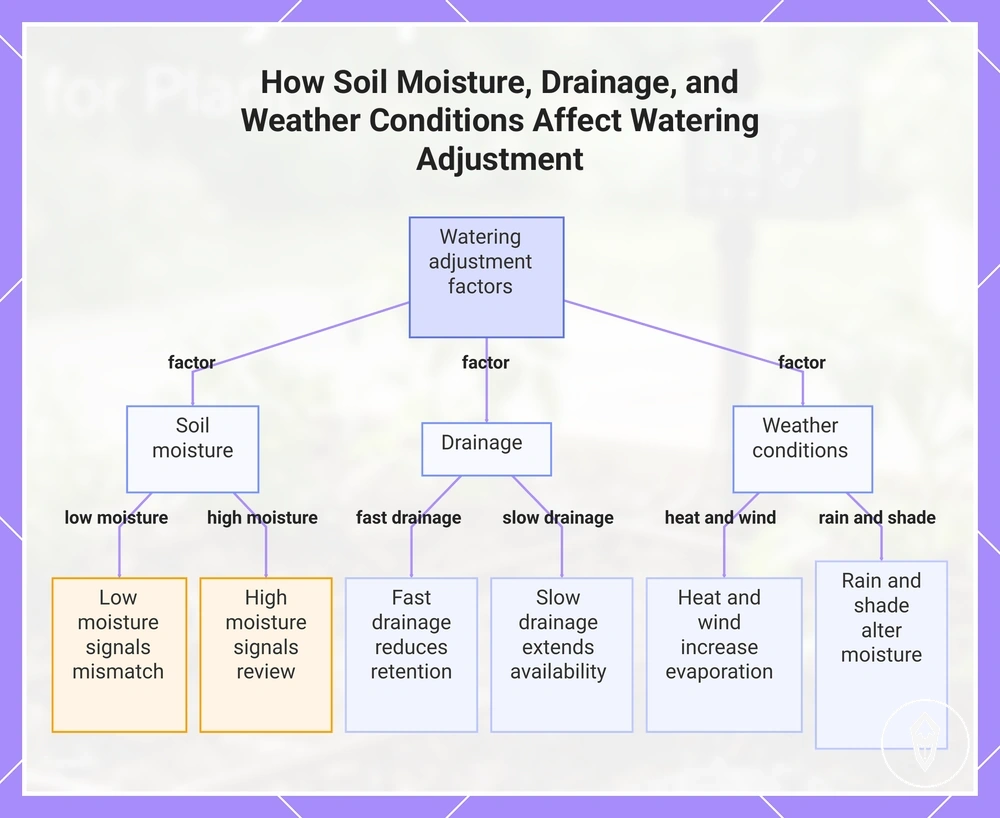
Soil moisture, drainage, and weather conditions can change how the same automatic watering kit setting affects water use. The combined moisture level, drainage speed, and weather exposure determine whether a setting matches the current growing conditions.
Soil moisture, drainage, and weather conditions can change how the same automatic watering kit setting affects water use.
Soil moisture influences how much available water remains near the plant area, while drainage speed affects how quickly moisture moves away from the target zone. Weather conditions such as heat, wind, rain, and shade can change evaporation exposure and plant demand, so observations should guide any setting adjustment.
- Soil moisture: A lower moisture level may indicate that the current setting is not matching water demand, while higher moisture levels may signal that output should be reviewed.
- Drainage: Faster drainage can reduce moisture retention, while slower drainage can keep moisture available longer and change the watering adjustment needed.
- Heat and wind: Heat and wind can increase evaporation exposure, which may increase water demand compared with less exposed conditions.
- Rain: Rain changes available moisture conditions, so watering settings may need review after natural rainfall.
- Shade and seasonal demand: Shade and seasonal demand changes affect moisture conditions, so observation of the plant area should guide adjustment.
This chart shows the key factors that determine whether an automatic watering setting matches current growing conditions, based on soil moisture, drainage, and weather.
Coverage gaps, overlap, and outlet placement
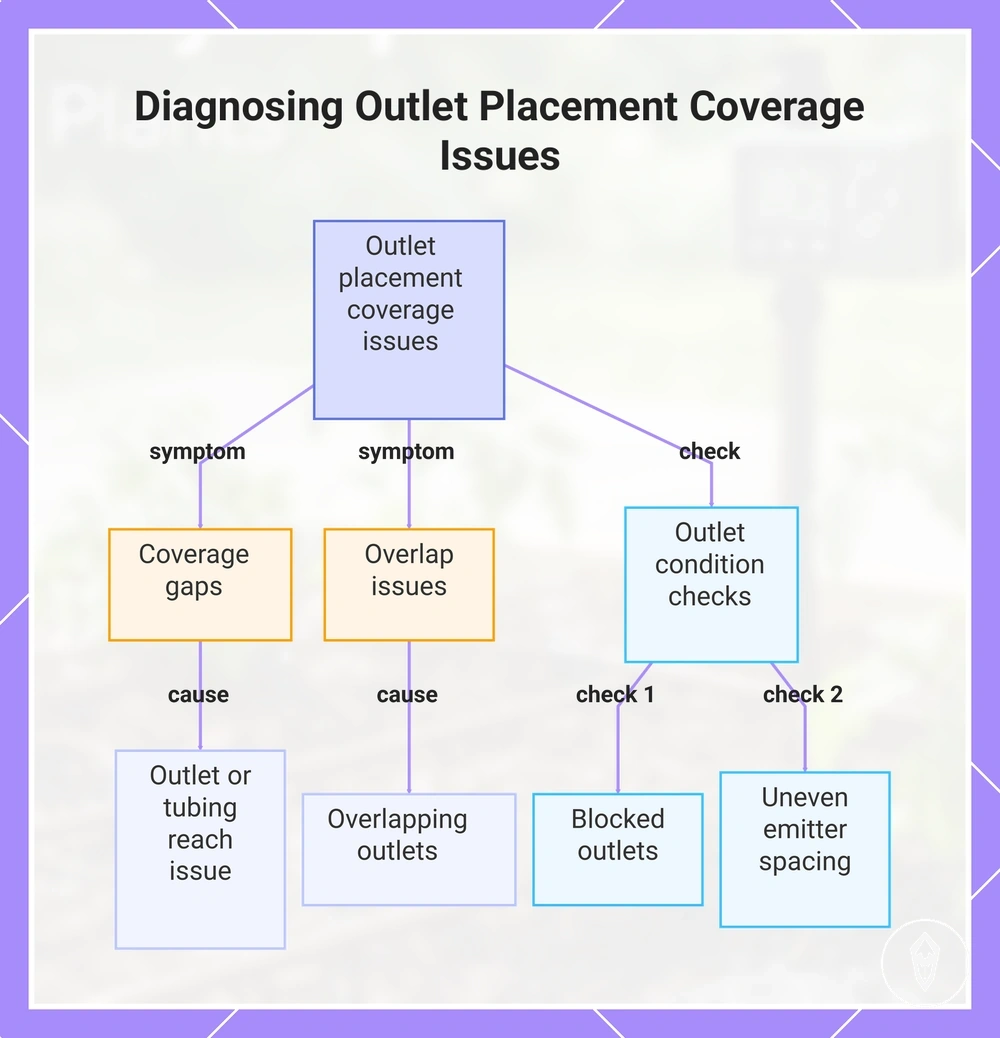
Outlet placement affects how water reaches the intended watering zone and can create coverage gaps, overlap, or runoff risks when the layout does not match plant position. Checking emitter spacing, tubing reach, and outlet position helps identify coverage issues that may affect water distribution.
Checking emitter spacing, tubing reach, and outlet position helps identify coverage issues that may affect water distribution.
Dry spots and wet areas can have different causes, including outlet placement, blocked outlets, uneven container distribution, or overlapping watering zones. A local layout check helps identify whether the coverage pattern matches the intended plant area before changing other settings.
- Coverage gaps: A dry spot may indicate that outlet placement or tubing reach does not cover the intended area, so the watering zone should be checked.
- Emitter spacing: Uneven emitter spacing can create coverage imbalance between plant positions, requiring a review of outlet locations and distribution.
- Overlap: Excess water in one area may indicate overlapping outlets, so outlet positions should be checked for concentrated delivery zones.
- Blocked outlets: Reduced delivery from a blocked outlet can appear as uneven watering, so each outlet should be inspected.
- Tubing reach: Limited tubing reach can affect outlet position, making the coverage layout an important part of the check.
This chart shows the main symptoms of outlet placement problems and the checks to identify coverage gaps, overlap, and delivery issues.
Timer schedules that improve water efficiency
Timer schedules improve water efficiency by controlling when and how long water is delivered, but the schedule only supports efficient use when watering frequency and run duration match plant demand and weather conditions.
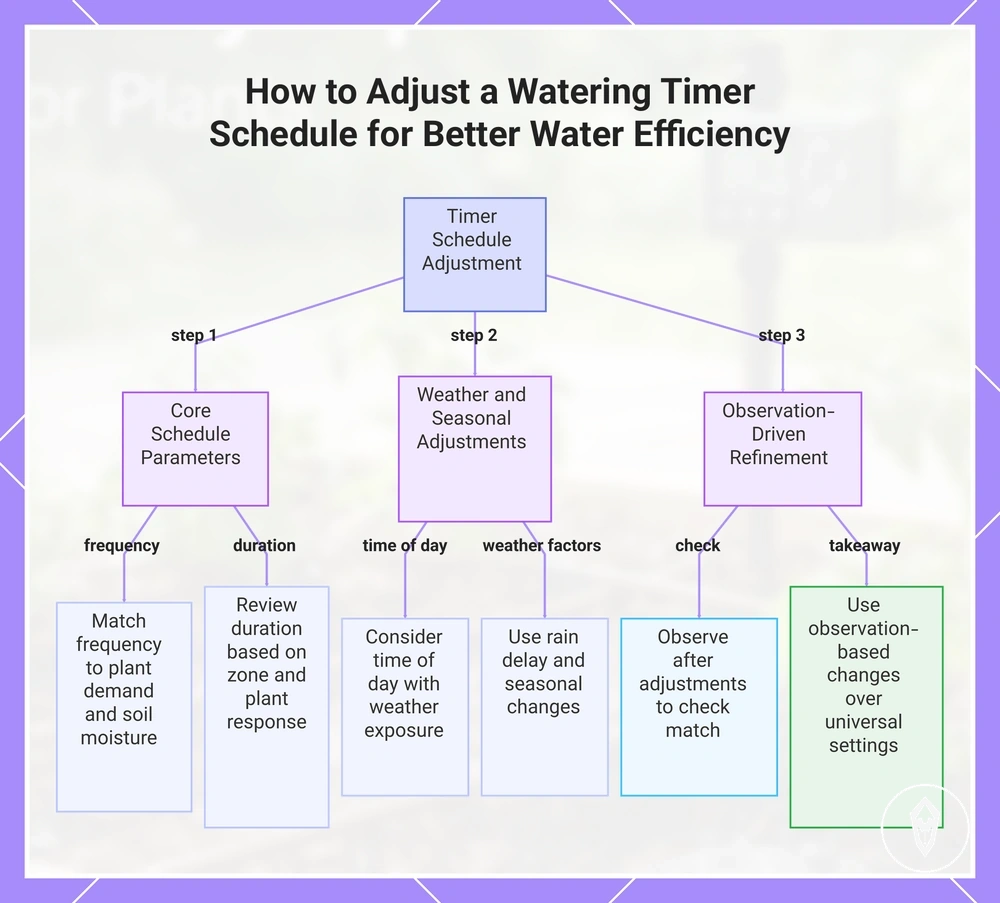
A watering timer should be adjusted by considering frequency, duration, soil moisture, and changing weather conditions together.
A watering timer should be adjusted by considering frequency, duration, soil moisture, and changing weather conditions together. The goal is controlled watering rather than maximum automation, so observation after adjustments helps determine whether the schedule matches the watering area.
- Watering frequency: Adjust watering frequency according to plant demand and soil moisture conditions so the timer schedule matches the current watering need.
- Run duration: Review run duration based on the watering zone and plant response, because the delivery period affects how water is used in the area.
- Time of day: Consider the time of day alongside weather exposure, as heat, wind, and evaporation conditions can influence water-use efficiency.
- Rain delay: Use rain delay settings when rainfall changes moisture availability to help avoid unnecessary watering during wetter conditions.
- Seasonal adjustment: Apply seasonal adjustment changes when plant demand and weather conditions change, using observation-based changes to guide the schedule.
The timing and flow setup should be considered after understanding how frequency and run duration affect watering outcomes. Observation-based changes help refine the timer schedule without relying on one universal setting.
Observation-based changes help refine the timer schedule without relying on one universal setting.
This chart shows the three main adjustment steps — core parameters, environmental factors, and observation — to improve water efficiency from a timer schedule.
Watering frequency and run duration
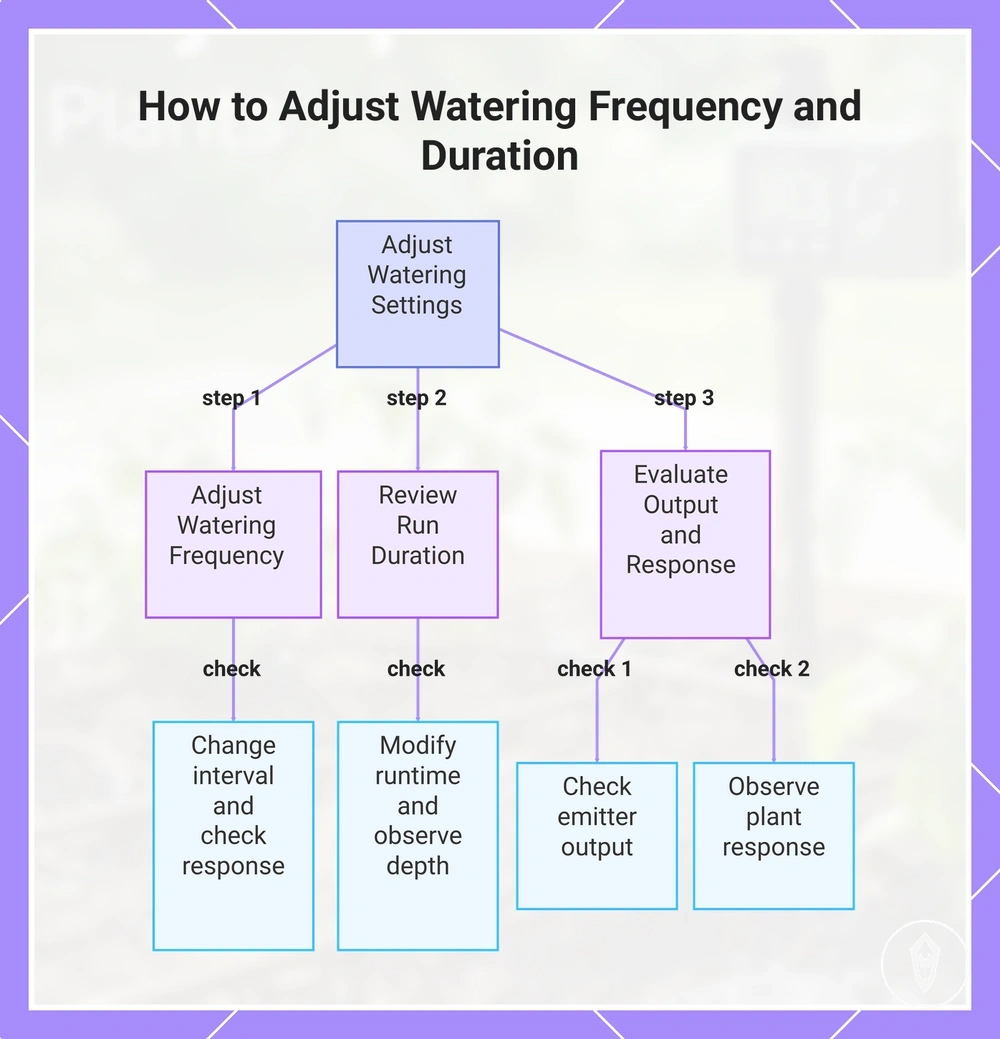
Watering frequency and run duration work together to control total water output, because changing the watering interval or runtime changes how much water reaches the watering zone.
Adjusting one setting at a time helps show how frequency, duration, emitter output, and soil wetting depth affect plant response.
Adjusting one setting at a time helps show how frequency, duration, emitter output, and soil wetting depth affect plant response. A smaller or larger adjustment may change under-watering or overwatering signals, so the next change should be guided by observation after the previous setting change.
- Adjust watering frequency: Change the watering interval and check plant response and soil conditions to see whether the total output matches the watering need.
- Review run duration: Modify runtime and observe soil wetting depth to check whether water reaches the intended area without creating signs that require further adjustment.
- Check emitter output: Review how emitter output combines with frequency and duration, then observe whether the delivered water level matches the plant area.
- Observe plant response: Use under-watering or overwatering symptoms as signals to review settings, rather than treating one sign as a final diagnosis.
This chart shows the step-by-step adjustment process for watering frequency and duration, including checks on emitter output and plant response.
Early morning timing and evaporation control
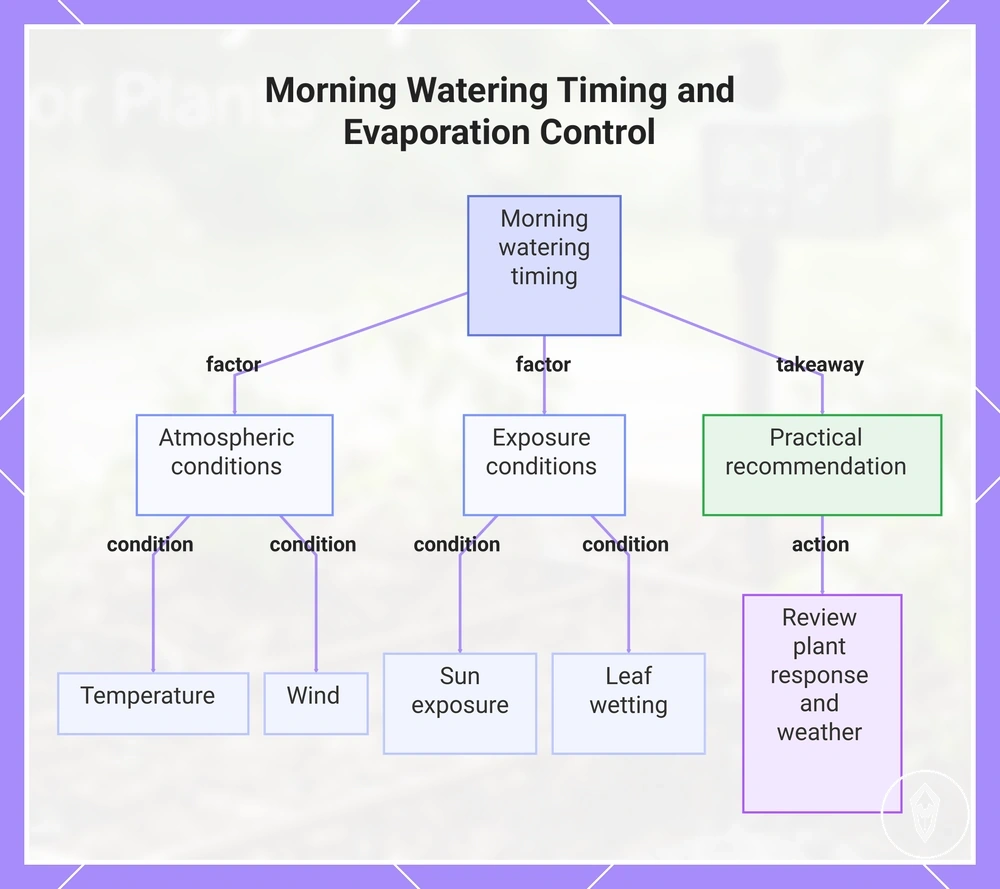
Early morning timing can support evaporation control by delivering water during cooler conditions before higher temperature and sun exposure increase water loss. The effect depends on local conditions such as temperature, wind, and exposure around the watering area.
Timing should be reviewed alongside plant response and local weather conditions.
Morning watering may support root-zone absorption when water reaches the plant area before stronger heat and wind conditions increase evaporation exposure. For example, an exposed area with higher sun exposure and wind may require different timing considerations than a shaded area with lower exposure. Timing should be reviewed alongside plant response and local weather conditions.
- Temperature: Cooler temperature conditions can reduce evaporation exposure compared with hotter periods, so timing may affect water availability.
- Wind: Wind can increase water loss from exposed areas, making timing and local exposure important factors to review.
- Sun exposure: Higher sun exposure can increase evaporation risk, so cooler timing may support more effective water availability.
- Leaf wetting: Water on plant surfaces can remain exposed in some conditions, so timing can be considered alongside plant position and environment.
This chart shows how early morning watering timing helps reduce evaporation and the key environmental and exposure factors that influence its effectiveness.
Rain delay and seasonal schedule adjustment
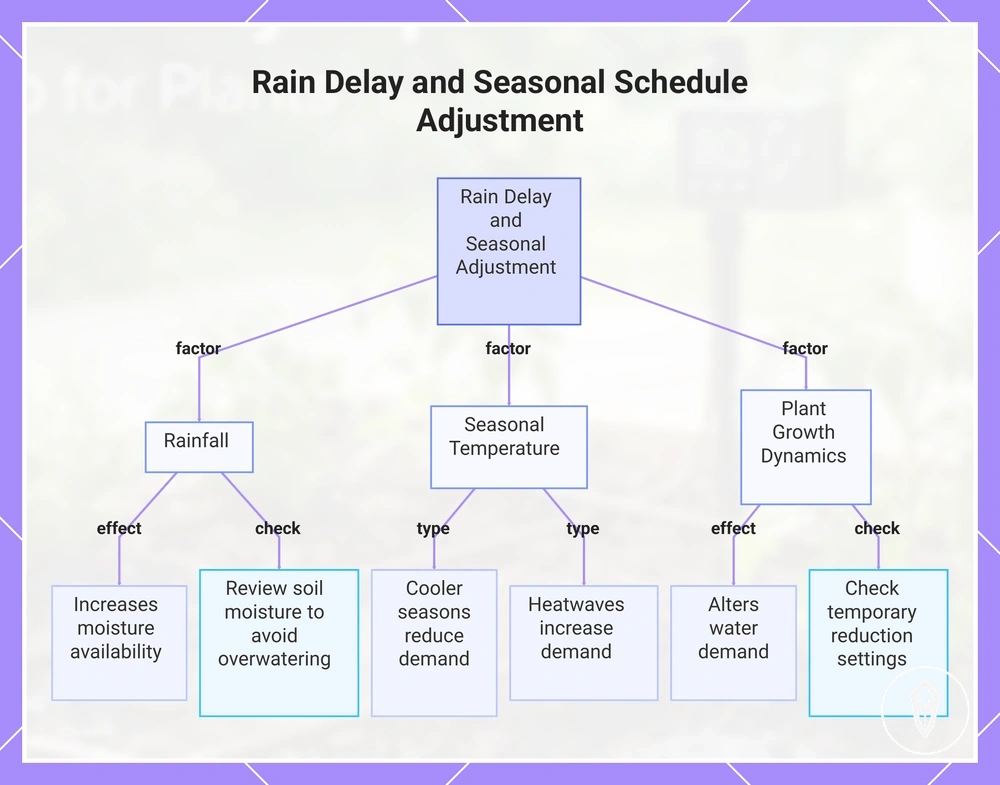
Rain delay and seasonal adjustment help reduce unnecessary watering when rainfall, cooler seasons, or changing plant demand reduce the need for additional water. These schedule changes should match natural moisture conditions, weather changes, and plant growth requirements.
Observation of soil moisture and plant response should guide the next schedule check.
Weather changes can affect how a timer schedule performs, so temporary reductions or pauses may help align watering with current conditions. For example, rainfall may increase available moisture, while a heatwave may increase plant demand and require schedule review. Observation of soil moisture and plant response should guide the next schedule check.
- Rainfall: Rainfall can increase natural moisture availability, so rain delay should be reviewed when soil moisture conditions change to avoid unnecessary watering.
- Cooler seasons: Cooler seasons may reduce plant demand, so seasonal adjustment can help align the schedule with lower water requirements.
- Heatwaves: Heatwaves can increase water demand, so the watering schedule may need review based on exposure, soil moisture, and plant response.
- Plant growth: Plant growth changes can alter demand, so temporary reduction settings should be checked against current growing conditions.
This chart shows how rain delay and seasonal adjustment help reduce unnecessary watering by aligning schedules with rainfall, temperature changes, and plant growth.
Flow control for precise water delivery
Flow control affects water delivery precision by managing emitter output, pressure stability, and balanced distribution across outlets. Efficient flow depends on how these factors work together to support consistent delivery conditions.
Efficient flow depends on how these factors work together to support consistent delivery conditions.
Adjustable drip emitters, pressure regulation, low-volume output, and outlet balance each influence how water reaches the intended area. Reviewing the relationship between each part, its condition, and the resulting water outcome helps identify whether uneven flow requires a setting or layout check.
| Entity or part | Attribute or criterion | Value or condition | Effect or decision |
|---|---|---|---|
| Adjustable drip emitters | Emitter output | Output can be adjusted according to emitter type and the intended watering area. | Helps align water delivery with plant demand when outlet settings are suitable. |
| Pressure regulation | Pressure stability | Pressure control influences how consistently water is distributed through outlets. | Helps identify whether uneven delivery is related to pressure conditions. |
| Outlets | Low-volume output | Controlled output provides measured delivery for the watering zone. | Supports precise distribution while requiring checks for output changes or uneven flow. |
| Line layout | Outlet balance | Balanced distribution depends on outlet arrangement, emitter condition, and line layout. | Uneven flow indicates that outlet position, emitter condition, or balance may need review. |
The flow and pressure control relationship helps evaluate how settings and components influence water delivery. Checking emitter output, pressure regulation, and outlet balance can clarify the cause of inconsistent distribution.
Adjustable drip emitters and outlet balance
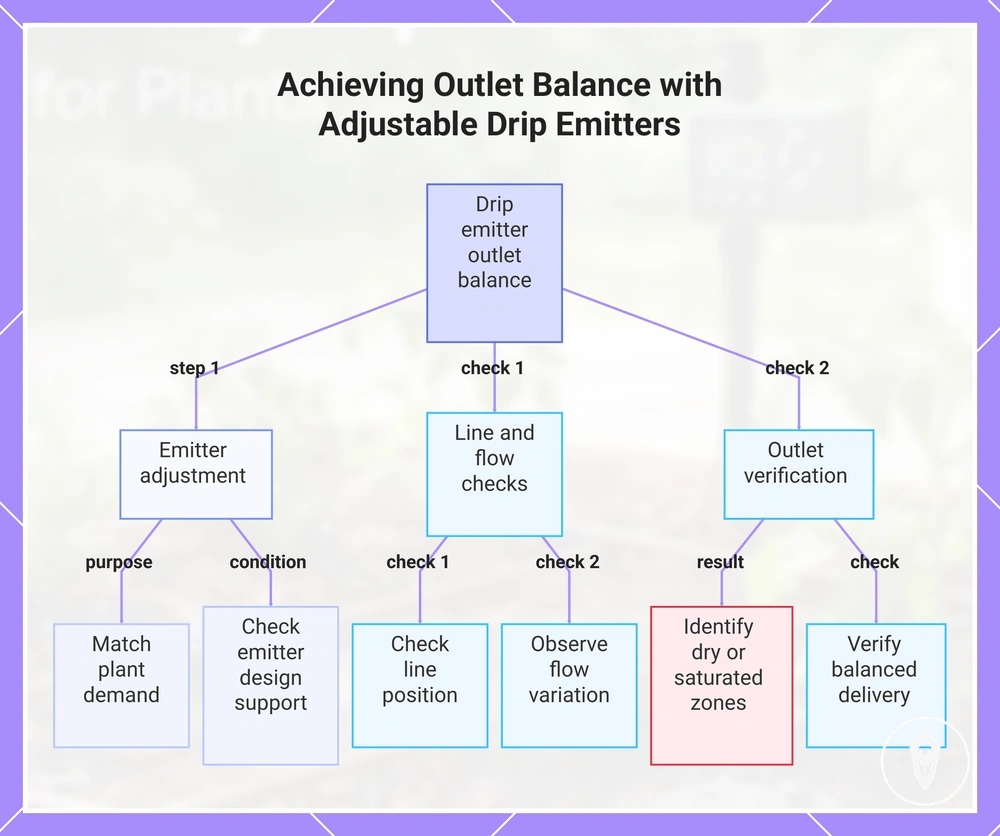
Adjustable drip emitters help match outlet output to different plant demand conditions by allowing emitter adjustment where supported by the emitter design. Outlet balance depends on emitter output, line position, flow variation, and the watering needs of each area.
Uneven distribution can occur when outlets deliver different amounts of water across the watering zone.
Uneven distribution can occur when outlets deliver different amounts of water across the watering zone. Checking each outlet after an adjustment helps identify whether the change improves balance or creates dry zones and saturated zones that require further review.
- Emitter adjustment: Check whether adjustable drip emitters match the intended plant demand, because emitter output changes can affect water distribution across outlets.
- Outlet balance: Review each outlet after changes to identify dry zones, saturated zones, or uneven distribution that may require further adjustment.
- Line position: Check line position when outlet areas receive different water amounts, as position can influence distribution results.
- Flow variation: Observe flow variation after emitter adjustment to confirm whether outlet output remains suitable for the watering area.
- Outlet check: Inspect each outlet after changes to verify that the adjusted settings support balanced water delivery.
This chart shows how to adjust drip emitters and perform key checks to achieve balanced water delivery across outlets.
Pressure regulation and low-volume output
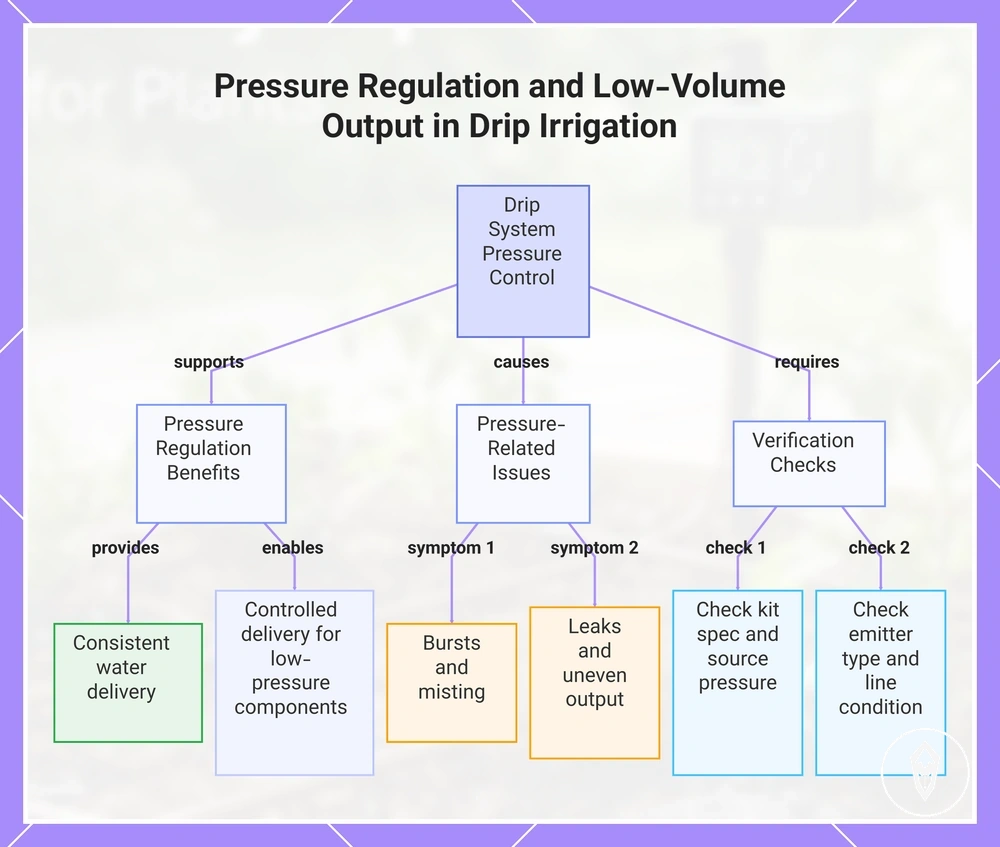
Pressure regulation supports low-volume output by helping maintain more consistent water delivery conditions for drip components. The relationship between pressure control and emitter output affects how evenly water is delivered under the specific kit conditions.
Pressure regulation supports low-volume output by helping maintain more consistent water delivery conditions for drip components.
High or unstable pressure conditions can contribute to bursts, misting, leaks, or uneven output when components are not matched to the system requirements. For example, a low-pressure drip component may require pressure conditions that support controlled delivery rather than excess flow. Checking the kit specification, source pressure, line length, emitter type, and component condition helps verify the appropriate delivery conditions.
- Pressure regulation: Pressure control can stabilize delivery conditions, while the result depends on kit specification, source pressure, and connected components.
- Low-volume output: Low-volume output supports controlled delivery when low-pressure drip components match plant demand and watering conditions.
- Emitter consistency: Emitter consistency requires checking emitter type, line conditions, and component condition when water distribution changes.
- Leaks and excess flow: Leaks or excess flow can indicate that pressure conditions, emitter type, or component condition require verification.
This chart explains how pressure regulation supports consistent low-volume output, common issues from unstable pressure, and key verification checks.
Preventing overwatering with automatic watering kits
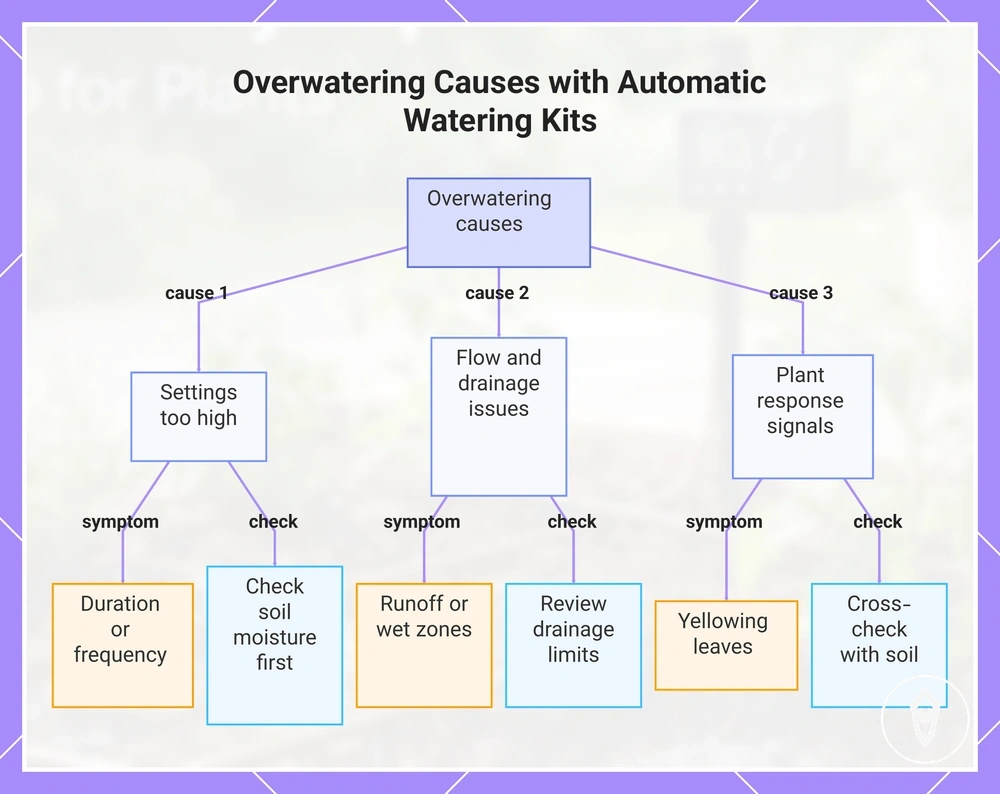
Overwatering is usually addressed by reducing watering duration, timer frequency, or emitter output after checking soil and plant response. The likely causes are often linked to settings, flow distribution, or drainage conditions rather than a single symptom.
Symptoms should be connected to likely causes before making changes.
Symptoms should be connected to likely causes before making changes. Saturated soil, runoff, yellowing leaves, or excessive wetness may suggest that duration, timer frequency, emitter output, or drainage conditions require review, but similar signs can also come from soil mix, weather, or plant-related conditions.
- Saturated soil: Wet soil may indicate that watering duration or timer frequency is too high, so check moisture conditions before reducing output.
- Runoff: Runoff may indicate excessive output, concentrated emitter delivery, or drainage limits, so check the watering area and water movement.
- Yellowing leaves: Yellowing leaves can occur with overwatering conditions, but plant response should be checked alongside soil moisture and other growing factors.
- Emitter output: High emitter output in a concentrated area may create overly wet zones, so check whether delivery matches the plant area.
- Drainage: Limited drainage can keep soil wet for longer, so review drainage conditions before changing watering settings.
After identifying the likely cause, make a related setting change and observe the outcome before further adjustments. For more detailed troubleshooting steps, see overwatering fixes.
For more detailed troubleshooting steps, see overwatering fixes .
This chart shows how to connect overwatering symptoms in automatic watering kits to their likely causes, focusing on settings, flow, and drainage.
Soil and plant signs that settings are too high
Settings too high may be indicated by wet soil, runoff, wilting, yellowing, water pooling, or other plant signs, but these symptoms should be read together rather than treated as proof of one cause.
High timer duration, frequent watering, or excessive emitter output may contribute to these signs when water delivery exceeds the plant area needs.
High timer duration, frequent watering, or excessive emitter output may contribute to these signs when water delivery exceeds the plant area needs. Similar symptoms can also come from drainage limits, soil mix, plant health issues, or weather conditions, so the next check should compare the symptom with the setting and growing conditions.
- Wet soil: Persistently wet soil may suggest high duration or frequent watering, so check soil moisture and drainage before changing the system.
- Runoff: Runoff may indicate that emitter output or watering duration is too high for the area, so check water movement and delivery settings.
- Wilting: Wilting with wet soil requires checking drainage, soil condition, and plant response because the sign may have more than one possible cause.
- Yellowing: Yellowing may be linked to moisture conditions, but drainage, soil mix, weather, or plant health should also be reviewed.
- Water pooling: Water pooling may indicate limited drainage or excessive output, so check the watering area before adjusting settings.
- Algae or fungus gnats: These signs may occur in consistently moist conditions, so check wetness levels and surrounding growing conditions.
Small timer and flow changes before replacing parts
Small changes to the timer and flow settings can help test whether a watering issue comes from adjustment conditions before considering replacement. Controlled testing uses one setting change at a time and checks the result before making further decisions.
Changing multiple settings together can make it harder to identify the effect of each adjustment.
Changing multiple settings together can make it harder to identify the effect of each adjustment. A gradual approach helps compare runtime, watering intervals, emitter output, and soil response while keeping part replacement as a decision only when a part is damaged, clogged, or unsuitable.
- Reduce runtime: Lower the timer runtime and check soil response after the watering cycle to see whether moisture conditions move closer to the intended level.
- Adjust watering intervals: Space watering intervals and review soil response over one or more cycles before making another setting change.
- Lower emitter output: Reduce emitter output where adjustment is available and check whether water delivery better matches the watering area.
- Review the result: Check the outcome after one or more cycles and decide whether the setting change improved conditions or whether a part condition requires further review.
Water-saving kit features that support efficient use
Water-saving features support efficient use when they match the watering layout, plant demand, and growing conditions. The useful feature depends on how the setup distributes water across the intended area.
The useful feature depends on how the setup distributes water across the intended area.
For pots, adjustable drip emitters may help match output to individual plant needs, while mixed plants may require different delivery conditions across the same area. Exposed locations may need weather-related features, and low-pressure setups may need features that support stable delivery. The first decision signal is whether the feature matches the layout and watering conditions.
The first decision signal is whether the feature matches the layout and watering conditions.
The main feature criteria can be compared by looking at each feature, its condition, its water-efficiency role, and when it becomes useful.
| Feature | Attribute or condition | Water-efficiency role | When it matters |
|---|---|---|---|
| Adjustable drip emitters | Emitter output adjustment based on plant demand and watering area | Helps match controlled output to different plant or container needs. | Useful for pots or mixed plants with different watering requirements. |
| Timer programs | Watering duration and interval control | Helps align watering cycles with changing plant demand. | Relevant when watering needs change over time. |
| Rain delay | Schedule pause after rainfall conditions | Helps avoid unnecessary watering when natural moisture is available. | Useful in locations affected by changing weather exposure. |
| Moisture sensing | Soil moisture condition information | Helps review watering decisions using current soil conditions. | Relevant when moisture levels differ across the growing area. |
| Pressure regulation | Pressure stability for connected components | Supports more consistent delivery conditions. | Important for low-pressure setups or systems with varied output needs. |
| Low-volume output | Controlled water delivery through suitable components | Supports targeted delivery and reduces excess output risk. | Useful when focused watering is needed for specific areas. |
These criteria should be used to understand feature fit rather than rank one option above another. Water-saving features provide support only when the feature condition matches the layout, plant demand, and delivery requirements.
These criteria should be used to understand feature fit rather than rank one option above another.
A suitable feature choice depends on the watering environment, such as pots, mixed plants, exposed locations, or low-pressure setups. Reviewing the layout, plant needs, and system conditions helps identify which features provide relevant water-saving support without relying on universal claims.
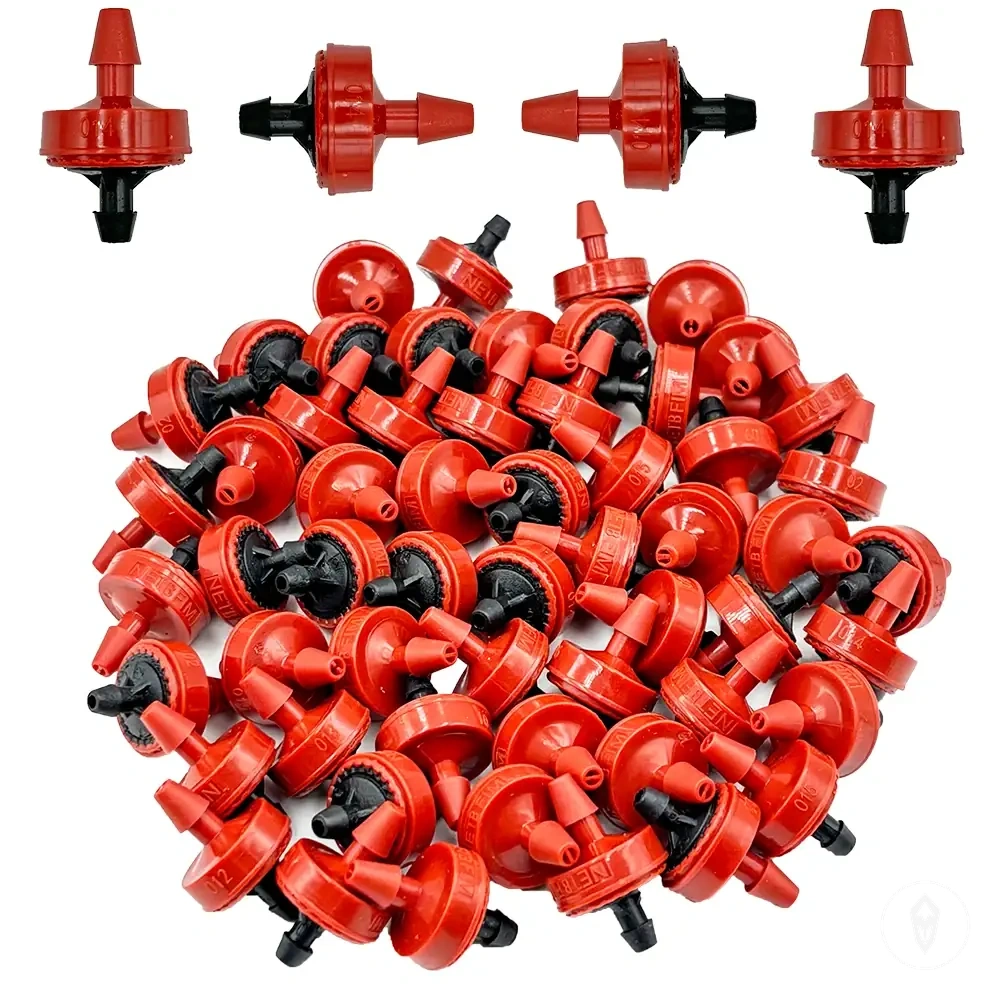
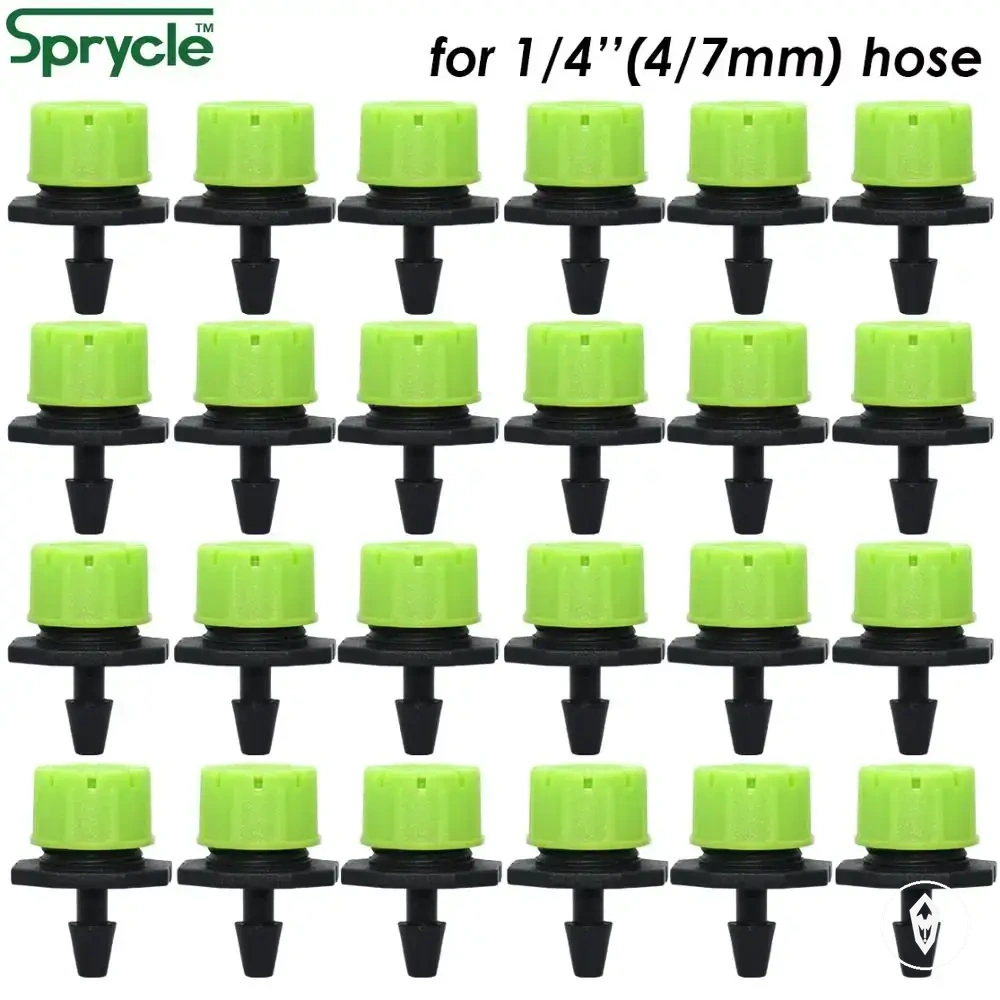
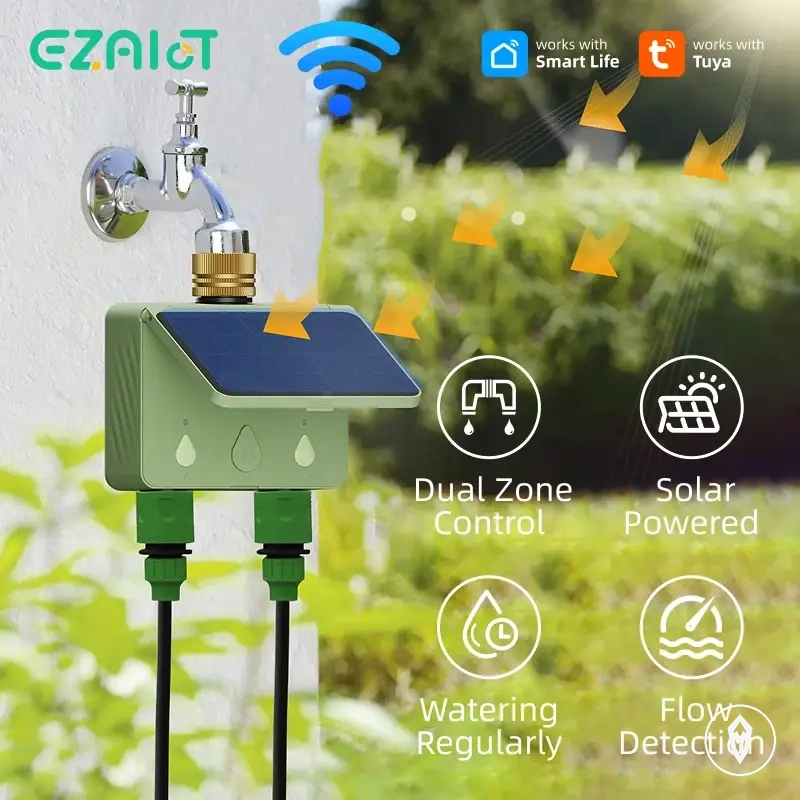
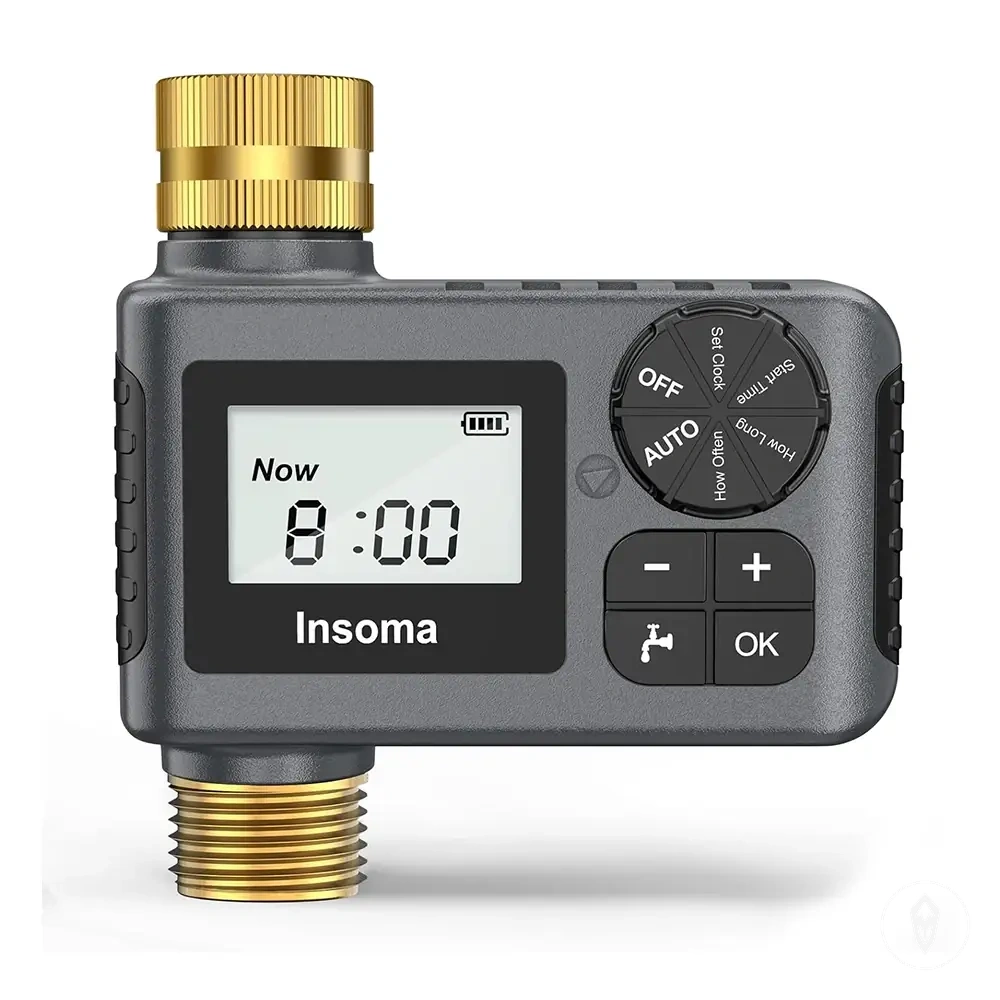
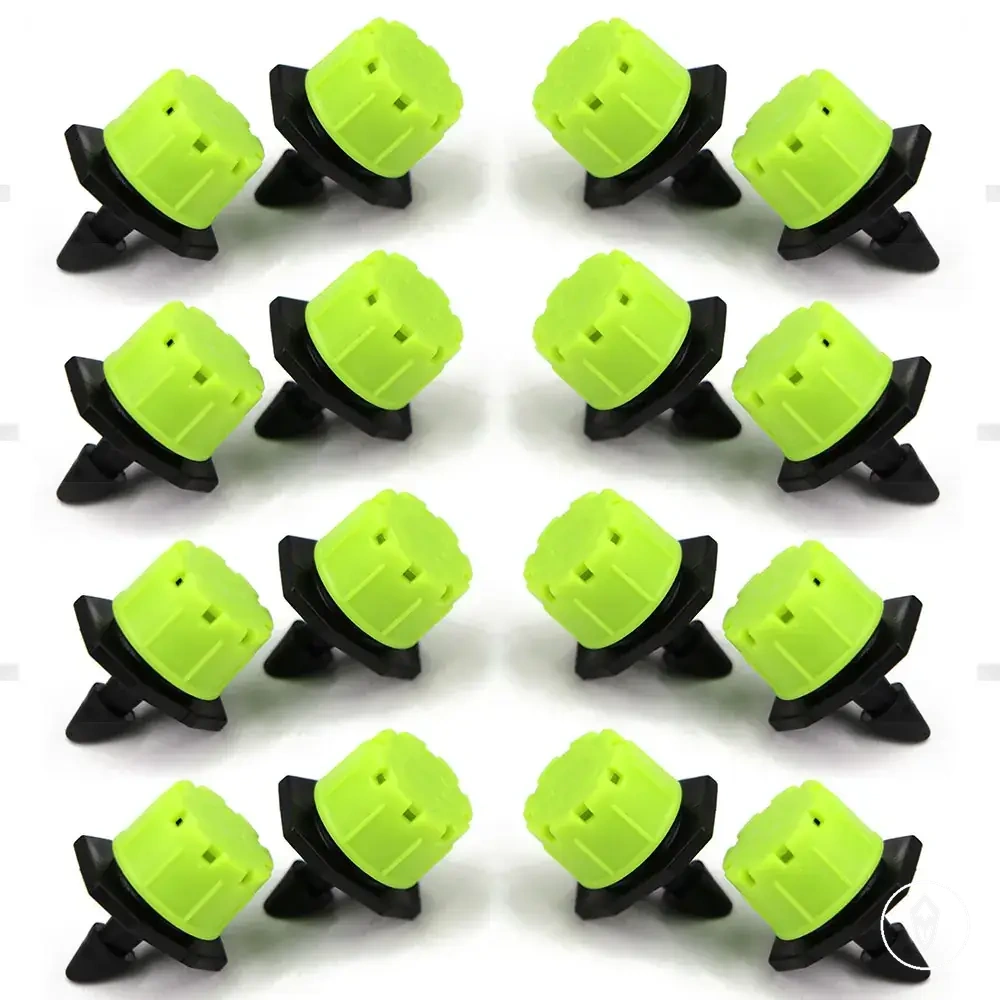
The products below are useful examples for comparing available options.
The products below are useful examples for comparing available options. Before buying, check that the compatibility criteria, key features, and product details match your needs.
Smart timers, moisture sensing, and water shortage alerts
Smart timers and sensor-based features can support efficient watering when they match the watering setup, plant needs, and operating conditions. These features are useful when their compatibility with the system allows schedule changes, moisture checks, or alerts to support better decisions.
Smart timers and sensor-based features can support efficient watering when they match the watering setup, plant needs, and operating conditions.
For example, moisture sensing can provide information about soil response, while rain delay can adjust schedules when rainfall changes watering conditions. Water shortage alerts can support user action when available water conditions require attention, but smart features still require review of placement, settings, battery reliability, and the overall watering setup.
- Rain delay: Rain delay can adjust a watering schedule after rainfall conditions, but the effect depends on reviewing local weather and plant requirements.
- Moisture sensing: Moisture sensing can support watering reduction decisions by providing soil response information, but sensor placement and soil conditions require checking.
- Programmable intervals: Programmable intervals can adjust watering schedules to suit changing demand, but settings still require review when conditions change.
- Water shortage alerts: Water shortage alerts can indicate low available water conditions, but they require user action and review of the water source or reservoir condition.
- Battery reliability: Battery reliability requires monitoring the power condition of sensor-based features because reduced power availability can affect operation.
- User oversight: User oversight remains necessary to review schedules, alerts, and watering results because smart features do not correct unsuitable layouts, pressure conditions, or emitter balance issues.
Emitter types and low-pressure drip components
Emitter types and low-pressure drip components affect controlled water delivery through their output, consistency, and suitability for plant demand. The right component attributes depend on matching the component output with the watering conditions.
The matching decision comes from the component condition and the required watering outcome.
Different setups may require different component characteristics because outlet type, pressure conditions, clog risk, and plant demand influence delivery results. Adjustable outlets may support changing output for different plants, while low-pressure components may require suitable pressure regulation for consistent delivery. The matching decision comes from the component condition and the required watering outcome.
The comparison below focuses on how component attributes affect water delivery rather than ranking one option above another.
The comparison below focuses on how component attributes affect water delivery rather than ranking one option above another.
| Component | Attribute | Trade-off | Useful condition |
|---|---|---|---|
| Drip emitters | Emitter type and output pattern | Different emitter types provide different delivery characteristics that need to match plant demand. | Useful when the watering area requires controlled delivery for specific plants. |
| Adjustable outlets | Output adjustment | Adjustable outlets provide flexibility but require checking output against plant demand. | Useful for pots or areas with different watering requirements. |
| Pressure regulation | Pressure stability | Pressure conditions influence output consistency and connected component performance. | Relevant when source pressure and kit requirements need to be matched. |
| Low-flow parts | Controlled output | Low-flow parts support focused delivery but require suitable component matching. | Useful when the watering layout requires low-volume component output. |
| Clog resistance | Maintenance condition | Clog resistance can reduce output disruption risk, but component condition still requires checking. | Relevant where water quality or maintenance conditions may affect delivery. |