
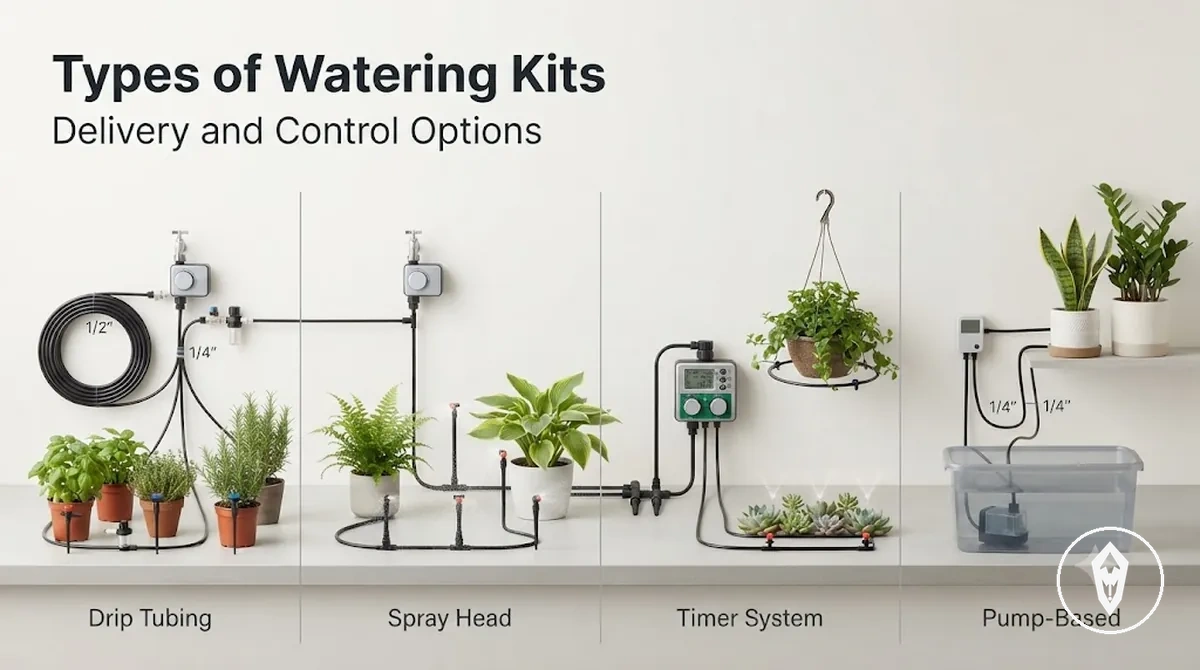
Types of automatic watering kits by delivery and control
Automatic watering kits are classified by delivery method, control style, and water source conditions because these attributes determine how water reaches plants and how the watering process operates. The main kit types are separated by how they distribute water, how watering is controlled, and how water is supplied. These delivery and control factors provide the main sorting frame for comparing automatic watering kit types.

For a container garden, outdoor planting area, or grouped plants, the suitable watering kit type depends on the plant layout, available water source, pressure conditions, power access, and kit design. An automatic watering kits category includes different configurations that use specific delivery methods and control styles for different setups. The practical effect is that users can select a kit type by matching the watering approach to their plant arrangement and operating conditions.
The table below organizes the main classification logic before individual type characteristics are explored.
Types of automatic watering kits by delivery and control can be separated by the relationship between the kit type, its main attribute, the operating condition, and the selection effect. The table below organizes the main classification logic before individual type characteristics are explored.
Types of automatic watering kits by delivery and control organize the differences between delivery methods, control styles, and water source conditions.
Types of automatic watering kits by delivery and control organize the differences between delivery methods, control styles, and water source conditions.
| Type | Attribute | Condition | Selection effect |
|---|---|---|---|
| Drip watering kit | Delivery method | Uses drip outlets for targeted water placement near plants | Supports layouts where controlled water placement is the main requirement |
| Spray or micro-spray watering kit | Delivery method | Uses spray outlets for wider surface water distribution | Supports layouts where broader coverage is needed |
| Timer-controlled watering kit | Control style | Uses scheduled settings through a timer or controller | Helps manage watering start and stop timing |
| Pump-based watering kit | Water source method | Uses a pump to move water from a reservoir or container | Supports setups that use stored water as the supply source |
| Gravity-fed watering kit | Water source method | Uses elevated water storage to create water movement | Requires selection based on supply conditions and flow requirements |
Table of Contents
How automatic watering kit types are separated
Automatic watering kit types are separated by three classification dimensions: delivery method, control style, and water source. The delivery method defines how water reaches plants, the control style defines how watering is managed, and the water source defines how supply conditions support the kit. These dimensions create the classification framework used to compare different automatic watering kit types.
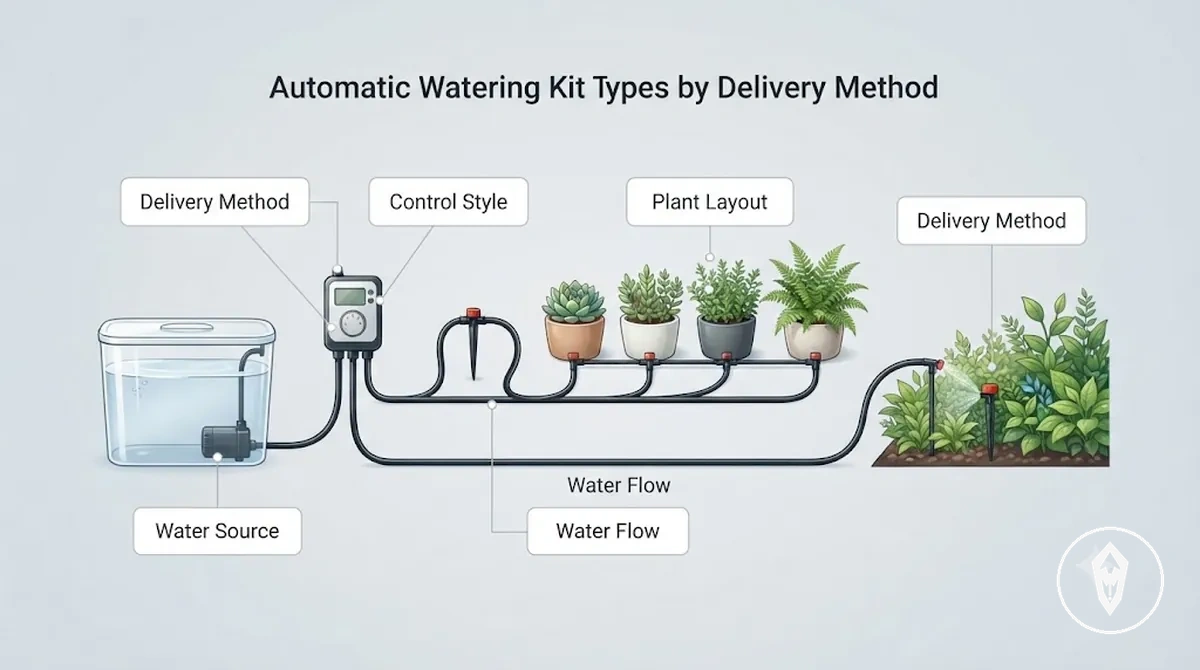
The type of automatic watering kit changes according to plant placement, available water supply, pressure conditions, and power needs. A drip irrigation kit uses a different delivery method from a spray-based watering kit because the outlet pattern changes how water is distributed. A timer-controlled kit, pump-based kit, or gravity feed kit also changes the control style or water source conditions, which affects how the system fits a particular setup.
The table below organizes how delivery, control, and supply differences influence the choice between kit types.
How automatic watering kit types are separated can be understood by connecting each type attribute to its condition and selection effect. The table below organizes how delivery, control, and supply differences influence the choice between kit types.
| Dimension | What changes | What it affects |
|---|---|---|
| Delivery method | Outlet pattern changes between drip outlets, spray outlets, and other distribution methods | Water placement and suitability for different plant layouts |
| Control style | Watering management changes through timers, controllers, or manual control options | Watering schedules and operating control |
| Water source | Supply method changes through connected sources, reservoirs, pumps, or gravity feed | Pressure requirements, power needs, and supply conditions |
The classification of a watering kit should be separated from detailed evaluation of individual components and operating requirements. The watering kit components explain the parts that make up a system, while control and pressure requirements explain specific setup criteria. Type selection provides the starting point before checking these related attributes.
Delivery method changes where the water reaches the plant
Delivery method changes where the water reaches the plant by determining whether an automatic watering kit directs water to targeted root areas, surface soil, or wider planting zones. The delivery method uses attributes such as drip emitters, micro drip line, micro-spray heads, and distribution tubing to create different coverage patterns. The selected delivery type affects watering precision and how the kit fits a specific plant layout.
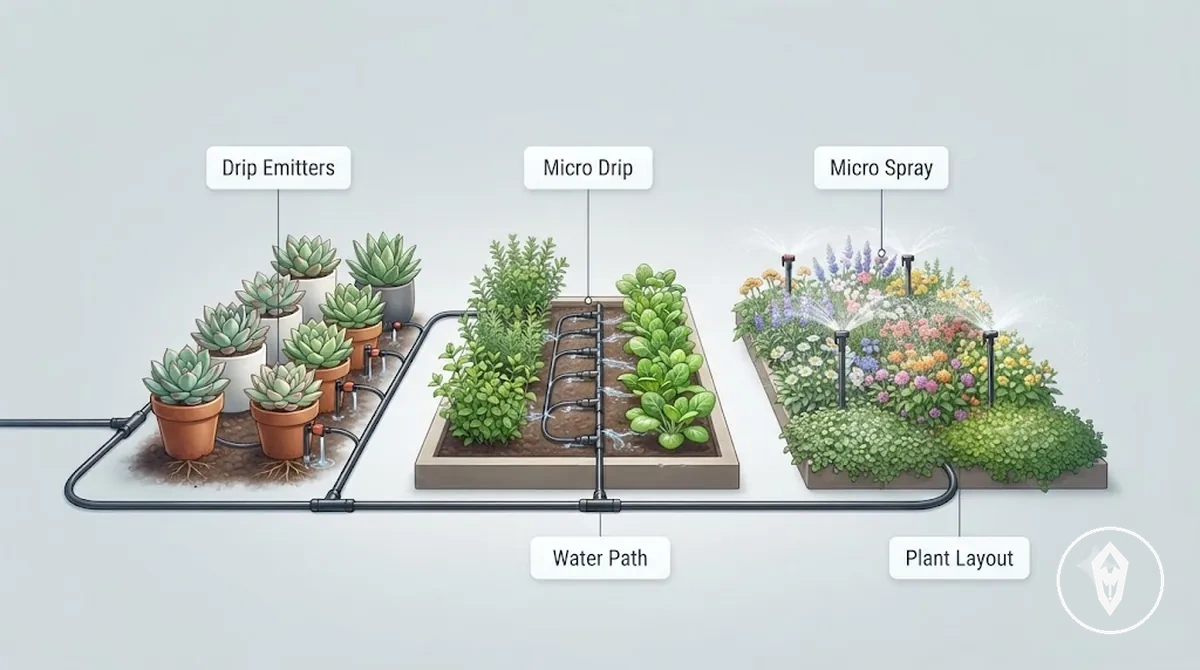
Delivery method changes where the water reaches the plant by separating outlet patterns and coverage outcomes. The following points show how each delivery attribute changes water placement and the conditions where each approach is considered.
- Drip emitters: Direct water through focused outlets, supporting plant layouts where watering points are positioned close to specific plants.
- Micro drip line: Distributes water through tubing with multiple outlets, supporting repeated watering locations across arranged plants.
- Micro-spray heads: Spread water across a wider surface area, supporting planting zones where broader coverage is needed.
- Distribution tubing: Creates the connection path between the water source and delivery outlets, affecting how the watering kit reaches different plant positions.
Control style changes how watering starts and stops
Control style changes how watering starts and stops by determining how an automatic watering kit manages activation, timing, and shutoff behavior. A timer, controller, or manual override changes how the watering schedule is applied, while the power source affects which control options are available. The selected control style should match the required watering frequency, duration, and operating conditions.
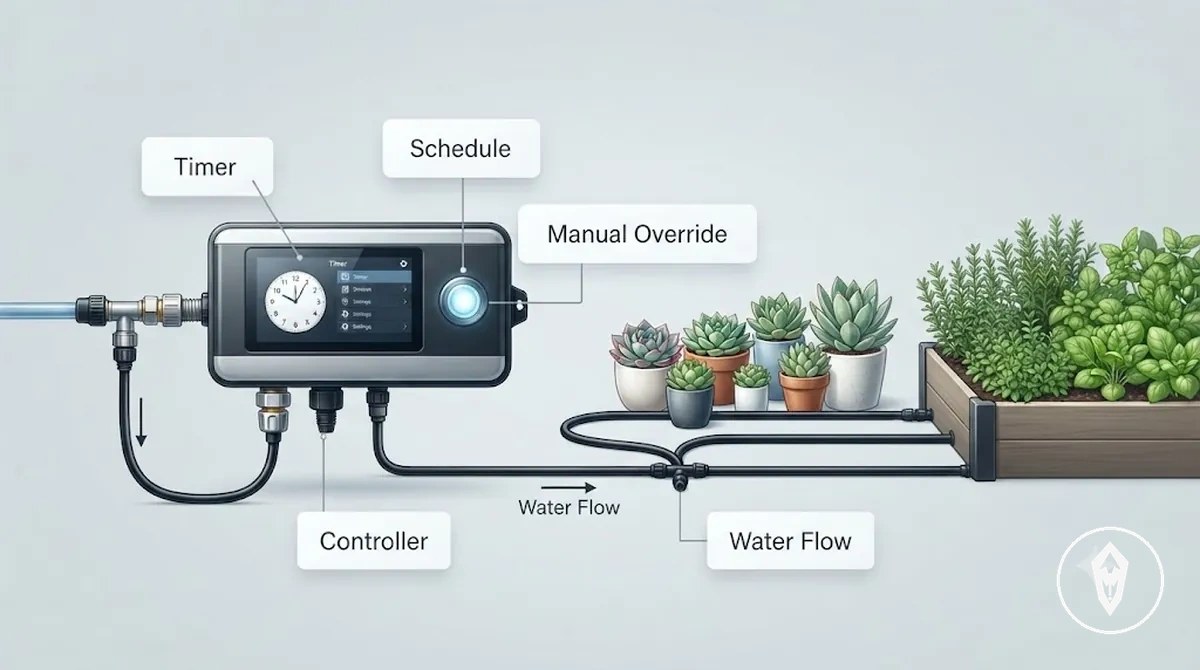
Control style changes how watering starts and stops by separating the main control attributes used to manage a watering kit.
- Timer: Controls watering through scheduled start and stop periods, defining when the system operates.
- Controller: Manages watering settings by applying selected schedules and control functions within the kit design.
- Manual override: Allows watering to be started or stopped manually when the programmed schedule does not match the immediate watering need.
- Schedule and duration: Defines watering frequency and the length of each watering period based on the selected control settings.
Water source changes whether the kit needs pressure, gravity, or a pump
Water source changes whether the kit needs pressure, gravity, or a pump by determining how an automatic watering kit receives and moves water through the system. A connected tap supply, elevated storage container, or active pump creates different supply conditions that influence pressure needs, flow behaviour, and suitable plant layouts. The selected water source becomes a key type attribute when matching a watering kit to an available setup.
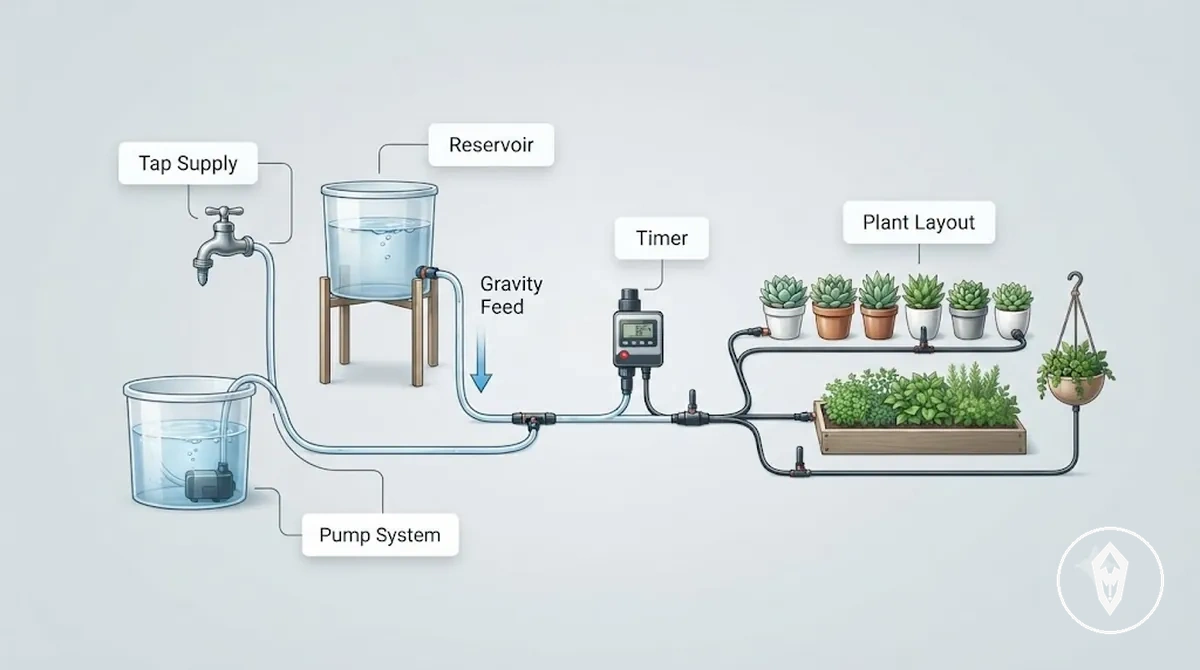
Water source changes whether the kit needs pressure, gravity, or a pump by separating the main supply conditions used to classify kit types.
- Tap connection: Uses a direct water supply source where available pressure and flow conditions influence the suitable watering kit type.
- Reservoir supply: Uses stored water as the source, making reservoir placement and available water volume part of the selection condition.
- Gravity feed: Uses elevated storage as the supply method, making elevation and low-pressure flow conditions important for the kit choice.
- Pump-based supply: Uses an active pump to move water from a container or reservoir, with pump design affecting flow and delivery conditions.
Delivery-based automatic watering kit types
Delivery-based automatic watering kit types are separated by how water is placed around plants through different outlet patterns and coverage methods. The delivery method of an automatic watering kit determines whether water reaches targeted root areas, spreads through planted sections, or covers wider surface zones. These type attributes create different coverage patterns for different plant layouts.
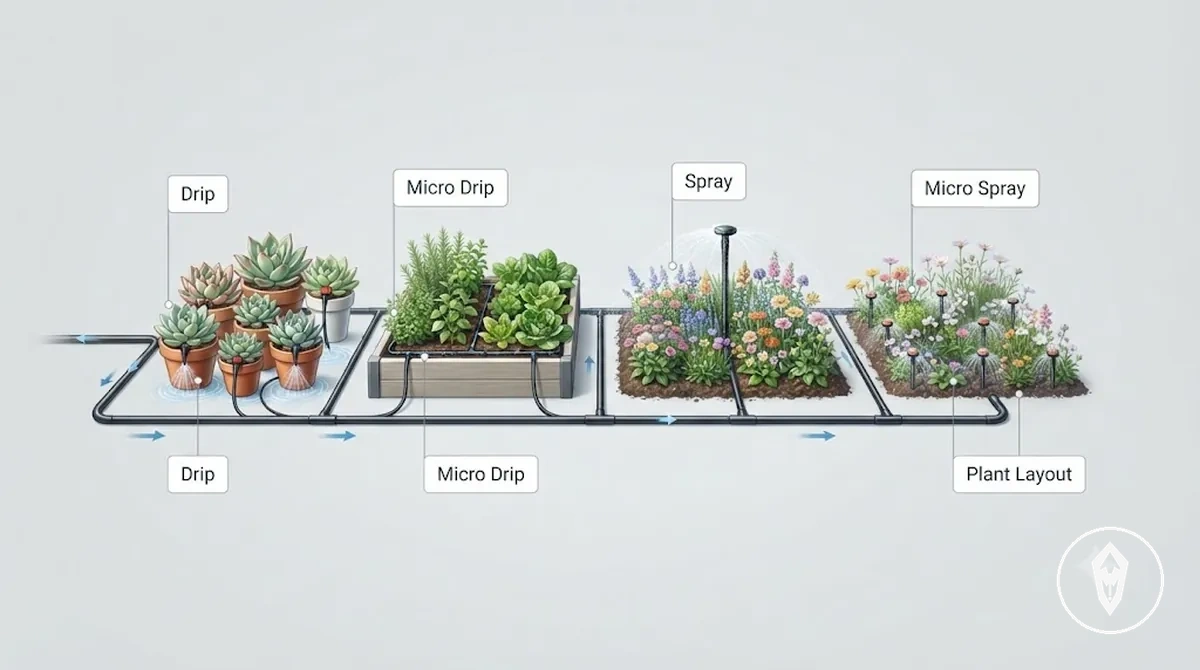
Delivery-based automatic watering kit types include drip, micro drip, spray, and micro-spray approaches that use different emitters, nozzles, and tubing layouts. Drip-based delivery places water through focused outlets, while spray-based delivery distributes water across broader areas. The practical effect is that delivery method selection changes watering precision and how the kit fits the plant layout.
The table below separates each delivery type by its main attribute, common fit, and main limitation.
Delivery-based automatic watering kit types organize the differences between outlet type, coverage pattern, and water placement. The table below separates each delivery type by its main attribute, common fit, and main limitation.
| Kit type | Main attribute | Common fit | Main limitation |
|---|---|---|---|
| Drip | Focused water delivery through emitters | Plant layouts requiring targeted water placement | Coverage follows the outlet positions and tubing layout |
| Micro drip | Small outlets distributed along tubing | Arranged plants requiring repeated watering points | Water distribution follows the selected outlet arrangement |
| Spray | Wider water distribution through spray outlets | Planting areas requiring broader surface coverage | Water placement is less focused than root-zone delivery |
| Micro-spray | Smaller spray heads for controlled surface coverage | Plant zones requiring wider coverage with defined spray areas | Coverage is affected by spray pattern and planting conditions |
Delivery method selection separates root-zone delivery from wider surface coverage rather than ranking one approach as universally better. The drip vs spray kit differences provide a deeper comparison of how these delivery patterns change water placement between kit types.
Drip kits for direct root-zone watering
Drip kits for direct root-zone watering place water at or near the root zone through controlled outlets, making them suitable for plant layouts that require focused water placement. A drip kit uses drip emitters, tubing, and drip line to direct flow toward selected planting areas instead of spreading water across a wider surface. This type condition makes drip delivery suitable when root-zone targeting is the main requirement.
This type condition makes drip delivery suitable when root-zone targeting is the main requirement.
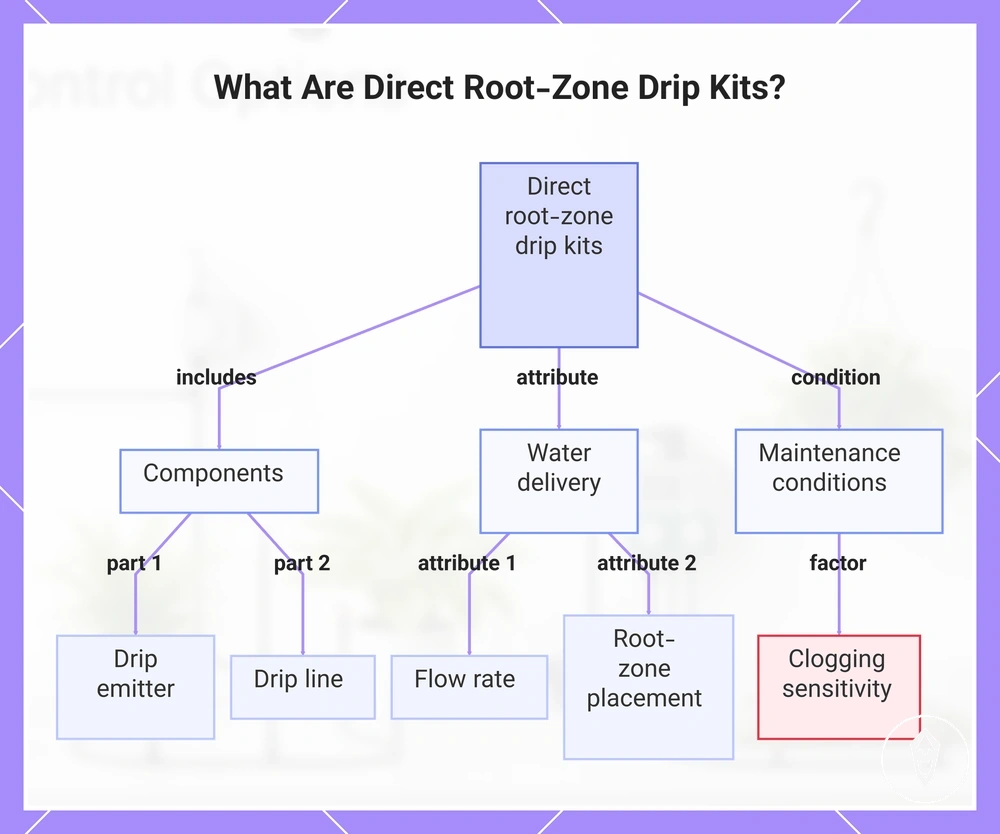
Drip kits for direct root-zone watering should be evaluated through local attributes that influence placement, flow, and maintenance conditions. The following points separate the main drip kit characteristics that affect how the system fits different plant arrangements.
- Drip emitter: Controls the outlet point where water leaves the tubing, defining where water is delivered near the root zone.
- Drip line: Uses tubing with repeated outlets to distribute water across arranged planting areas such as containers, beds, or shrub zones.
- Flow rate: Determines the amount of water delivered through each outlet, with suitable flow depending on emitter design and system conditions.
- Root-zone placement: Directs water close to plant roots, supporting targeted watering where plant spacing requires focused delivery.
- Clogging: Clogging sensitivity is influenced by emitter size, filtration, water quality, and flow conditions, so maintenance requirements vary by drip kit design.
This chart shows the main components, water delivery attributes, and maintenance conditions of drip kits designed for direct root-zone watering.
Micro drip kits for small plants and close spacing
Micro drip kits for small plants and close spacing use smaller tubing and drip emitters to place water in compact planting areas. A drip kit with micro tubing and smaller outlets can suit pots, grouped containers, and closely spaced plants where root zone placement needs a more focused delivery pattern. The fit depends on the plant arrangement, water source, flow rate, and system adjustment limits.
The fit depends on the plant arrangement, water source, flow rate, and system adjustment limits.
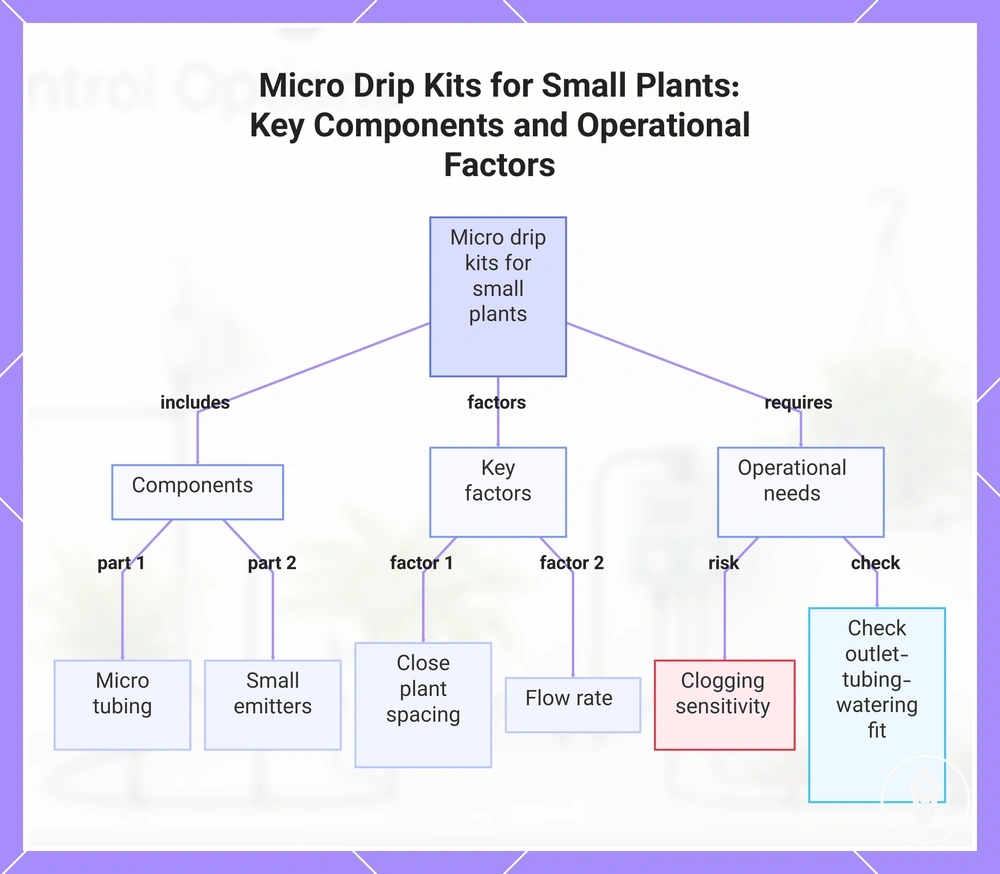
Micro drip kits for small plants and close spacing require checking the relationship between outlet placement, tubing reach, and watering conditions. These checks help identify whether the kit design matches the container grouping or planting layout.
- Micro tubing: Provides smaller delivery paths for compact layouts, with reach and placement depending on the tubing arrangement.
- Small emitters: Deliver water at individual outlet points, with flow rate suitability depending on emitter design and plant needs.
- Close plant spacing: Supports grouped containers or nearby plants where multiple watering points are positioned within a limited area.
- Flow rate: Affects how much water each outlet provides, with adjustment depending on the drip kit design and supply conditions.
- Clogging sensitivity: Can increase with smaller outlets when water quality, filtration, and maintenance conditions are not suitable for the system.
This chart shows the main components, performance factors, and operational requirements of micro drip kits designed for small plants and close spacing.
Spray and micro-spray kits for wider surface coverage
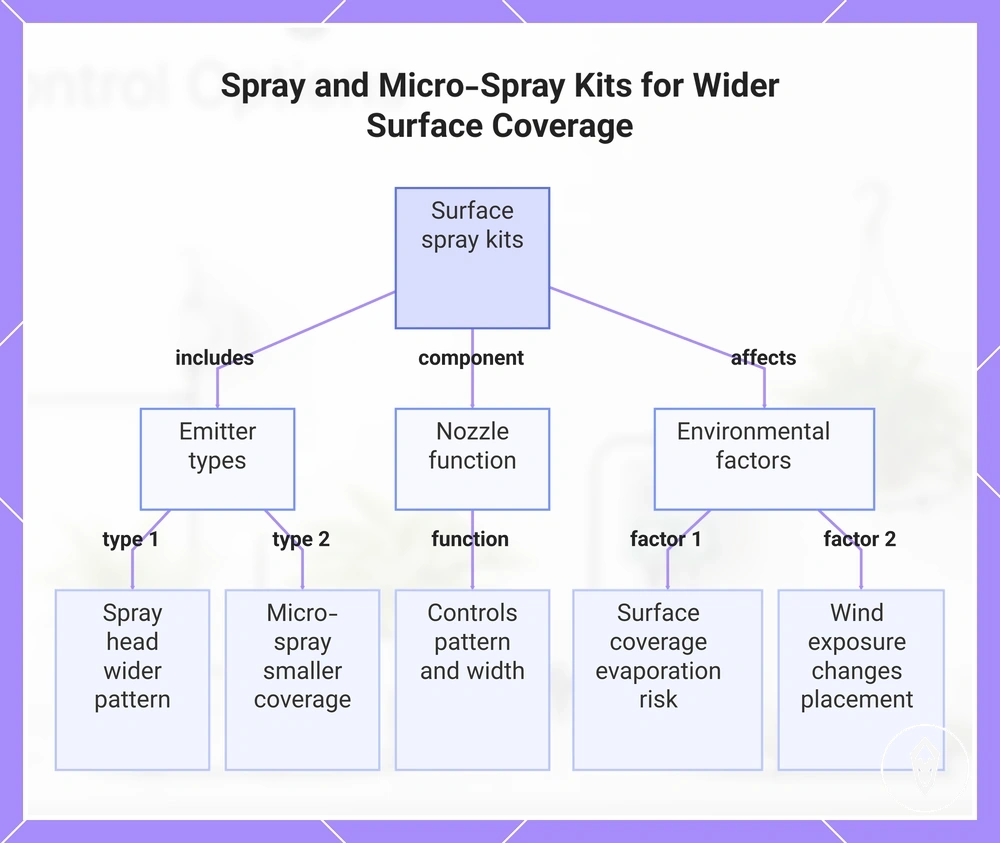
Spray and micro-spray kits for wider surface coverage distribute water across broader soil or planting surfaces through spray heads, micro-spray outlets, and adjustable nozzles. These delivery types use spray patterns and coverage width as the main distinctions from point-based emitters. The fit depends on plant density, planting layout, and conditions such as wind exposure.
The fit depends on plant density, planting layout, and conditions such as wind exposure.
Spray and micro-spray kits for wider surface coverage should be evaluated by how the nozzle pattern, surface coverage, and exposure conditions affect water placement. These attributes help separate wider surface delivery from more focused root-zone watering approaches.
- Spray head: Creates a wider water pattern, with coverage affected by the spray design and surrounding plant density.
- Micro-spray: Provides smaller spray coverage areas, which can suit mixed planting areas where broader distribution is needed.
- Nozzle: Controls the spray pattern and coverage width, with results depending on the selected nozzle design.
- Surface coverage: Spreads water across planting surfaces, while evaporation exposure can affect how much water remains available after distribution.
- Wind exposure: Can change spray placement because moving air may affect the direction and consistency of distributed water.
This chart shows the main components and environmental factors that affect water placement in spray and micro-spray kits.
Control-based and supply-based automatic watering kit types
Control-based and supply-based automatic watering kit types are separated by how watering is triggered, powered, and supplied rather than by outlet pattern. These types include timer-controlled systems, controller-based setups, pump-supported supply, gravity flow, and smart control options. The main distinction is whether the kit manages scheduling, moves water from a source, or combines control and supply functions.
Each control or supply type has different conditions that affect setup suitability.
Each control or supply type has different conditions that affect setup suitability. A timer uses a schedule to manage watering intervals and duration, while a controller can adjust control functions based on the selected settings. Pump-based types use a power source to move water from a reservoir, gravity-based types rely on stored water placement, and smart control can modify scheduling through connected features. Smart control changes watering schedules but does not automatically solve pressure, flow, or coverage limits because those conditions depend on the wider system setup.
A timer uses a schedule to manage watering intervals and duration, while a controller can adjust control functions based on the selected settings.
Control-based and supply-based automatic watering kit types organize the main control and supply paths by their trigger method, power source, and water availability conditions.
| Kit type | Main attribute | Common fit | Main limitation |
|---|---|---|---|
| Timer-controlled kit | Schedule-based watering control | Setups requiring controlled intervals and duration settings | Requires suitable water availability and system conditions |
| Pump-based kit | Powered water movement from a reservoir | Setups where stored water needs active supply movement | Depends on pump design, power source, and supply conditions |
| Gravity-fed kit | Water supply through elevated storage placement | Setups using stored water with gravity-supported flow | Flow depends on storage arrangement and available water |
| Smart control kit | Connected scheduling and control functions | Setups requiring adjustable watering schedules | Control changes scheduling but does not remove pressure, flow, or coverage limits |
| Manual override kit | User-triggered watering control | Situations requiring manual start or stop actions | Requires user input when automatic scheduling is not active |
Timer-controlled kits for scheduled watering
Timer-controlled kits for scheduled watering automate watering by controlling when a watering cycle starts, how long it runs, and how often it repeats. A timer or controller uses a schedule with interval and duration settings to manage watering actions, while the selected power source supports the control operation. This type condition suits setups where watering timing needs structured control rather than manual operation alone.
This type condition suits setups where watering timing needs structured control rather than manual operation alone.
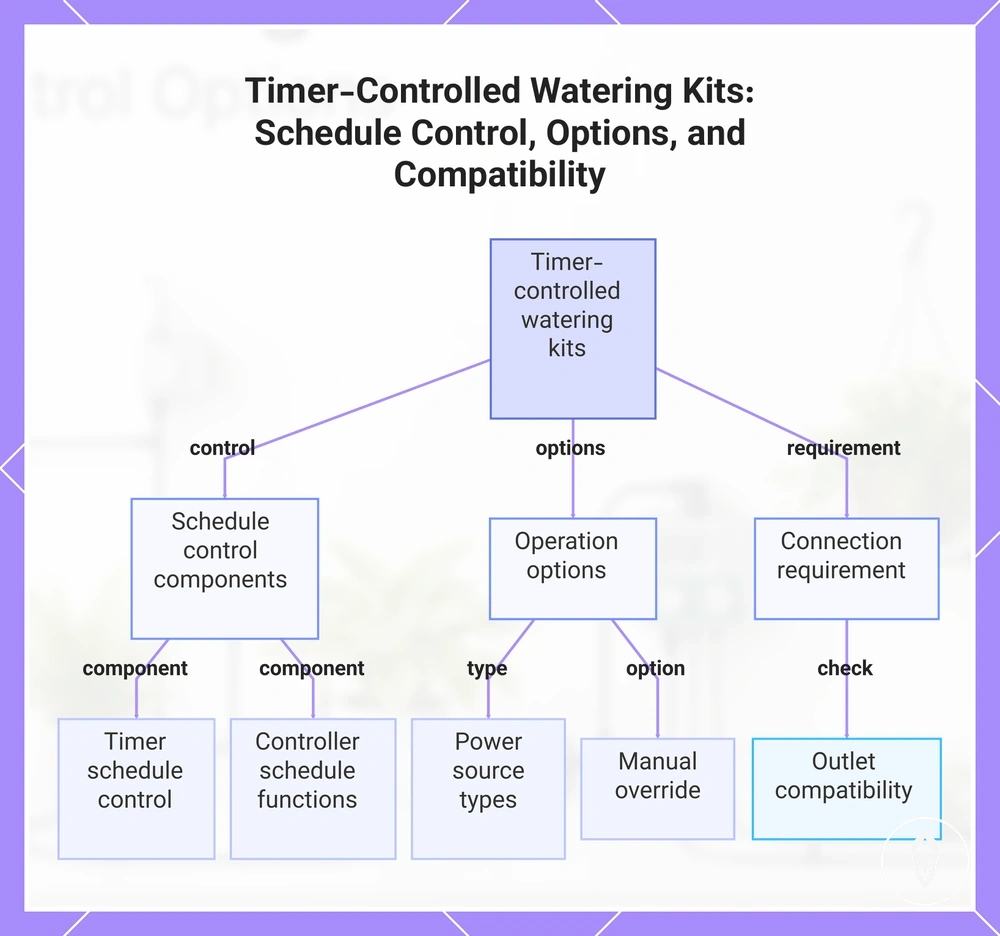
Timer-controlled kits for scheduled watering should be checked by their control flexibility and connection conditions. A battery or mains timer can provide different operating options, while manual override allows watering outside the programmed schedule. The timer or controller still needs to match the watering kit design, connected outlets, and available water conditions for reliable operation.
Timer-controlled kits for scheduled watering should be checked by their control flexibility and connection conditions.
Timer-controlled kits for scheduled watering separate the main attributes that affect schedule behaviour and control suitability.
- Timer: Controls watering start and stop actions through a programmed schedule, with available settings depending on the timer design.
- Controller: Manages schedule functions such as interval and duration, with control options depending on the kit configuration.
- Power source: Determines how the timer or controller receives power, with battery and mains options using different supply conditions.
- Manual override: Allows a direct watering action outside the programmed schedule when manual control is needed.
- Outlet compatibility: Requires matching the timer connection with the connected watering components because control behaviour depends on the overall kit design.
This chart shows the main attributes of timer-controlled watering kits, including schedule control components, operation options, and connection requirements.
Pump-based kits for reservoir-fed watering
Pump-based kits for reservoir-fed watering move water from a reservoir when a direct supply source is unavailable or not preferred. A pump-based kit uses a pump, reservoir, power source, tubing, and outlets to transfer stored water through the system, with flow conditions affected by lift height, tubing length, and outlet count. This type condition suits setups that rely on stored water and require an active supply method.
This type condition suits setups that rely on stored water and require an active supply method.
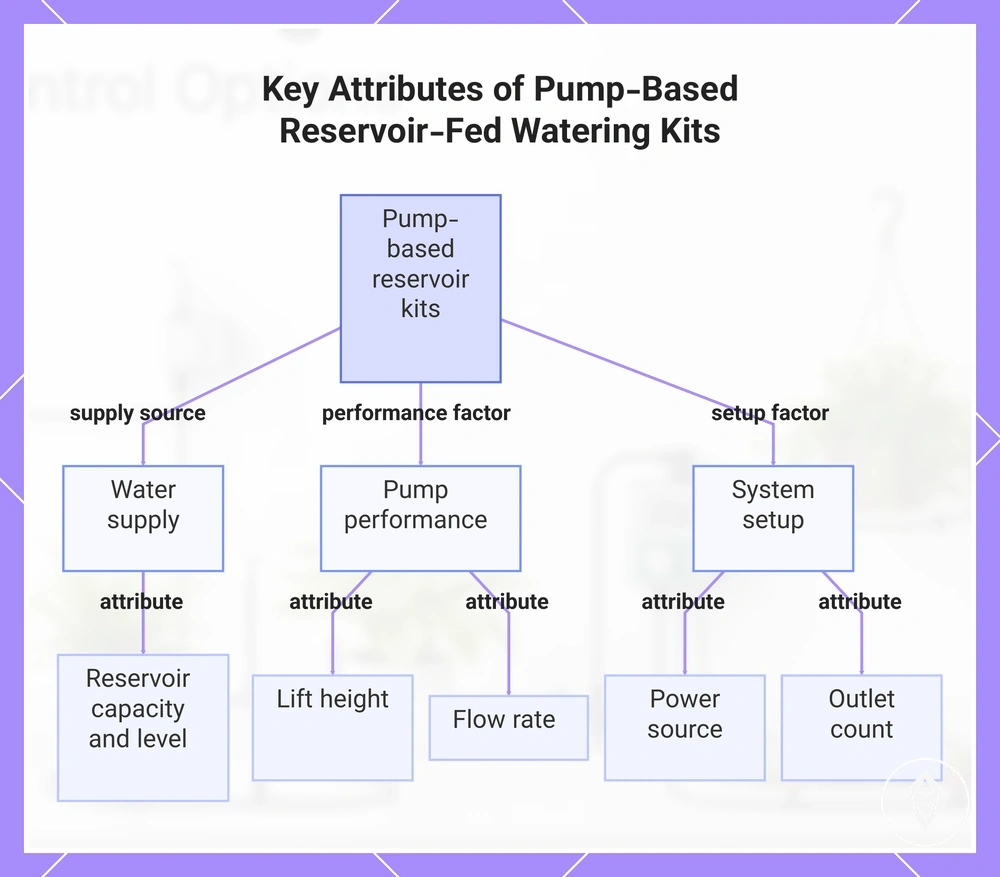
Pump-based kits for reservoir-fed watering should be evaluated by the relationship between reservoir capacity, pump operation, and watering layout. Pump performance changes with lift height, flow rate requirements, tubing length, and outlet count, so the selected setup needs to match the intended plant arrangement and supply conditions.
Pump-based kits for reservoir-fed watering separate the main attributes that affect reservoir-fed operation and pump suitability.
Pump-based kits for reservoir-fed watering separate the main attributes that affect reservoir-fed operation and pump suitability.
- Reservoir: Provides the stored water source, with water level and available capacity affecting supply availability.
- Lift height: Affects pump operation because moving water higher changes the flow conditions the pump must handle.
- Flow rate: Determines water movement through the system, with output affected by pump design, tubing length, and connected outlets.
- Power source: Supplies energy for pump operation, with the required power method depending on the pump design and setup location.
- Outlet count: Changes distribution demand because connected outlets influence how available flow is shared across the watering layout.
This chart shows the main attributes and factors that affect the operation and suitability of pump-based kits for reservoir-fed watering.
Gravity-fed kits for low-pressure watering
Gravity-fed kits for low-pressure watering rely on an elevated reservoir to move water without an active pump. A gravity-fed kit uses head height, tubing, and drippers to create a low-pressure supply path, with flow conditions affected by the emitter type and system layout. This type condition suits setups where stored water elevation can provide the required watering flow.
This type condition suits setups where stored water elevation can provide the required watering flow.
Gravity-fed kits for low-pressure watering should be evaluated by how elevation, flow restriction, and outlet arrangement affect the watering layout. The relationship between the elevated reservoir, tubing length, and connected drippers determines whether the kit matches the intended plant arrangement.
Gravity-fed kits for low-pressure watering separate the main attributes that influence low-pressure operation and supply suitability.
Gravity-fed kits for low-pressure watering separate the main attributes that influence low-pressure operation and supply suitability.
- Elevated reservoir: Provides the stored water source, with its position affecting the available head height for water movement.
- Head height: Influences flow conditions because the elevation difference between the reservoir and drippers affects water movement.
- Low pressure: Creates a restricted flow condition, so dripper selection needs to match the available supply conditions.
- Tubing length: Affects flow distribution because longer tubing paths can change the available flow reaching outlets.
- Outlet count: Influences suitability because more connected drippers can change how available flow is shared across the system.
Smart and app-controlled kits as control variants
Smart and app-controlled kits as control variants add remote scheduling, alerts, and sensor-based logic to a watering setup through a connected controller. A timer or controller can manage schedule settings such as duration and intervals, while app control provides another way to adjust watering actions. This type condition depends on the power source, connection method, and overall kit design.
This type condition depends on the power source, connection method, and overall kit design.
Smart and app-controlled kits as control variants should be evaluated by how added control features interact with the watering system. A controller may support app scheduling, manual override, alerts, or sensor input, but these functions adjust control behaviour rather than replacing limits caused by water supply, pressure, flow, or coverage conditions.
Smart and app-controlled kits as control variants separate the main features that affect remote management and control suitability.
Smart and app-controlled kits as control variants separate the main features that affect remote management and control suitability.
- App control: Provides remote access to watering settings, with available functions depending on the controller and connection method.
- Schedule: Allows watering times and duration settings to be adjusted through the controller or connected app.
- Sensor input: Uses connected sensor information to influence control decisions when the kit supports sensor-based logic.
- Manual override: Allows direct watering control outside the programmed schedule when adjustment is needed.
- Power source: Supports controller operation, with reliability affected by the selected power method and connection conditions.
Type differences that affect fit and performance
Type differences that affect fit and performance depend on matching the kit type to the plant layout, water source, and control needs. A kit type can change watering precision, coverage, and reliability depending on conditions such as container arrangement, spacing, tubing length, pressure, flow, and outlet count. The main condition is selecting a type whose attributes match the watering requirements rather than treating one option as universally suitable.
The final decision should consider how each attribute affects practical suitability.
Type differences that affect fit and performance are best evaluated by the trade-offs between coverage, flow behaviour, and watering control. Different kit types can suit different setups when their delivery and supply attributes align with the plant layout, available water conditions, and maintenance requirements. The final decision should consider how each attribute affects practical suitability.
Type differences that affect fit and performance organize the main criteria by condition, trade-off, and decision outcome.
Type differences that affect fit and performance organize the main criteria by condition, trade-off, and decision outcome.
| Option/condition | Attribute/criterion | Trade-off | Decision cue |
|---|---|---|---|
| Container plants | Plant layout and watering precision | Focused delivery can suit grouped containers, while wider coverage can suit broader planting areas | Match the kit type to plant spacing and watering placement needs |
| Close or spread-out planting areas | Coverage pattern and plant spacing | Wider coverage can reduce the need for multiple outlets, while targeted delivery can improve placement control | Consider whether coverage or precision is the main requirement |
| Long tubing layouts | Tubing length, pressure, and flow | Longer tubing paths can change flow distribution across connected outlets | Check whether the kit type matches the available flow conditions |
| Different water sources | Water source and pressure conditions | Reservoir-fed, gravity-fed, and connected supply setups create different flow conditions | Choose a kit type that matches the available supply method |
| Multiple outlet systems | Outlet count and clogging risk | More outlets can change flow distribution, while smaller outlets may require closer maintenance attention | Evaluate outlet demand and maintenance conditions together |
Type differences that affect fit and performance also relate to how control settings and supply conditions influence operation. Reviewing control and pressure requirements helps evaluate criteria such as scheduling, pressure conditions, and flow suitability when comparing kit types.
Pots, hanging baskets, garden beds, and landscape areas
Pots, hanging baskets, garden beds, and landscape areas require different kit type considerations because plant layout controls delivery, coverage, and watering precision. Container plants, raised beds, shrubs, and wider landscape areas can create different spacing, tubing reach, water source, pressure, and flow conditions. The main fit condition is matching the kit type to the physical arrangement and coverage needs of the plants.
The main fit condition is matching the kit type to the physical arrangement and coverage needs of the plants.
Pots, hanging baskets, garden beds, and landscape areas should be evaluated by how layout attributes affect suitability. A kit type that fits compact containers may have different trade-offs from a system used across broader planting areas because outlet count, tubing length, and coverage patterns change with the setup.
Pots, hanging baskets, garden beds, and landscape areas should be evaluated by how layout attributes affect suitability.
Pots, hanging baskets, garden beds, and landscape areas organize the main compatibility conditions that separate kit types by setup, attribute, and decision factor.
- Pots: Container layouts often need focused coverage and suitable outlet placement, with fit depending on plant spacing and watering precision requirements.
- Hanging baskets: Elevated plant positions require suitable tubing reach and flow conditions because the layout changes how water is delivered.
- Raised beds and garden beds: Larger planting sections require a kit type that matches spacing, coverage pattern, and outlet distribution needs.
- Shrubs and landscape areas: Wider planting zones require consideration of coverage, water source, pressure, and flow conditions before selecting a kit type.
- Tubing reach and spacing: Plant distance and tubing length affect fit because the kit layout must support the required delivery points.
Tap, reservoir, rain barrel, and indoor water-source conditions
Water source conditions determine which kit type is practical because supply pressure, flow availability, and storage limits affect how a watering system can operate. A mains tap, reservoir, rain barrel, or indoor water source creates different conditions for matching the kit type to the plant layout, coverage needs, and watering requirements. The main fit condition is selecting a system that matches the available supply method and operating constraints.
The suitable kit type depends on the relationship between the water source and the intended plant layout.
Tap, reservoir, rain barrel, and indoor water-source conditions should be evaluated by how pressure, elevation, storage volume, and refill needs affect suitability. Direct supply sources and stored water sources create different flow conditions, while indoor placement can change tubing reach and pump requirements. The suitable kit type depends on the relationship between the water source and the intended plant layout.
Tap, reservoir, rain barrel, and indoor water-source conditions organize the main supply attributes that influence kit type selection.
Tap, reservoir, rain barrel, and indoor water-source conditions organize the main supply attributes that influence kit type selection.
| Option/condition | Attribute/criterion | Trade-off | Decision cue |
|---|---|---|---|
| Mains tap | Water source, pressure, and flow availability | Provides a direct supply path, while suitability depends on the available supply conditions | Match the kit type to the existing water source characteristics |
| Hose connection | Connection access and flow path | Provides a flexible supply connection, while tubing length and outlet demand still affect fit | Check whether the connection method supports the plant layout |
| Reservoir | Reservoir volume, refill frequency, and pump need | Allows stored water use, but operation depends on available water volume and system design | Consider storage capacity alongside coverage requirements |
| Rain barrel | Height, flow conditions, and stored water access | Uses collected water, while elevation and available flow affect kit suitability | Evaluate whether the kit type matches the available supply conditions |
| Indoor water source | Placement, tubing reach, and pump requirement | Indoor setups may require different routing and supply considerations | Check the water source location against the watering layout |
Flow, pressure, coverage, and clogging trade-offs
Flow, pressure, coverage, and clogging trade-offs affect how consistently a kit type performs because water movement, outlet design, and maintenance conditions interact. A watering system may suit one plant layout but require different conditions for another because the water source, pressure, flow, and coverage requirements change. The main condition is matching these attributes to the selected kit type and intended watering layout.
The suitable choice depends on how these factors align with the plant layout and water source.
Different kit types create trade-offs between watering precision, coverage pattern, and maintenance sensitivity. Flow rate, emitter size, filter need, nozzle opening, tubing length, and outlet count influence how water is distributed, while clogging risk changes with the system design and maintenance conditions. The suitable choice depends on how these factors align with the plant layout and water source.
Different kit types create trade-offs between watering precision, coverage pattern, and maintenance sensitivity.
Flow, pressure, coverage, and clogging trade-offs organize the main performance conditions that influence kit type selection.
| Option/condition | Attribute/criterion | Trade-off | Decision cue |
|---|---|---|---|
| Different watering demands | Flow rate and distribution | Available flow is shared across the system, so outlet arrangement affects water delivery conditions | Match flow requirements to the kit type and plant layout |
| Variable supply conditions | Pressure and water source | Pressure conditions influence how consistently outlets receive water through the system | Evaluate the water source before selecting a kit type |
| Different coverage needs | Coverage pattern and watering precision | Focused delivery supports targeted placement, while broader coverage changes distribution behaviour | Select the coverage style that matches the plant layout |
| Small outlet designs | Emitter size, filter need, and clogging sensitivity | Smaller openings can require more attention to water quality and maintenance conditions | Consider maintenance requirements alongside delivery precision |
| Extended watering layouts | Tubing length, nozzle opening, and outlet count | Longer tubing paths and more outlets can change flow distribution across the system | Check whether the kit type matches the layout demand |
How to choose between automatic watering kit types
Choosing between automatic watering kit types depends on matching the kit type to the plant layout, delivery method, control style, and water source conditions. The right fit depends on attributes such as coverage, pressure, flow, power availability, and maintenance tolerance within the watering setup. A suitable choice is based on how these conditions align with the required watering approach.
The decision depends on the required coverage and plant arrangement.
Delivery method helps determine fit because plant layout affects watering precision, coverage pattern, and outlet placement. A kit type with focused delivery may suit compact planting arrangements, while broader coverage may suit larger areas where water distribution needs are different. The decision depends on the required coverage and plant arrangement.
Delivery method helps determine fit because plant layout affects watering precision, coverage pattern, and outlet placement.
Control style affects selection when schedule needs, power source, and manual operation requirements change how watering is managed. A timer or controller can adjust watering duration and intervals, while suitability depends on the available control features and the conditions of the watering system.
Water source conditions narrow viable kit types because pressure, flow, reservoir access, and supply method influence system fit.
Water source conditions narrow viable kit types because pressure, flow, reservoir access, and supply method influence system fit. Direct supply and stored water setups create different operating conditions, while coverage and watering consistency depend on how the source matches the plant layout and kit design.
How to choose between automatic watering kit types starts with narrowing the main criteria before comparing specific options.
How to choose between automatic watering kit types starts with narrowing the main criteria before comparing specific options. These decision signals help choose the right kit type by comparing plant placement, watering precision, schedule needs, water source conditions, and maintenance tolerance.
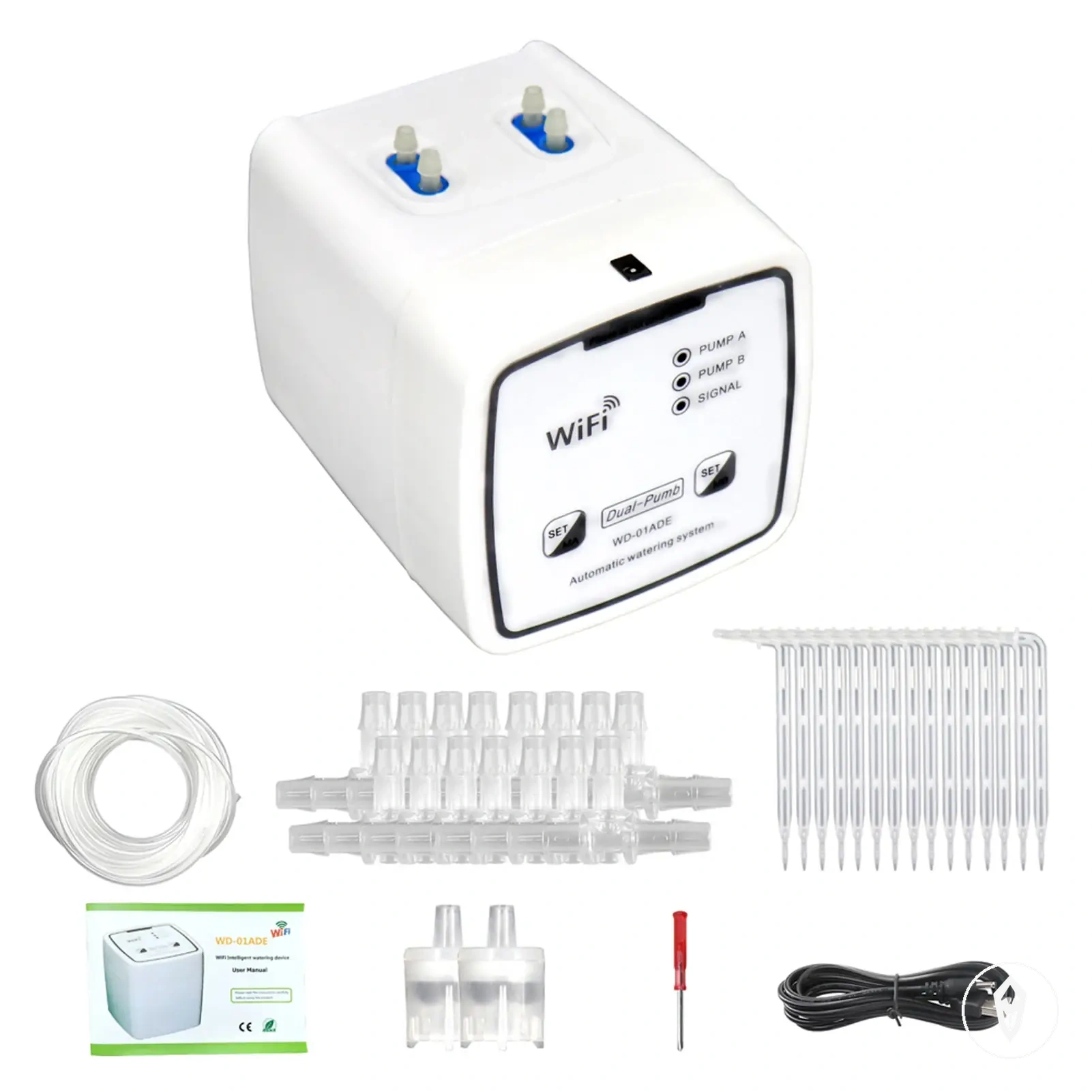
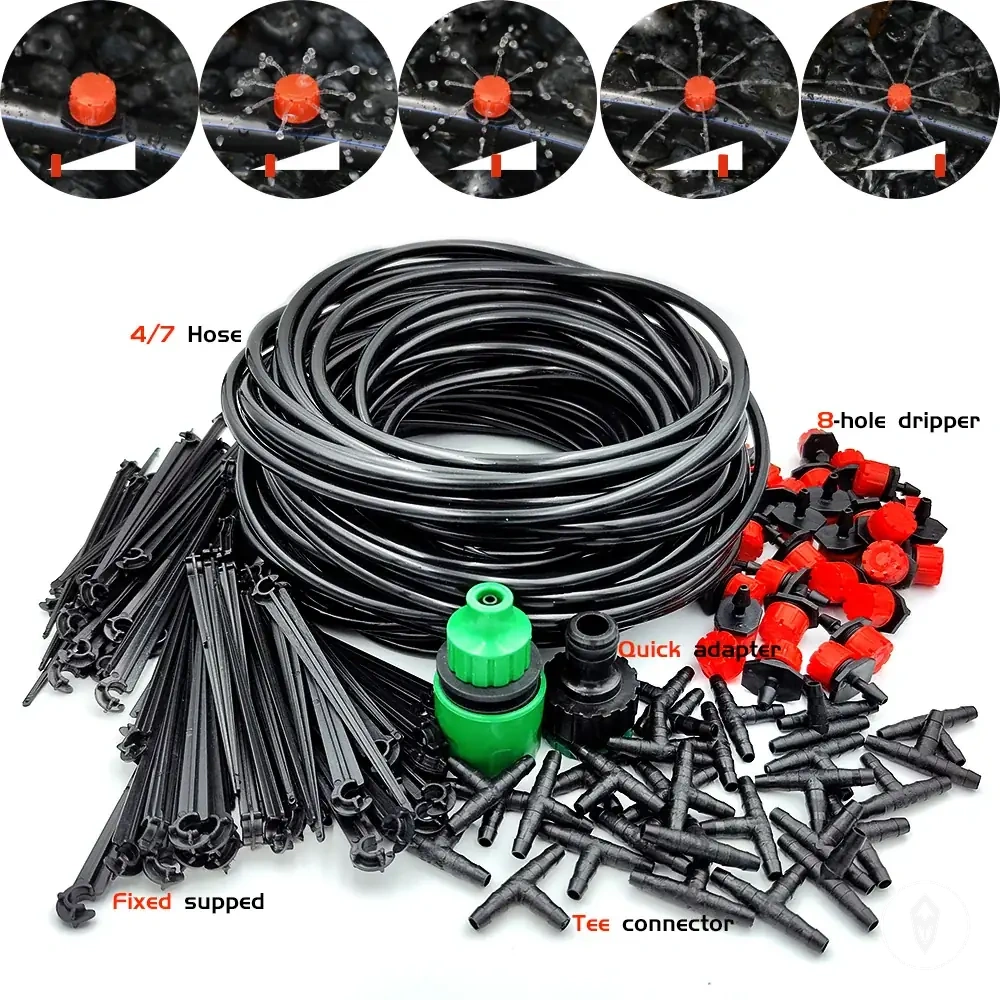
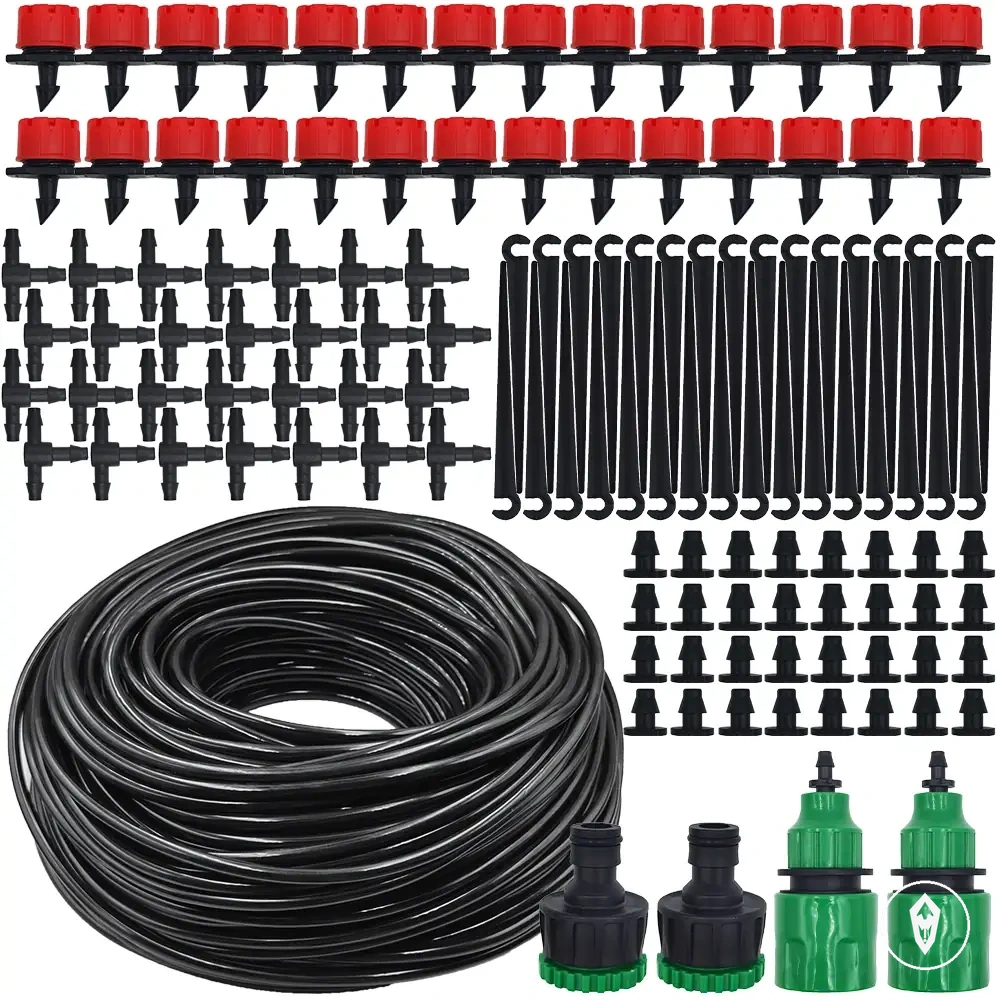
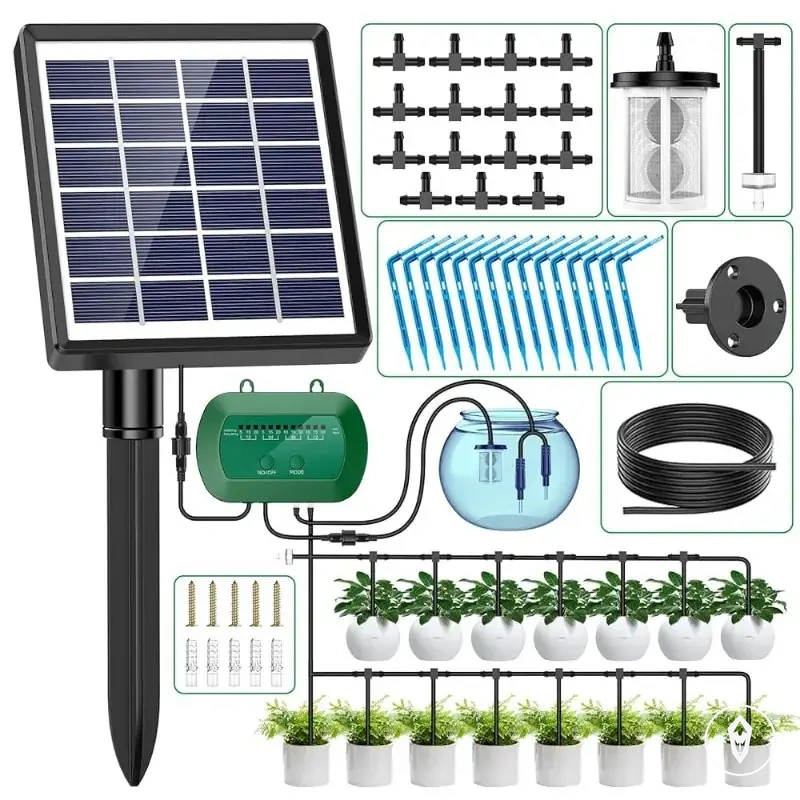
Here are product examples that may make comparison easier.
Here are product examples that may make comparison easier. Before buying, always review the compatibility criteria, essential features, and product details.
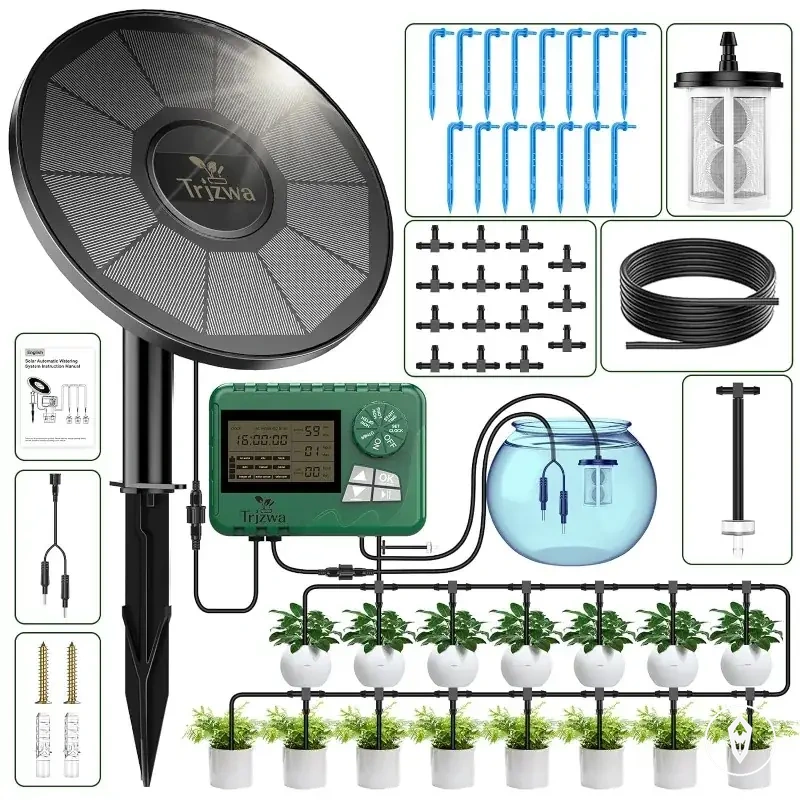
How to choose between automatic watering kit types organizes the main selection criteria by condition, trade-off, and decision factor.
| Option/condition | Attribute/criterion | Trade-off | Decision cue |
|---|---|---|---|
| Compact planting areas | Plant layout and watering precision | Focused delivery can support targeted placement, while wider coverage changes distribution needs | Match the kit type to the required watering area |
| Scheduled watering needs | Control style, duration, and power source | Automated scheduling adds control options, while operation depends on system conditions | Consider whether schedule management is required |
| Different water sources | Water source, pressure, and flow | Direct supply and stored water systems create different operating conditions | Select a kit type that matches the available supply method |
| Different coverage areas | Coverage pattern and outlet arrangement | Coverage needs can change how flow is distributed across the system | Evaluate the plant layout before selecting the delivery approach |
| Maintenance-sensitive setups | Maintenance tolerance and system conditions | Some designs require more attention to water conditions and component upkeep | Include maintenance needs as part of the fit decision |
Choose by delivery method when plant placement is the main constraint
Delivery method should guide the kit type choice when plant placement, spacing, or coverage shape is the main constraint. A kit type needs to match the plant layout, target watering zone, and required coverage pattern because delivery approaches create different watering precision and distribution conditions. The main condition is selecting a delivery method that fits the physical arrangement of the plants.
The main condition is selecting a delivery method that fits the physical arrangement of the plants.
Choose by delivery method when plant placement is the main constraint by comparing how plant density, pot spacing, bed shape, tubing reach, and outlet placement affect suitability. The decision depends on whether the setup requires focused root-zone watering, close-spacing distribution, or wider surface coverage.
The decision depends on whether the setup requires focused root-zone watering, close-spacing distribution, or wider surface coverage.
Choose by delivery method when plant placement is the main constraint organizes the delivery criteria that separate kit types by condition, trade-off, and decision factor.
| Option/condition | Attribute/criterion | Trade-off | Decision cue |
|---|---|---|---|
| Root-zone watering | Target watering zone and watering precision | Focused delivery places water in selected areas, while coverage depends on outlet arrangement and layout | Consider this when plants need targeted watering placement |
| Close plant spacing | Plant density and outlet placement | Distributed delivery points can suit grouped plants, while spacing affects how outlets are arranged | Match the kit type to the distance between plants |
| Pots and compact layouts | Tubing reach and watering precision | Compact arrangements may need delivery points positioned close to individual plants | Check whether the delivery method reaches each target watering zone |
| Garden beds and wider areas | Coverage shape and surface distribution | Broader coverage changes how water is spread across the planting area | Select a delivery approach that matches the bed shape and coverage requirement |
| Different system conditions | Water source, pressure, and flow | Supply conditions can affect how effectively a delivery method operates | Confirm the delivery choice matches the available system conditions |
Choose by control style when watering schedule is the main constraint
Control style should guide the kit type choice when watering schedule, timing consistency, or user absence is the main constraint. A timer or controller manages schedule settings such as interval, duration, and day scheduling, but it does not replace the need to match the plant layout, water source, pressure, flow, and coverage conditions. The main condition is selecting a control approach that fits the required level of watering management.
The main condition is selecting a control approach that fits the required level of watering management.
Choose by control style when watering schedule is the main constraint by comparing how simple timers, smart controls, manual override, and sensor-influenced control affect scheduling decisions. These control options change how watering is managed, while delivery performance still depends on the wider watering system conditions.
These control options change how watering is managed, while delivery performance still depends on the wider watering system conditions.
Choose by control style when watering schedule is the main constraint organizes the main control criteria that separate kit types by condition, trade-off, and decision factor.
- Simple timer: Uses a timer to manage watering intervals, duration, and day schedules through programmed timing settings. This suits setups where basic schedule control is the main requirement.
- Smart controller: Uses a controller to manage schedules and remote control functions when supported by the system. Reliability depends on the power source and connection conditions.
- Manual override: Provides a manual backup option that allows watering adjustments outside the programmed schedule when direct control is needed.
- Sensor-influenced control: Uses sensor input to adjust control decisions when the system supports sensor-based scheduling logic.
- Power source: Affects controller operation because schedule reliability depends on the available power conditions and overall system design.
Choose by water source when pressure or power is the main constraint
Water source should lead the kit type decision when pressure, elevation, reservoir access, or power availability limits the setup. A kit type needs to match the water source because tap-fed, reservoir-fed, and gravity-fed systems create different flow and coverage conditions. The main condition is selecting a watering approach that fits the available supply method, plant layout, and system requirements.
Choose by water source when pressure or power is the main constraint by comparing how supply conditions affect suitability.
Choose by water source when pressure or power is the main constraint by comparing how supply conditions affect suitability. Pressure, pump power, reservoir volume, rain barrel elevation, tubing run, and outlet count influence how consistently water can be distributed across the intended coverage area.
Choose by water source when pressure or power is the main constraint organizes the main supply criteria that separate kit types by condition, trade-off, and decision factor.
Choose by water source when pressure or power is the main constraint organizes the main supply criteria that separate kit types by condition, trade-off, and decision factor.
| Option/condition | Attribute/criterion | Trade-off | Decision cue |
|---|---|---|---|
| Tap-fed setup | Water source, pressure, and flow availability | Direct supply provides a connected source, while suitability depends on available pressure and system design | Match the kit type to the tap pressure and flow conditions |
| Reservoir-fed setup | Reservoir volume and pump power | Stored water allows a separate supply method, while operation depends on storage capacity and pump requirements | Consider reservoir access and power availability together |
| Gravity-fed setup | Rain barrel elevation and available flow | Water movement depends on elevation, tubing run, and the resulting supply conditions | Evaluate whether the layout supports gravity-based delivery |
| Extended watering layouts | Tubing length and outlet count | Longer runs and more outlets can change how available flow is distributed | Check the supply method against the plant layout and coverage needs |
| Power-limited setups | Pump requirement and power source | Pump-based systems require suitable power conditions, while non-pump systems use different supply constraints | Select a kit type that matches the available power conditions |
Where type choice differs from components, compatibility, and setup
An automatic watering kit type defines the main system direction through delivery method, control style, and water source, while later decisions focus on the parts and conditions needed for a specific setup. Type choice separates the overall category of the watering approach before checking components, compatibility, and installation requirements.
The main attributes of an automatic watering kit are separated into different decision layers.
The main attributes of an automatic watering kit are separated into different decision layers. The delivery method determines how water is distributed, the control style determines how schedules are managed, and the water source determines supply conditions. Components such as tubing and emitters, timer and flow requirements, setup compatibility, and installation sequence are checked after the kit type is selected because they depend on the chosen system approach and plant layout.
The delivery method determines how water is distributed, the control style determines how schedules are managed, and the water source determines supply conditions.
Where type choice differs from components, compatibility, and setup organizes the boundary between selecting a kit type and evaluating the later requirements for a complete watering system.
| Type | Attribute | Condition | Selection effect |
|---|---|---|---|
| Kit type | Delivery method, control style, and water source | Defines the overall automatic watering kit approach | Sets the main system category before detailed decisions |
| Components | Tubing, emitters, timers, and flow-related parts | Selected according to the chosen kit type and plant layout | Supports the selected watering method and control approach |
| Compatibility | Part matching and setup conditions | Checked against system requirements, pressure, flow, and connected components | Confirms whether selected parts suit the intended arrangement |
| Setup | Installation sequence and physical arrangement | Depends on component placement and the selected system design | Completes the practical implementation after type selection |