
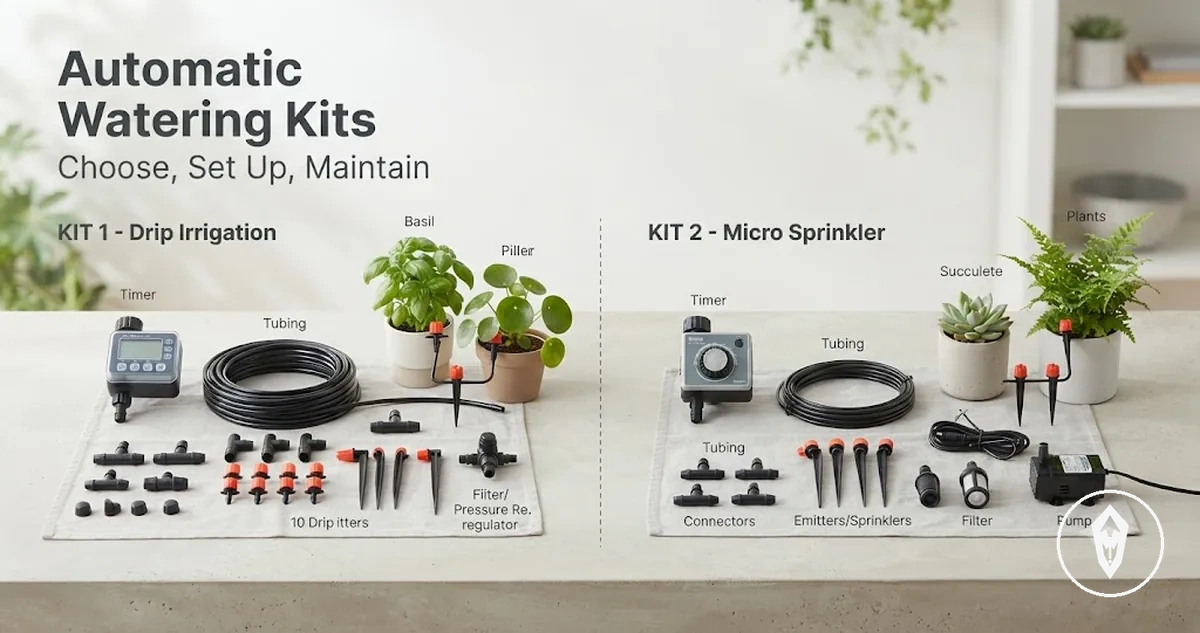
Automatic Watering Kits for Plant Watering Decisions
Automatic watering kits are complete plant watering systems that combine control and water-delivery components to automate watering across selected plants. Suitability is conditional on plant type, container layout, water source, timer control, tubing coverage, and the maintenance needed to keep water flowing consistently, so this page supports criteria-led evaluation rather than product ranking.
Automatic watering kits are complete plant watering systems that combine control and water-delivery components to automate watering across selected plants.
Automation is commonly considered for indoor or outdoor pots and containers that need a repeatable watering schedule, particularly when manual watering is difficult to maintain. An automatic plant watering kit is a suitable option when the water source provides stable flow, the tubing reaches every intended container, and the emitters can be positioned for the plants being watered.
The main selection criteria are system fit, control, coverage, setup, and maintenance.
The main selection criteria are system fit, control, coverage, setup, and maintenance. A suitable watering kit includes a timer or comparable control method for the intended schedule, tubing and connectors that cover the planned layout, and emitters or drip outlets assigned to the target pots. Reliability is more likely when connections remain secure, water delivery reaches each container, and maintenance points stay accessible, which makes understanding the basic system layout the next practical step.
Treat those single items as accessories or alternatives unless they are combined into a compatible automatic watering system.
A complete automatic watering kit combines the components needed to control and distribute water, while an isolated timer, a self-watering pot, or loose irrigation parts perform only part of that function. Treat those single items as accessories or alternatives unless they are combined into a compatible automatic watering system.
Table of Contents
What automatic watering kits include as complete watering systems
An automatic watering kit is a complete watering system that combines water delivery parts with control parts to water plants with less manual intervention. It groups the components needed to move, regulate, and deliver water as one connected system rather than relying on isolated accessories. A complete watering system is distinct from a single timer, hose, or separate irrigation fitting because those individual parts do not provide the full watering function on their own.
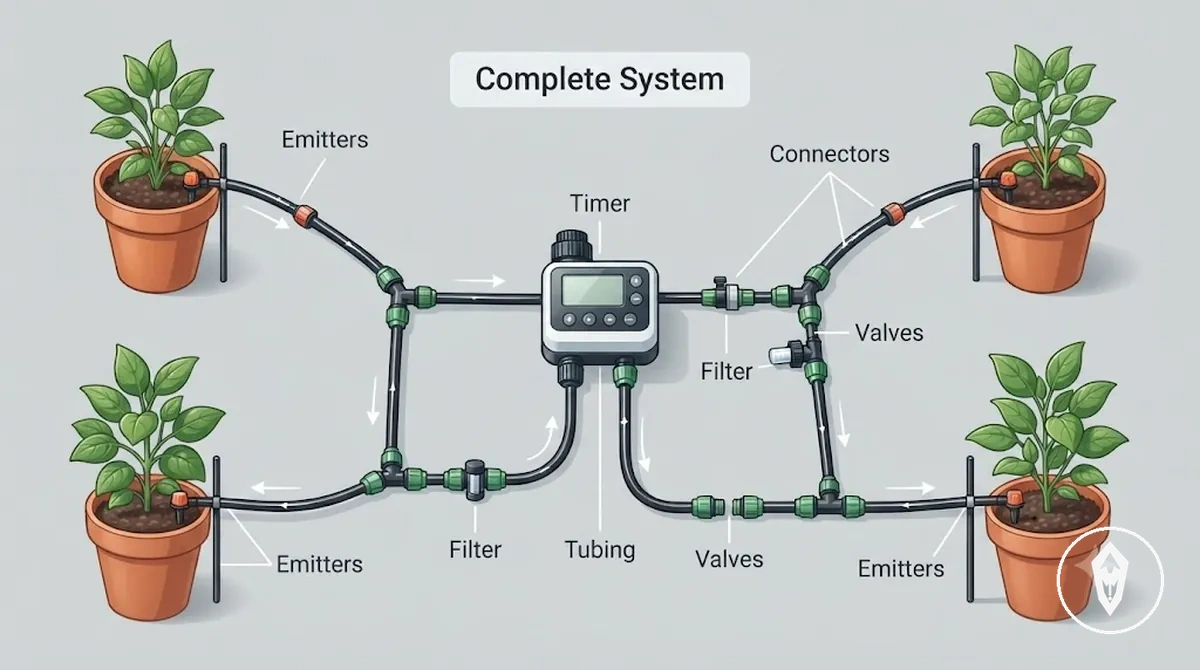
The automatic watering kit basics normally include the components that manage scheduling, water flow, distribution, and delivery. The list below groups the included parts by their primary role within a complete watering system so it is easier to understand how they contribute to coverage, control, and reliability.
- Timer: controls when watering starts and stops according to the selected schedule.
- Tubing: carries water from the water source through the planned watering route.
- Emitters: deliver water to individual plants, pots, or containers at the intended outlet points.
- Connectors and fittings: join tubing sections, branches, and accessories into a continuous water path.
- Valves: regulate, isolate, or open water flow within part of the system.
- Filter: reduces debris entering the tubing and emitters, helping maintain more consistent water delivery.
- Stakes: secure tubing or emitters in position to maintain planned plant coverage.
A complete watering kit is defined by how its parts work together rather than by the presence of a single component. Individual timers, hoses, valves, or fittings remain separate irrigation parts unless they are combined into a connected automatic plant watering system that provides both water delivery and control.
Kit types and watering delivery methods
Kit types mainly change how water is delivered to plants and how watering is controlled. Different watering delivery methods influence water placement, coverage pattern, pressure requirements, and plant suitability, making the delivery format an important selection criterion. The most suitable kit type becomes clearer after considering the planting layout and available water source.
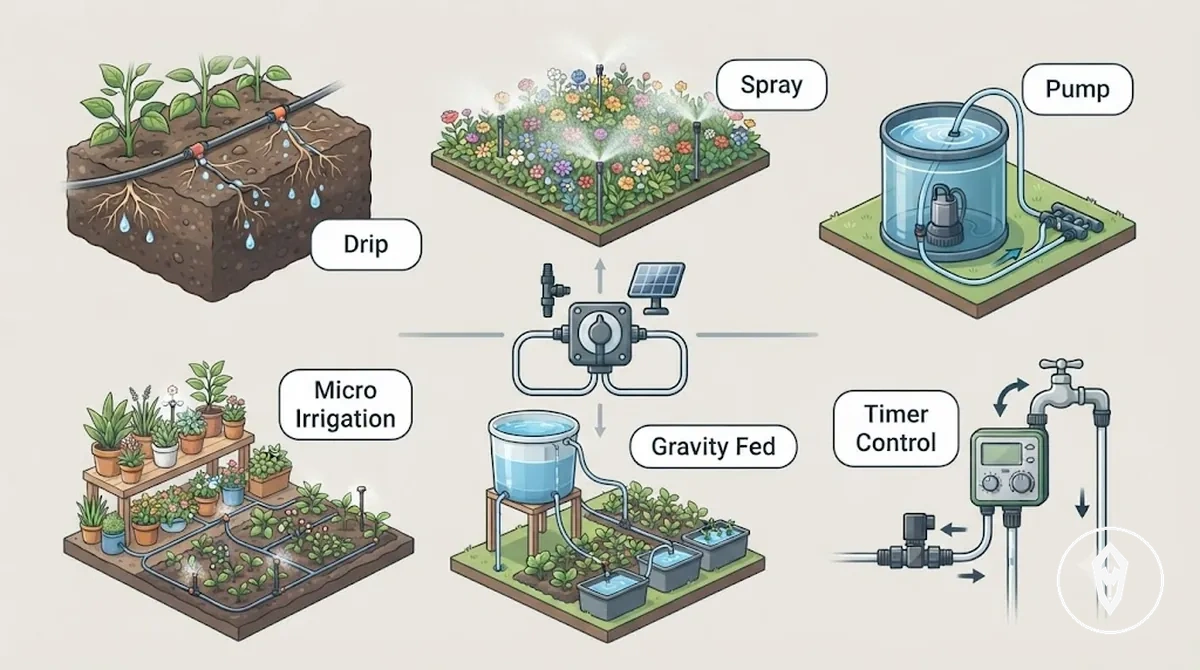
A garden with closely spaced containers or planting rows often suits a drip or micro-irrigation kit because these watering delivery methods place water close to the root zone through emitters with low splash. Larger planted areas that benefit from wider coverage commonly use spray nozzles, while pump systems draw water from a reservoir for locations without a pressurised tap. Timer-controlled kits automate watering schedules for a compatible water source, and gravity-fed kits rely on an elevated reservoir instead of powered pumping. The comparison below highlights how each broad kit format differs by delivery method, control style, and practical use.
A kit type alone does not determine whether it matches a particular watering requirement.
A kit type alone does not determine whether it matches a particular watering requirement. Delivery method, available pressure, water source, and plant suitability together provide a more reliable basis for choosing an automatic watering kit than the product category alone.
The comparison below summarises how common watering delivery methods differ by control requirements, suitable applications, and typical limitations.
The comparison below summarises how common watering delivery methods differ by control requirements, suitable applications, and typical limitations.
| Type | Delivery method | Control need | Best-fit situation | Common limitation |
|---|---|---|---|---|
| Drip | Root-zone emitters | Optional timer | Targeted watering with low splash | Limited broad-area coverage |
| Spray | Spray nozzles | Optional timer | Wider plant coverage | Requires adequate water pressure |
| Pump | Reservoir-fed pumping | Power supply | Indoor plants or water storage systems | Requires power and reservoir capacity |
| Timer-controlled | Scheduled water delivery | Built-in or connected timer | Routine automatic watering | Needs a compatible water source |
| Gravity-fed | Elevated reservoir flow | Reservoir height | Areas without powered pumping | Lower flow than pressurised systems |
| Micro-irrigation | Small-scale emitters or micro-sprays | Compatible control system | Precise watering for mixed planting layouts | Requires careful layout planning |
Drip, spray, pump, timer-controlled, and gravity-fed formats
Drip, spray, pump, timer-controlled, and gravity-fed formats change how water is delivered and controlled rather than guaranteeing better watering results. The key comparison points are water delivery, control requirement, pressure or reservoir dependence, best-fit setting, and the limitation to check before choosing a format.
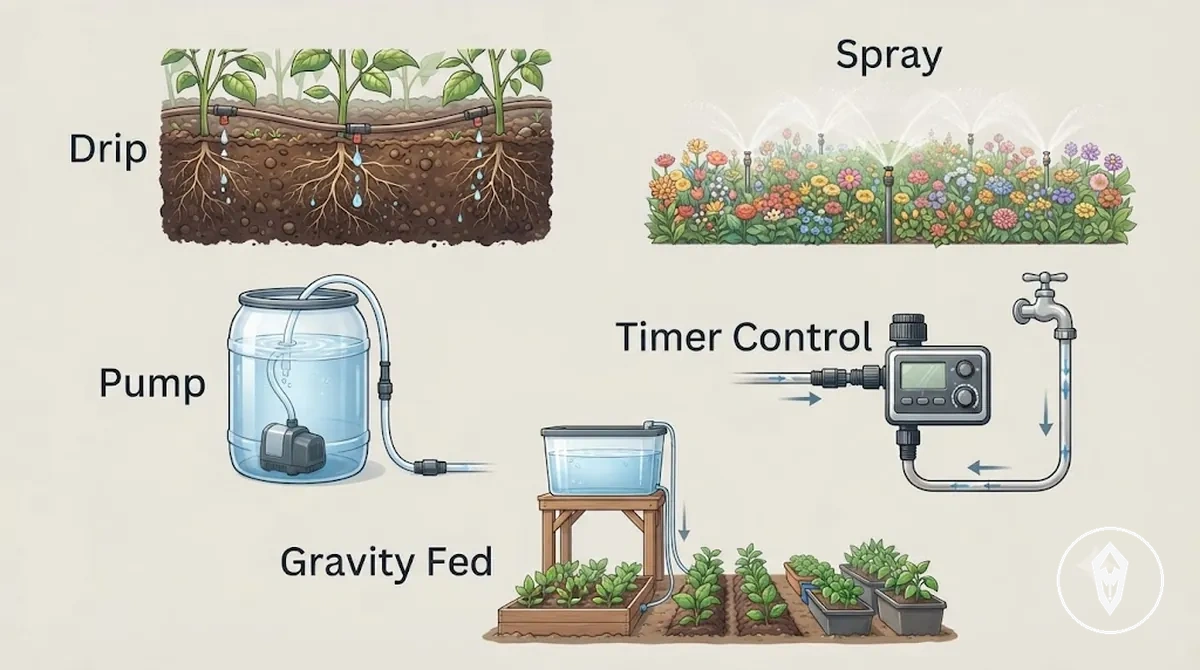
A drip format uses emitters to deliver water directly to the root zone, making it suitable for precise watering, while a spray format uses nozzles to cover a wider area when sufficient pressure is available. A pump format draws water from a reservoir with a power supply, whereas a gravity-fed format relies on an elevated container to create low-pressure flow. A timer-controlled format automates watering schedules for a compatible system. For a more detailed comparison of drip and spray watering kits, compare the delivery pattern, control requirement, and planting layout before selecting a format.
A timer-controlled format automates watering schedules for a compatible system.
The comparison below summarises how each watering format differs across the same practical selection criteria.
| Format | How water is delivered | Control dependency | Best-fit setting | Limitation to check |
|---|---|---|---|---|
| Drip format | Emitters supply water to the root zone | Manual or timer control | Pots, garden beds, and planting rows | Limited wide-area coverage |
| Spray format | Nozzles distribute water over a broader area | Manual or timer control | Open planting areas needing wider coverage | Requires adequate pressure and can produce overspray |
| Pump format | Pumps water from a reservoir | Power supply required | Indoor plants or locations without a pressurised tap | Requires power and reservoir capacity |
| Timer-controlled format | Automates scheduled water delivery | Timer required | Regular watering routines | Requires a compatible water source |
| Gravity-fed format | Water flows from an elevated reservoir | Reservoir height creates flow | Simple setups without powered pumping | Lower pressure than pressurised systems |
Components that change watering coverage and control
Components change watering coverage and control through water placement, flow, and adjustment rather than by acting independently. Tubing, emitters, connectors, valves, a timer, and a filter each influence how consistently water moves through the system and where it is delivered. Together, these components connect each part with a specific operating condition and its effect on watering coverage, flow, pressure, control, or reliability.
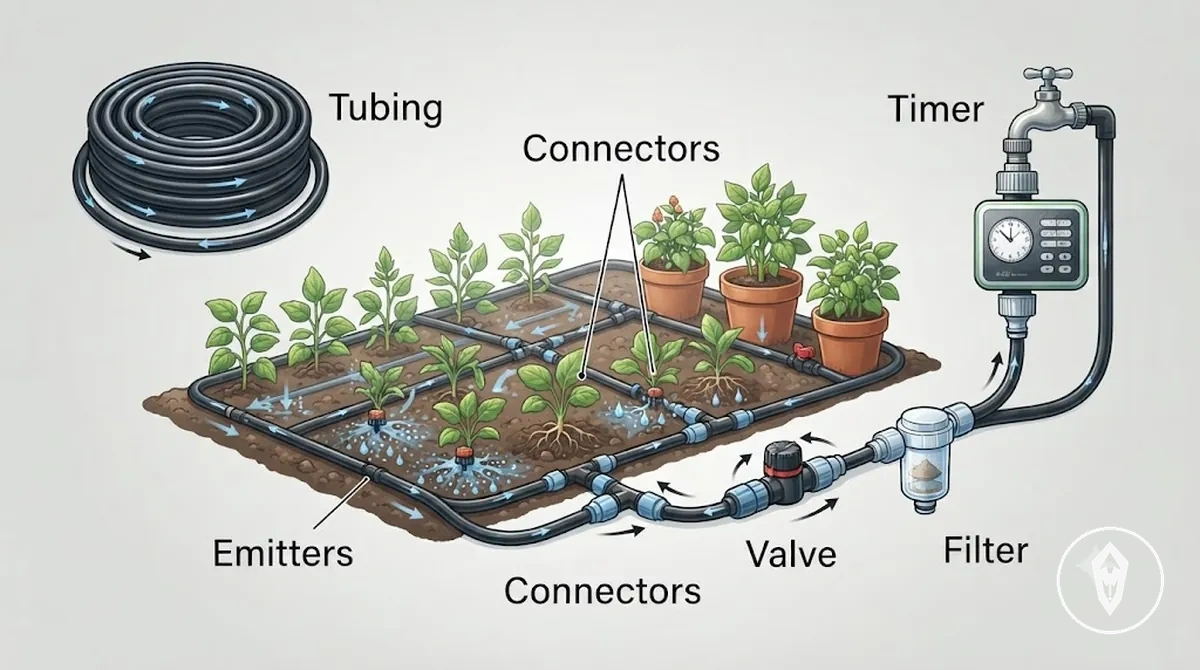
Each component has a distinct function within the watering system. Tubing carries water, so its length and diameter affect flow and available pressure across the layout. Emitters control water output and placement near plant roots, while connectors join compatible tubing sections to support the intended layout and reduce the likelihood of leaks. Valves regulate flow, timers provide scheduled control, and filters help reduce debris reaching emitters, supporting more consistent reliability. The table below compares these component attributes and their effect on watering coverage and control.
Each component has a distinct function within the watering system.
Missing or mismatched components can reduce system reliability even when the remaining watering components are installed correctly. For example, incompatible connectors can increase the likelihood of leaks, while unsuitable tubing, blocked filters, or clogged emitters can reduce flow or create uneven watering coverage. Checking which component no longer matches the system layout is usually more useful than assuming the entire kit is unsuitable.
Checking which component no longer matches the system layout is usually more useful than assuming the entire kit is unsuitable.
The comparison below shows how common automatic watering kit components affect where water goes, how much is released, and how consistently the system operates.
| Component | Attribute to check | Condition or value | Effect on coverage or control |
|---|---|---|---|
| Timer | Schedule control | Compatible watering schedule | Supports consistent watering control |
| Tubing | Length and diameter | Matched to the watering layout | Maintains suitable flow and pressure |
| Emitters | Output and placement | Positioned near plant roots | Determines watering coverage |
| Connectors | Fit | Compatible with connected tubing | Supports layout reliability and helps reduce leaks |
| Valves | Flow regulation | Adjusted to open or restrict water flow | Controls water distribution |
| Filter | Debris removal | Clean filter element | Helps maintain emitter flow and overall reliability |
Tubing, emitters, connectors, valves, timers, and filters
Tubing, emitters, connectors, valves, timers, and filters are local component classes that manage the water path, release point, adjustment, scheduling, and filtration within an automatic watering kit. Each part performs a distinct role that influences how water travels through the system and reaches plants. Together, they support water path, water release, control, and protection functions.
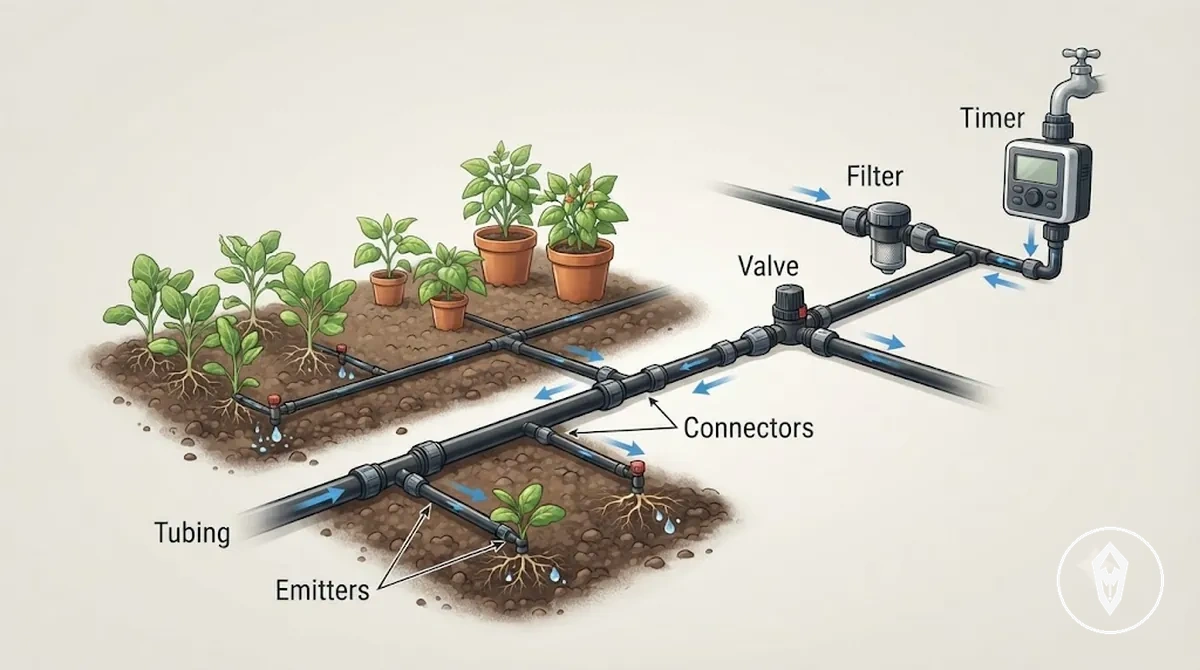
These parts directly affect watering output by influencing flow direction, release location, scheduling, and water cleanliness. For example, placing an emitter closer to a plant root concentrates water at that release point rather than distributing it across a wider area. Reviewing the following component attributes helps compare watering components for a specific layout and watering requirement.
- Tubing: Check length and diameter to confirm the water path supports the planned routing and maintains suitable flow and pressure.
- Emitters: Check output and placement so the release point matches the intended watering coverage.
- Connectors: Check fit to support a secure seal, maintain the layout, and reduce leak risk.
- Valves: Check adjustment to regulate or restrict water flow where greater control is required.
- Timers: Check programmability so watering schedules match the intended watering interval.
- Filters: Check filtration condition to help reduce debris reaching emitters and maintain consistent water flow.
- Water path: Check that all connected components create a continuous route from the water source to each release point.
Matching kits to plants, pots, and locations
Matching kits to plants, pots, and locations is most effective when the watering system aligns with plant water needs, container characteristics, and growing location conditions. Compatibility is determined by plant layout, container type, water access, exposure, and control requirements rather than by a universal kit. A kit is more suitable when these conditions match its intended watering method and layout.
A kit is more suitable when these conditions match its intended watering method and layout.
Indoor setups often benefit from controlled watering where water access, leakage risk, timer protection, or a reservoir are considered before installation. Outdoor setups may require layouts that account for weather exposure, available water pressure, and longer tubing routes. Balcony containers and hanging baskets usually require careful tubing routing and emitter placement because growing space is limited. Garden beds often benefit from layouts that distribute water across multiple planting positions, making plant spacing, exposure, and water access key compatibility factors.
Container layout also affects tubing routing and overall setup fit.
Compatibility is easier to evaluate by comparing the watering system with the plants and containers instead of focusing on product type alone. Plants with different water needs may require different emitter output or watering schedules, while pot size, soil, and drainage influence water retention and runoff. Container layout also affects tubing routing and overall setup fit. Review the checklist below to verify the most important compatibility conditions before choosing a kit.
No single watering kit is suitable for every growing location or planting arrangement.
No single watering kit is suitable for every growing location or planting arrangement. Checking each compatibility condition helps reduce the likelihood of selecting a setup that does not match the intended watering pattern without promising exact suitability.
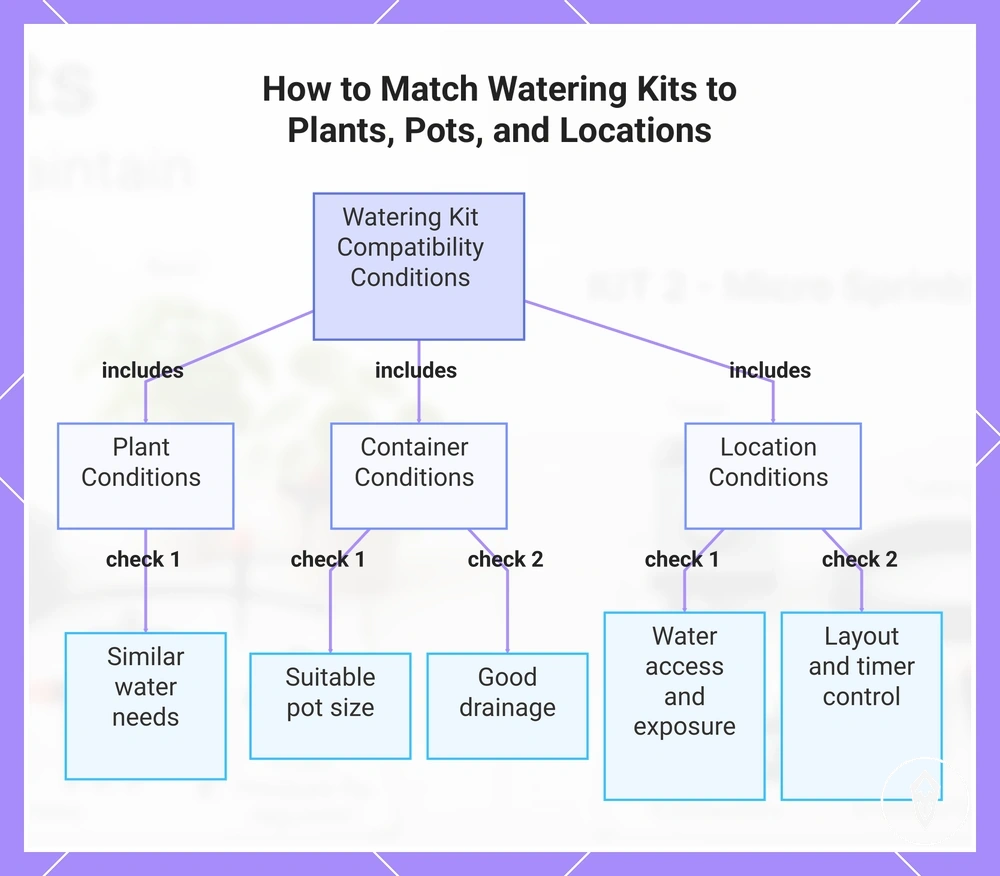
Use the following checklist to compare your growing conditions before making a selection, then match a kit to your setup using the relevant compatibility criteria.
Use the following checklist to compare your growing conditions before making a selection, then match a kit to your setup using the relevant compatibility criteria.
- Check whether plants have similar water needs so they can share the same watering schedule.
- Confirm pot or container size provides enough space for suitable emitter placement and tubing routing.
- Check that drainage allows excess water to leave containers and reduces runoff around plant roots.
- Confirm available water access matches the intended water source or reservoir arrangement.
- Assess indoor or outdoor exposure, including sunlight, weather, and environmental conditions where applicable.
- Check balcony, hanging basket, or garden-bed layout to ensure tubing can reach each planting position.
- Confirm timer and control features support the preferred watering interval for the growing location.
This chart shows the main compatibility conditions to check when selecting a watering kit for your plants, containers, and growing location.
Indoor pots, hanging baskets, balconies, garden beds, and outdoor containers
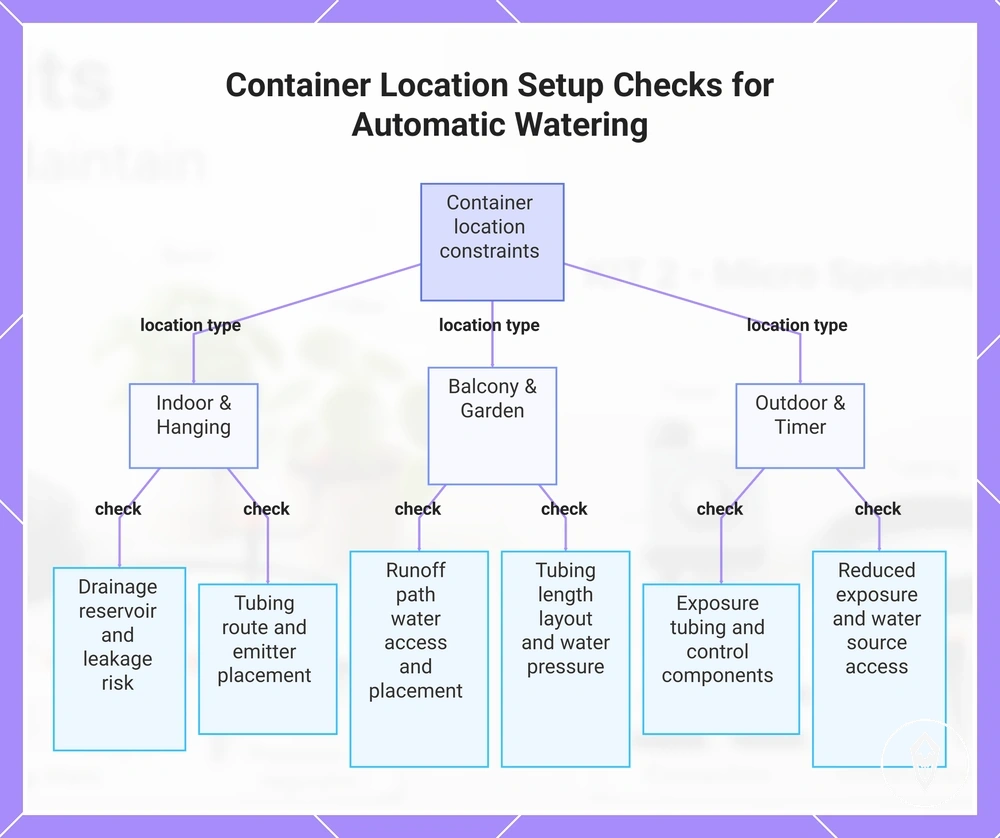
Indoor pots, hanging baskets, balconies, garden beds, and outdoor containers each create different conditions for water access, runoff, exposure, tubing route, and timer protection. Indoor setups place greater emphasis on managing leakage and reservoir placement, while elevated or exposed locations require closer attention to drainage, routing, and component placement. Each location should therefore be assessed against its own setup conditions before automation.
Each location should therefore be assessed against its own setup conditions before automation.
The local rule is to match the watering arrangement to the constraint created by the container setting. A setup is more suitable when water reaches every planting position, runoff is managed through available drainage, the tubing route remains practical, and timer protection matches the level of exposure. Locations with uncertain runoff, leakage, water access, or exposure require additional setup checks before using automatic watering.
- Indoor pots: Verify that drainage manages excess water, a reservoir or water source is accessible, and leakage risk is acceptable for the surrounding area.
- Hanging baskets: Check that the tubing route reaches the basket height and that emitter placement directs water into the growing medium.
- Balconies: Confirm that runoff has an appropriate drainage path, water access is practical, and container placement supports the planned tubing route.
- Garden beds: Check that tubing length and layout provide suitable coverage for the planting area and match the available water pressure.
- Outdoor containers: Verify that exposure allows suitable placement of tubing and control components for the intended outdoor setup.
- Timer protection: Position the timer where exposure is reduced while maintaining access to the selected water source.
This chart shows the key setup checks for each container location type when planning automatic watering.
Capacity, flow, pressure, and watering schedule criteria
Capacity, flow, pressure, and watering schedule must work together for a kit to deliver water consistently across the intended plant group. A suitable setup depends on whether the system can support the required plant count, tubing length, emitter output, and schedule control under the available water conditions. These criteria help evaluate coverage consistency and reduce the risk of uneven watering.
These criteria help evaluate coverage consistency and reduce the risk of uneven watering.
Plant count and tubing length influence the amount of coverage a setup requires because more watering points or longer routes change how water is distributed. Flow and pressure are affected by the water source, tubing layout, and kit design, while emitter output determines how water is released at each plant location. Timer range and watering schedule control when water is delivered, connecting capacity and control into one evaluation process.
Each criterion links a setup condition to a watering effect.
Each criterion links a setup condition to a watering effect. Plant count identifies the number of watering points needed, tubing length affects the route water must travel, flow and pressure influence distribution, emitter output affects local release, and timer scheduling affects watering consistency over time. The table below organises these criteria by the condition to check, the effect on watering, and the decision signal.
The table below organises these criteria by the condition to check, the effect on watering, and the decision signal.
Minimum requirements focus on suitable coverage, compatible flow, appropriate pressure conditions, and usable schedule control for the intended setup. Preference-based features may provide more adjustment options when plant needs, soil conditions, kit design, or watering routines change, but they do not replace the need for a suitable base setup.
| Criterion | Condition to check | Effect on watering | Decision signal |
|---|---|---|---|
| Plant count | Number of plants and watering points | Determines required coverage and emitter distribution | Choose capacity that matches the intended plant group |
| Tubing length | Distance and route between water source and plants | Influences water flow through the layout | Longer routes require suitable tubing and flow conditions |
| Flow rate | Available water flow from the source and system design | Affects how consistently water reaches outlets | Match water flow capability to the planned coverage |
| Pressure range | Available pressure and watering format requirements | Influences distribution and emitter performance | Check that pressure conditions support the setup |
| Emitter output | Release output and placement near plants | Controls water delivery at each location | Adjust output based on plant needs and coverage goals |
| Timer schedule | Timer range, watering frequency, and schedule control | Controls when water is delivered and helps manage consistency | Select schedule options that match the watering routine |
Plant count, tubing run, emitter output, and timer range
Plant count, tubing run, emitter output, and timer range must be checked together because each variable affects how a watering kit distributes and controls water. The number of plants, tubing distance, outlet count, release output, and schedule options can change whether a setup matches the intended coverage needs. These criteria work as connected conditions rather than separate checks.
These criteria work as connected conditions rather than separate checks.
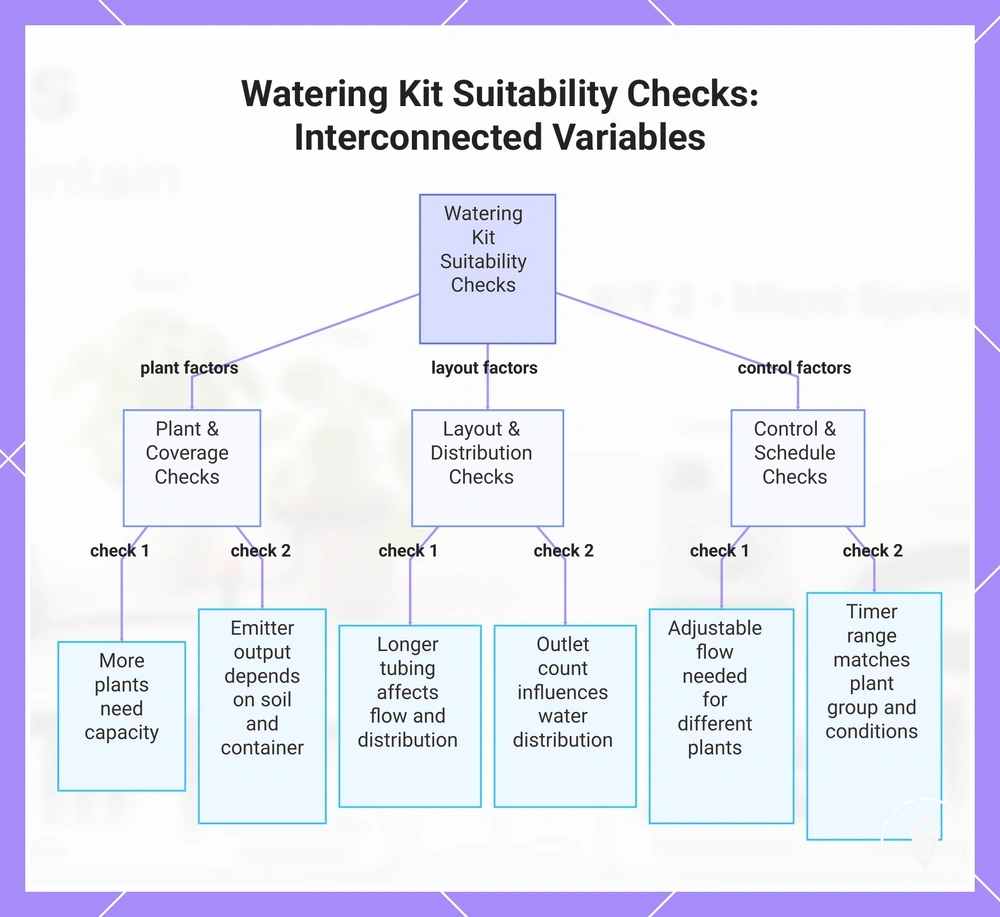
A larger container group may require more outlets and suitable emitter output when compared with a smaller setup, while a longer tubing run may require closer attention to water source conditions and flow. Soil, container size, plant needs, and kit design can change the preferred run time and watering frequency. The required settings therefore depend on the relationship between these variables rather than a fixed rule.
Use the following local checks to compare how each criterion can influence kit suitability.
Use the following local checks to compare how each criterion can influence kit suitability.
- Plant count: Check the number of plants because more watering points can require greater outlet capacity and suitable emitter coverage.
- Tubing run: Check the tubing distance from the water source because longer routes can affect flow conditions and water distribution across the layout.
- Emitter output: Check the release output and placement because plant needs, soil conditions, and container size can change the preferred watering delivery.
- Outlet count: Check the available outlets because the number of watering points influences how the system distributes water.
- Adjustable flow: Check flow adjustment options because different plants and containers may require different water delivery levels.
- Timer range: Check available run time and watering frequency because schedule control should match the plant group, growing conditions, and kit design.
This chart groups the key checks for watering kit suitability into plant, layout, and control factors, showing how each variable influences coverage.
Choosing a kit without relying only on product claims
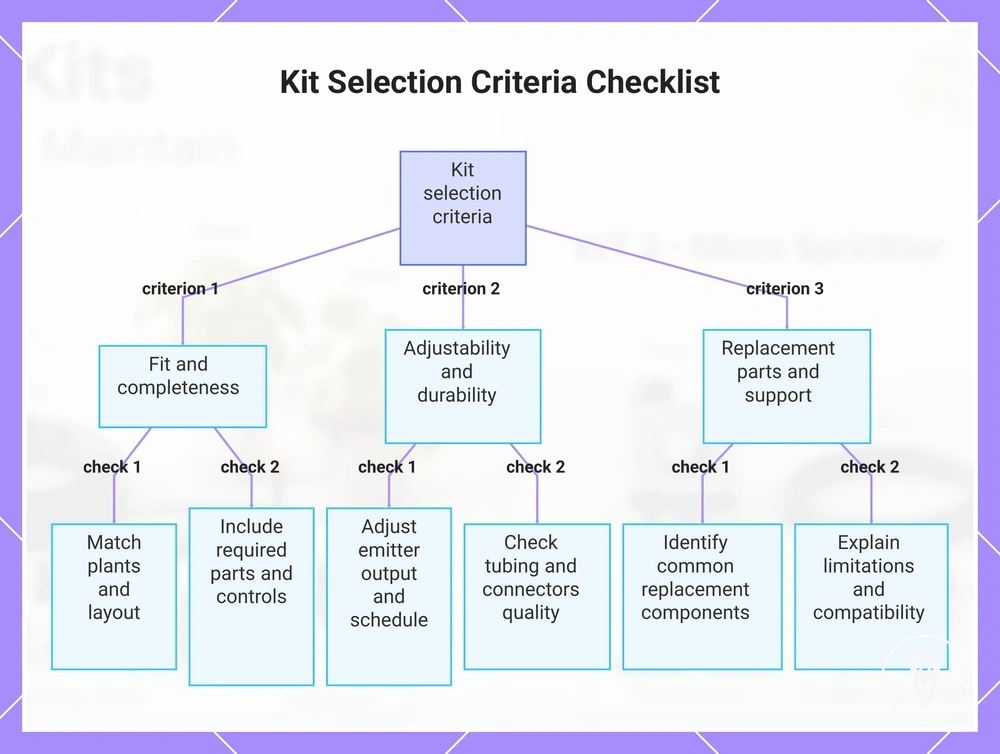
Choosing a kit requires checking product claims against practical criteria rather than relying on general descriptions alone. A useful feature is one where the condition behind the claim, the function it provides, and the effect on the watering setup are clear. The decision frame is fit, completeness, adjustability, durability, replacement parts, and support.
The decision frame is fit, completeness, adjustability, durability, replacement parts, and support.
Generic claims such as “best” or “complete” do not show whether a kit matches a specific watering setup. A complete-looking kit may still need evaluation of parts, connectors, timer control, and adjustment options before comparison. Stronger product claims provide clear feature conditions and explain why those conditions matter for the decision.
Kit features should be reviewed through feature → quality condition → decision effect relationships.
Kit features should be reviewed through feature → quality condition → decision effect relationships. Adjustability is useful when emitter output, flow, or schedule control can match changing plant requirements, while durability considerations relate to tubing, connectors, filters, and replacement parts. The following checklist highlights decision signals that separate useful claims from weak or incomplete descriptions.
The automatic watering kit selection checklist can help organise these criteria before any external price check.
Before comparing options, check whether each claim explains the condition behind the feature and whether it supports the intended setup. The automatic watering kit selection checklist can help organise these criteria before any external price check.
- Fit: Check whether the kit features match the plants, containers, water access, and layout conditions being considered.
- Completeness: Check whether required parts, connectors, timer controls, and related components are included or require separate consideration.
- Adjustability: Check whether emitter output, flow, and schedule settings can be adjusted for different plant needs.
- Durability: Check information about tubing, connectors, filters, and other components that affect long-term use.
- Replacement parts: Check whether commonly used components are identified for future changes or maintenance needs.
- Support: Check whether product information explains limitations, conditions, and compatibility factors instead of only listing features.
A criteria-led choice focuses on whether a kit meets the intended requirements rather than whether a claim sounds attractive. Reviewing the best automatic watering kit criteria helps compare decision signals without treating one claim as universal proof of suitability.
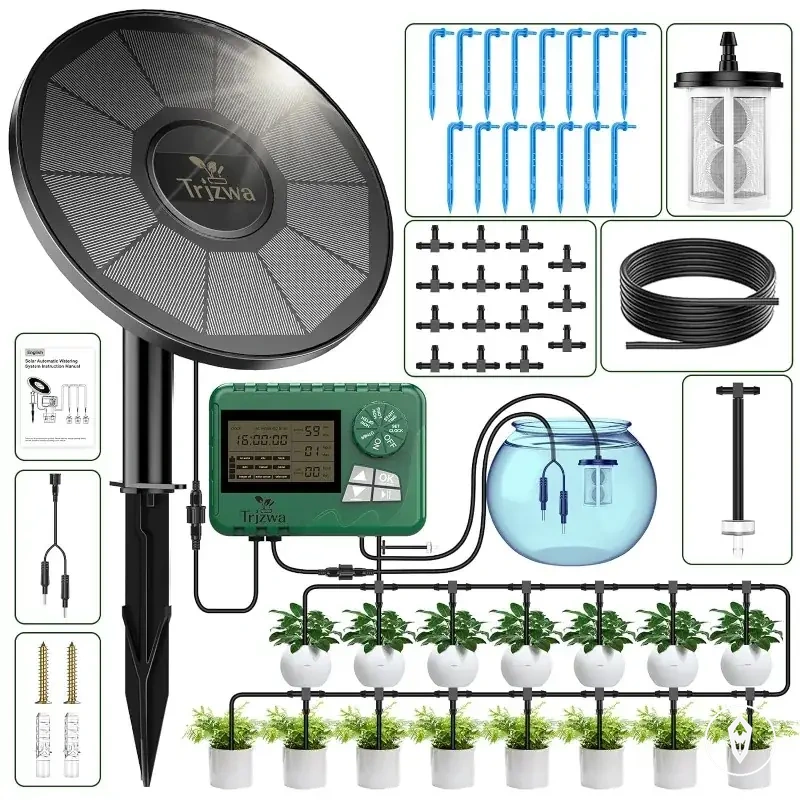
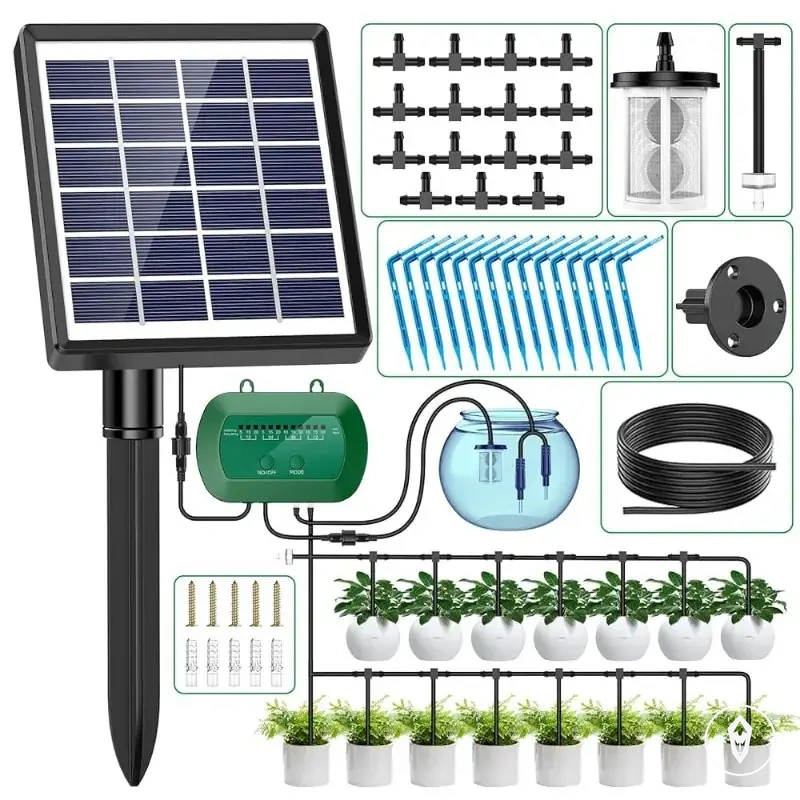
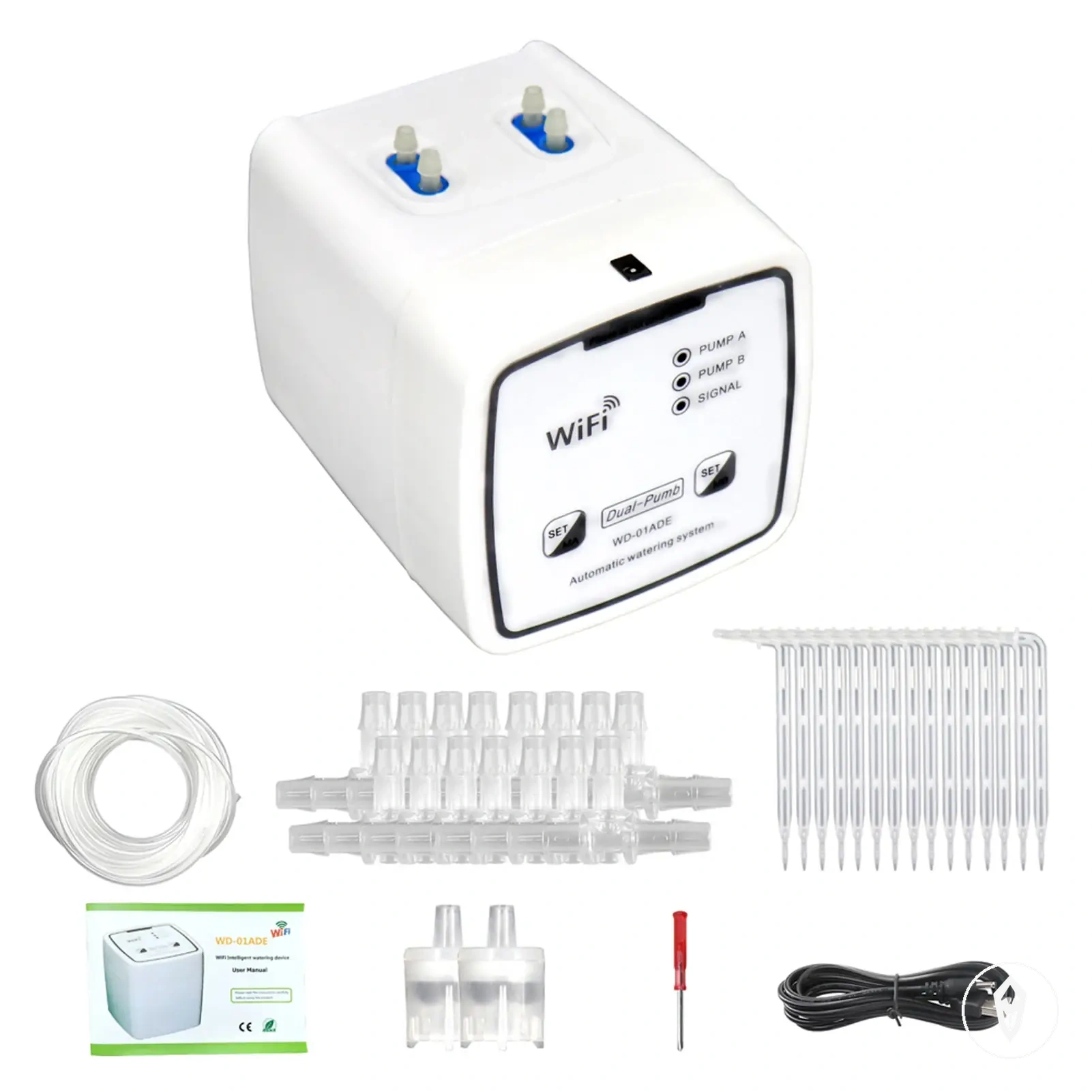
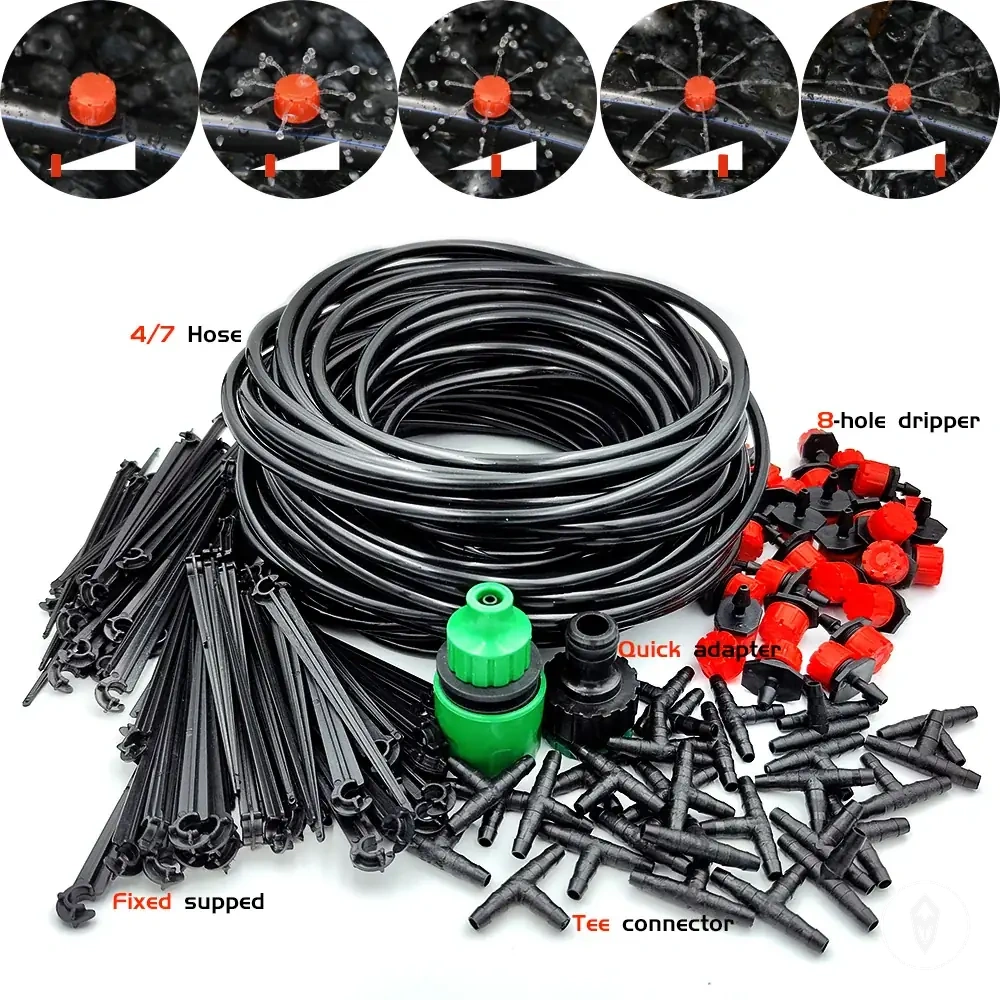
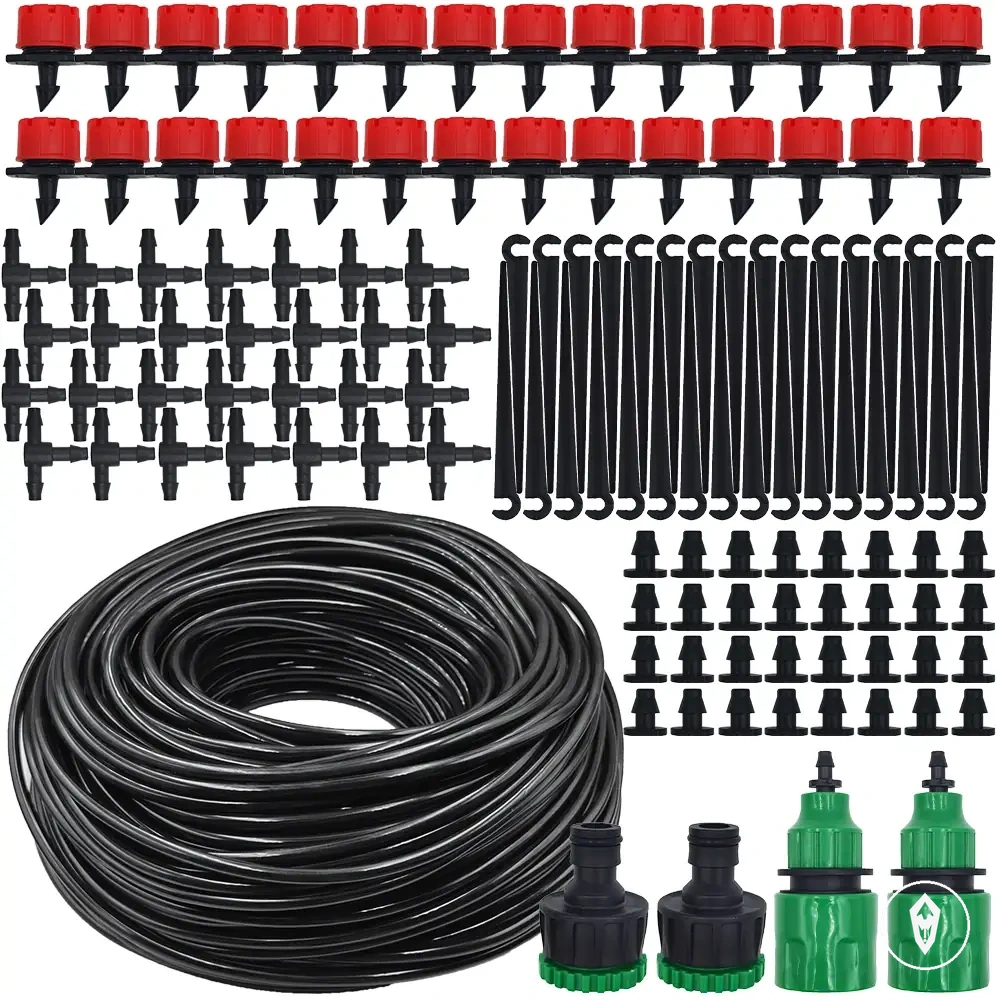
Here are product examples that may make comparison easier.
Here are product examples that may make comparison easier. Before buying, always review the compatibility criteria, essential features, and product details.
This chart shows the key criteria to evaluate when choosing a kit, focusing on practical checks rather than generic product claims.
Completeness, adjustability, durability, and replacement-part availability
Completeness, adjustability, durability, and replacement-part availability are quality checks that help qualify product claims before comparing kit options. Each check connects an attribute to a condition and the decision effect it creates, helping assess whether a feature supports the intended setup. These checks improve decision confidence by showing what evidence supports a claim.
The table below summarises these local quality checks.
A strong claim explains how a feature works and when it is useful, while a weak claim only lists features without describing the conditions behind them. Completeness, material, connector security, filter access, support, and part availability should be evaluated against the intended setup because different conditions can change the value of each feature. The table below summarises these local quality checks.
| Check | What to look for | Why it matters | Risk if missing |
|---|---|---|---|
| Completeness | Included timer, tubing, connectors, emitters, and related components | Shows whether the kit contains the parts needed for the intended setup | Additional components may need separate evaluation |
| Adjustability | Control over flow, emitter output, and watering schedule | Helps match water delivery to plant fit and changing requirements | Less flexibility when setup conditions change |
| Durability | Material suitability, connector security, and exposure conditions | Helps compare how components align with the intended environment | Component suitability may be unclear for the use case |
| Connector security | Connection fit and stability within the tubing layout | Supports reliable routing of water through connected parts | Water routing issues may occur if connections are unsuitable |
| Filter access | Accessibility of the filter component for ongoing checks | Supports practical filtration maintenance | Filter management may become more difficult |
| Replacement-part availability | Availability of compatible tubing, fittings, filters, and related parts | Supports future changes and maintenance decisions | Future adjustments may require broader kit comparison |
Setup requirements before the kit can work reliably
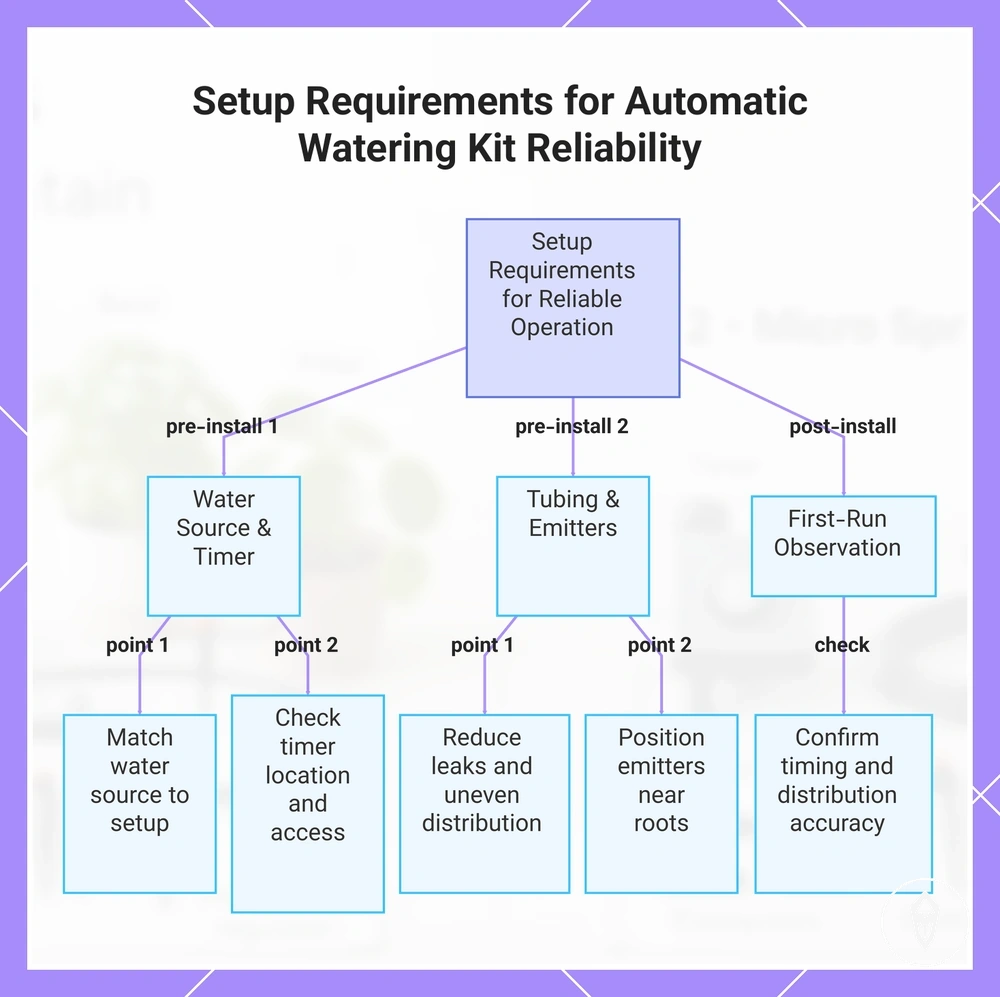
Reliable operation depends on setup requirements being suitable before an automatic watering kit is used with reduced manual attention. The water source, timer position, tubing route, and emitter placement must work together so the system can deliver water as intended. These conditions should be checked first because setup differences can affect leaks, uneven watering, and timing accuracy.
The following pre-install checks organise the main setup conditions that influence reliable operation.
The water source affects available flow and connection conditions, while timer position affects access and schedule control. A suitable tubing route considers bends, length, and connectors, and emitter placement helps direct water toward the intended plant roots and containers. The following pre-install checks organise the main setup conditions that influence reliable operation.
This check helps identify adjustments without replacing it with a full installation walkthrough.
A first-run observation helps identify whether water reaches the intended locations and whether the watering schedule matches the setup before unattended use. For example, a new container arrangement may need observation during the first test run to confirm emitter placement, flow distribution, and timing accuracy. This check helps identify adjustments without replacing it with a full installation walkthrough.
These overview checks do not replace detailed installation guidance because each kit and layout can require different setup conditions.
These overview checks do not replace detailed installation guidance because each kit and layout can require different setup conditions. Review the automatic watering kit installation guide for deeper installation information after the basic readiness conditions have been assessed.
Before use, review these setup requirements to confirm the conditions that support reliable operation.
Before use, review these setup requirements to confirm the conditions that support reliable operation.
- Water source: Check that the water source, connection, and available flow conditions match the intended watering setup.
- Timer position: Check that the timer location allows schedule adjustments and remains suitable for the intended placement.
- Tubing route: Check tubing bends, length, and connectors to reduce the likelihood of leaks or uneven water distribution.
- Emitter placement: Check that emitters are positioned near the intended plant roots and container areas for suitable water delivery.
- First-run observation: Check the initial cycle to confirm timing accuracy, watering distribution, and whether adjustments are needed before unattended use.
This chart shows the key setup checks that must be verified before using an automatic watering kit with reduced manual attention.
Water source, timer placement, tubing layout, and first-run checks
Water source, timer placement, tubing layout, and first-run checks verify the supply, control, routing, and output conditions needed before an automatic watering kit is used. These physical checks help identify setup conditions that can influence leaks, uneven watering, and timing accuracy. Review each condition before regular operation when the setup requirements have been confirmed.
Review each condition before regular operation when the setup requirements have been confirmed.
A first-run inspection helps reveal whether water reaches the intended locations and whether the setup behaves as expected before unattended use. For example, a new pot layout may need a first test run to observe emitter placement, connector seating, and water distribution. The outcome can change with factors such as pressure, pot layout, kit design, and outdoor exposure.
The outcome can change with factors such as pressure, pot layout, kit design, and outdoor exposure.
Use these local checks to confirm the main supply, control, routing, and output conditions before use.
- Check the water source: Confirm the water source connection and available flow conditions match the intended setup to reduce the risk of uneven water delivery.
- Check timer placement: Verify timer placement allows schedule access and suitable protection for the intended location and outdoor exposure conditions.
- Check tubing layout: Inspect tubing bends, length, and routing to reduce the risk of leaks or uneven distribution caused by unsuitable layout.
- Check emitter placement: Confirm emitter placement matches the intended plant areas and container layout so output reaches the required locations.
- Check connector seating: Verify connector seating within the tubing layout to reduce the risk of connection issues during operation.
- Complete first-run checks: Observe the first test run to confirm timing, output, and water distribution before relying on the setup with less frequent monitoring.
Maintenance and common problems that affect watering consistency
Maintenance problems that affect watering consistency usually come from parts, flow, schedule, or maintenance conditions changing over time. Leaks, clogs, uneven watering, overwatering, and timer failures can indicate that a component, setting, or connection needs review. A symptom-to-cause check helps identify the next maintenance step.
A symptom-to-cause check helps identify the next maintenance step.
Each common problem connects a part or condition to a symptom and a suitable first check. Leaks can relate to connectors, tubing, pressure conditions, or seal issues, while clogs can involve emitters, filters, debris, or reduced flow. Uneven watering can involve tubing layout, emitter output, or pressure changes, and timer failures can involve schedule settings, battery condition, water source, or control settings. The checklist below groups these recurring issues with likely conditions and next checks.
The required action depends on the symptom and the condition found during the check.
Regular maintenance can help identify recurring issues before they affect watering consistency. Checking connectors, filters, emitters, tubing, and schedules provides a way to review visible conditions and make adjustments when needed. The required action depends on the symptom and the condition found during the check.
Regular maintenance can help identify recurring issues before they affect watering consistency.
Simple maintenance actions may be enough when the cause is visible, such as a connection issue or a schedule setting that needs adjustment. When problems continue after basic checks, use automatic watering kit troubleshooting for deeper diagnostic checks and problem analysis.
| Symptom | Likely condition | First check | Prevention or next step |
|---|---|---|---|
| Leaks | Connector, tubing, pressure, or seal conditions affecting water containment | Inspect connectors, tubing joins, and visible seals | Review connection condition and routing during maintenance checks |
| Clogs | Debris affecting filters, emitters, or water flow | Check filter condition and emitter output | Maintain filtration and review changes in flow |
| Uneven watering | Changes in tubing layout, emitter output, or pressure conditions | Check water distribution, emitter placement, and tubing route | Adjust relevant settings or layout conditions when required |
| Overwatering | Watering schedule or output not matching plant requirements | Review timer schedule, run time, and plant conditions | Adjust watering settings based on the observed requirement |
| Timer failures | Schedule, battery, water source, or control conditions affecting operation | Check timer settings and available power conditions | Review timer operation and settings during maintenance |
Leaks, clogs, uneven watering, overwatering, and timer failures
Leaks, clogs, uneven watering, overwatering, and timer failures are symptoms that signal a possible condition affecting watering consistency rather than confirmed diagnoses. These symptoms can relate to connector fit, tubing, pressure or flow conditions, schedule settings, or component wear. The diagnostic table below maps each symptom to a likely attribute issue and an immediate check.
The diagnostic table below maps each symptom to a likely attribute issue and an immediate check.
Safe escalation starts with identifying the visible condition before applying further troubleshooting. A single symptom can have multiple possible causes, so the first check should clarify the most likely issue before deeper diagnosis. Troubleshooting should remain conditional because the cause depends on the specific setup, components, and operating conditions.
| Symptom | Likely attribute issue | Immediate check | What it means |
|---|---|---|---|
| Leaks | Connector fit, tubing connection, pressure condition, or seal issue | Check connector seating, tubing joins, and visible seals | May indicate a connection or routing condition affecting water containment |
| Clogs | Emitter, filter, debris, or flow condition | Check filter condition and emitter output | May indicate restricted water movement through the delivery path |
| Uneven watering | Emitter output, tubing layout, pressure loss, or distribution condition | Check emitter placement, tubing route, and water distribution | May indicate different watering conditions across the layout |
| Overwatering | Timer schedule, run time, soil moisture condition, or plant requirements | Check watering schedule and recent watering conditions | May indicate that water delivery does not match current plant needs |
| Timer failures | Battery, controller, schedule, or water source condition | Check timer settings, power condition, and water source connection | May indicate a control condition affecting watering timing |