
Automatic watering kits explained
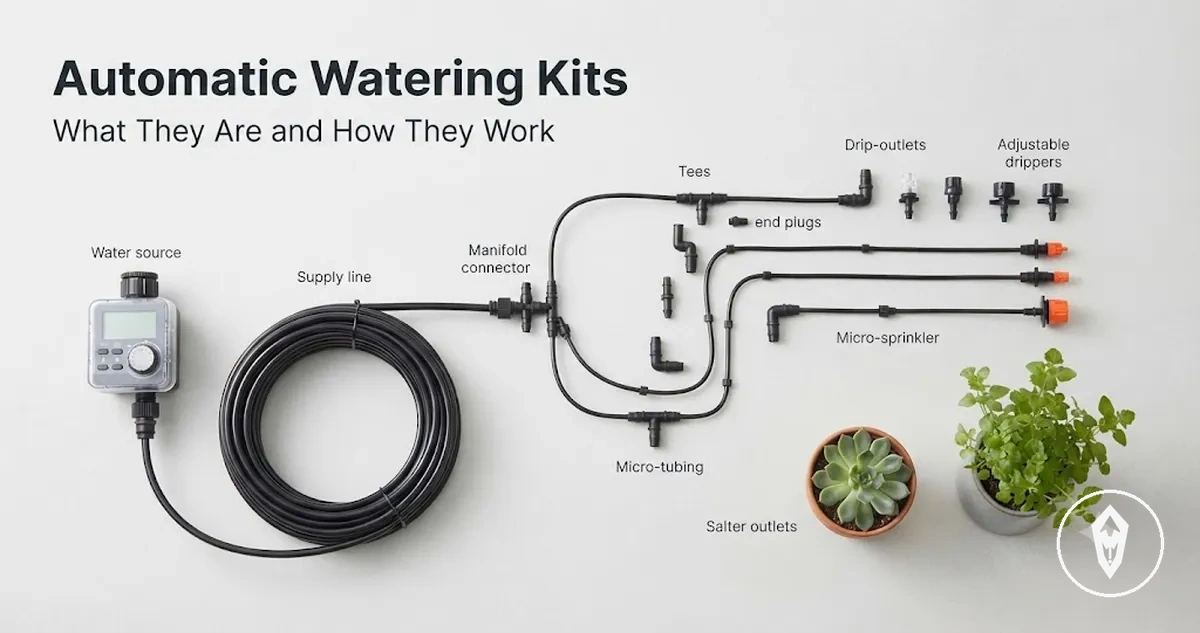
An automatic watering kit is a plant-watering setup made from connected parts that deliver water to plants through a controlled outlet path. The kit combines a water source connection, a control point such as a timer, tubing, and emitters or other outlets to support controlled plant watering. It is designed for kit-scale plant setups such as containers or small growing areas.
It is designed for kit-scale plant setups such as containers or small growing areas.
Understanding what an automatic watering kit means helps users evaluate how a watering setup fits their plant requirements before choosing, setting up, or troubleshooting a kit. The way water reaches plants depends on the kit type, water source, timer settings, tubing arrangement, pressure conditions, and emitter configuration. A drip watering kit uses drip delivery near the plant base, while other watering kit designs may use different outlet methods based on their setup conditions.
The meaning of an automatic watering kit focuses on how its parts work together, including the water source, control point, tubing path, and emitters.
The meaning of an automatic watering kit focuses on how its parts work together, including the water source, control point, tubing path, and emitters. This definition describes a connected plant-watering arrangement and keeps a clear scope boundary from larger irrigation systems that involve broader installation and coverage requirements.
Table of Contents
What an automatic watering kit is
An automatic watering kit is a grouped set of parts that delivers water to plants through controlled operation or scheduled watering. The kit connects a water source with tubing and outlets to create a path for water delivery to a plant container or growing area. A timer or control point can manage when water is released as part of the watering setup.
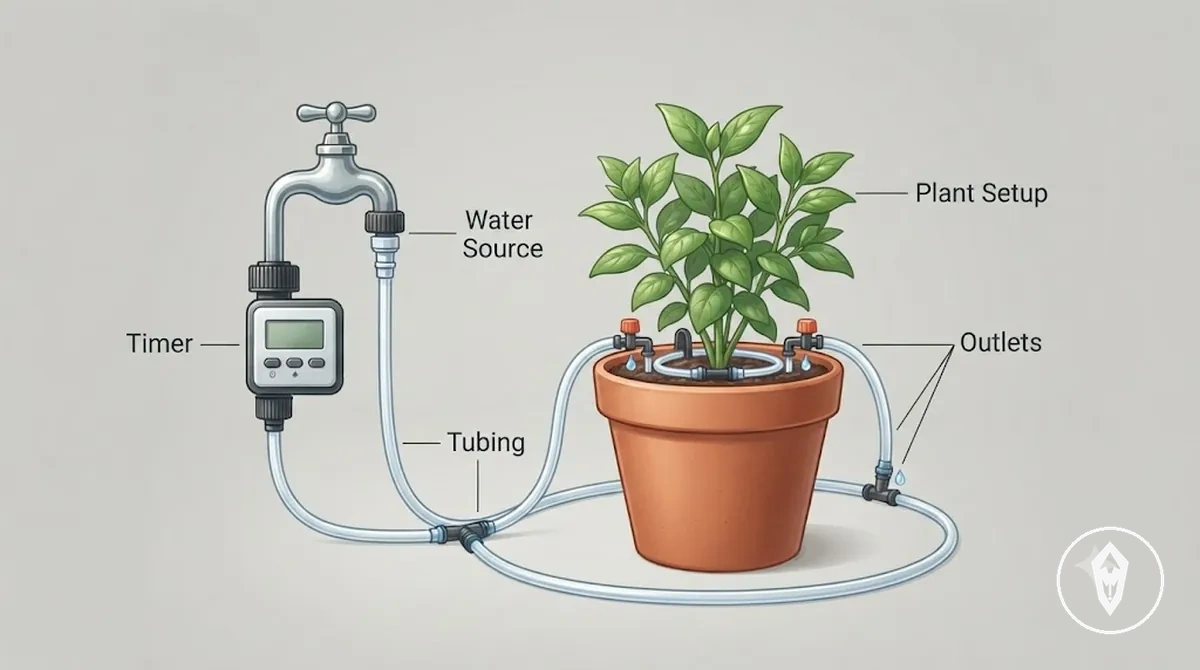
An automatic watering kit includes connected parts that work together for plant watering rather than acting as a single standalone component. The tubing creates the water path, while outlets such as emitters direct water toward the intended plant area. A drip watering kit is one example that uses drip delivery near plants, while other watering kit designs can use different outlet arrangements based on their setup. The automatic watering kits category covers these connected plant-watering setups, while larger irrigation systems may use broader layouts beyond a basic kit context.
The basic purpose of an automatic watering kit
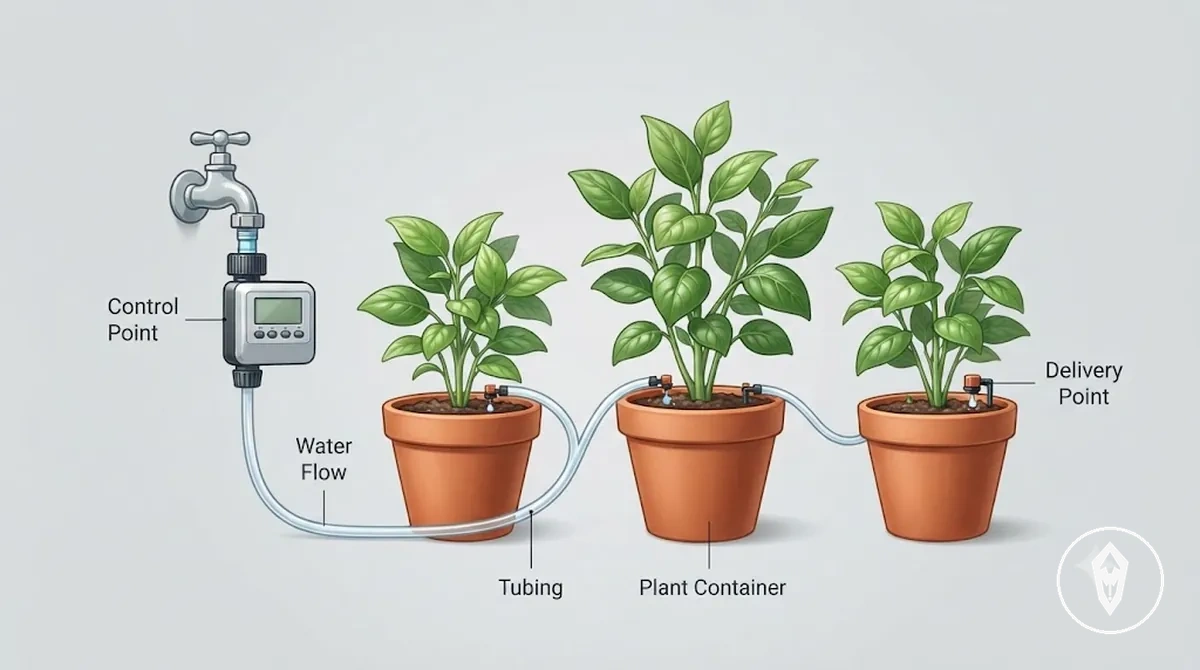
The basic purpose of an automatic watering kit is to reduce manual watering by moving controlled amounts of water to plant containers or small growing areas. The kit supports plant watering by directing water through a delivery point, such as an outlet placed near the plant area. A watering schedule can control when water is released, while the result depends on the plant setup, water source, and kit configuration.
What stays outside the automatic watering kit scope
The scope of a small automatic watering kit covers connected plant-watering parts, not every topic related to garden water management. This definition focuses on the kit setup itself and separates it from broader systems, garden tools, and product-specific claims. A small automatic watering kit provides controlled delivery for a plant setup, while topics outside this meaning require their own context.
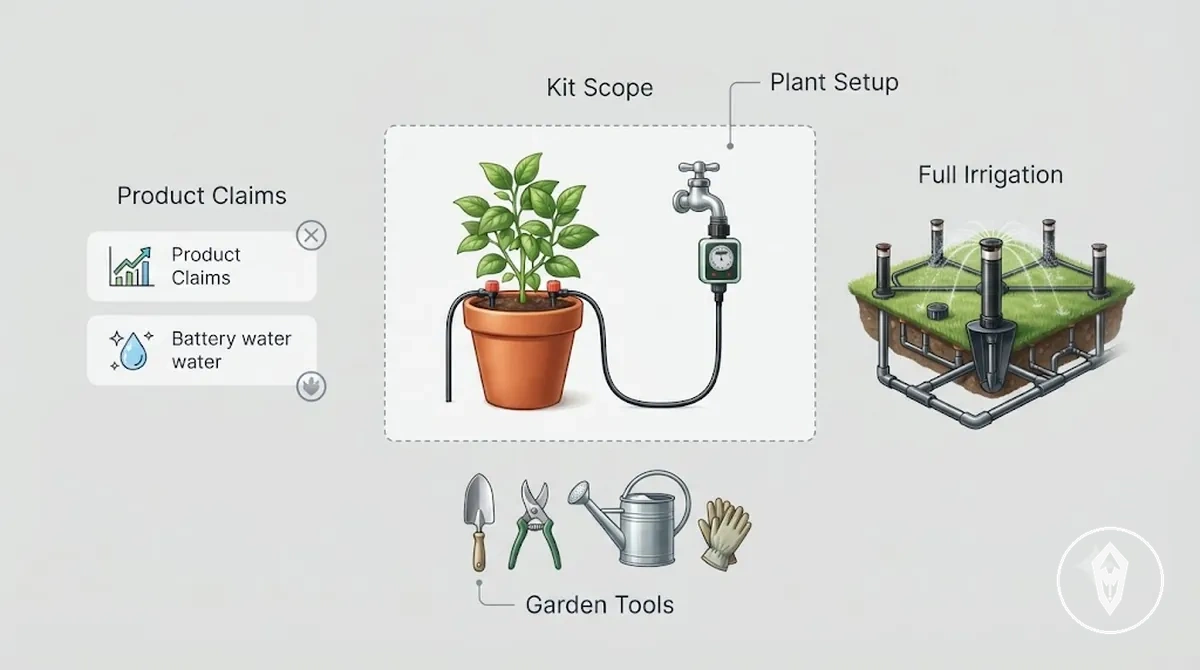
The following areas are outside the scope of this automatic watering kit definition:
- Full-scale irrigation: Broader systems with larger layouts and wider watering purposes are not part of a small kit definition.
- Garden tools: General tools used for gardening are separate from connected watering kit components.
- Product-specific claims: Product rankings, individual offers, and model-focused claims are not included in the basic concept.
- Installation procedures: Detailed setup instructions are handled separately from defining what an automatic watering kit is.
How automatic watering kits work
Automatic watering kits move water from a source to plants through a connected path of control points, tubing, and outlets. The operating logic follows a water source or reservoir, a control condition, a tubing route, and an outlet that delivers water toward the plant area.
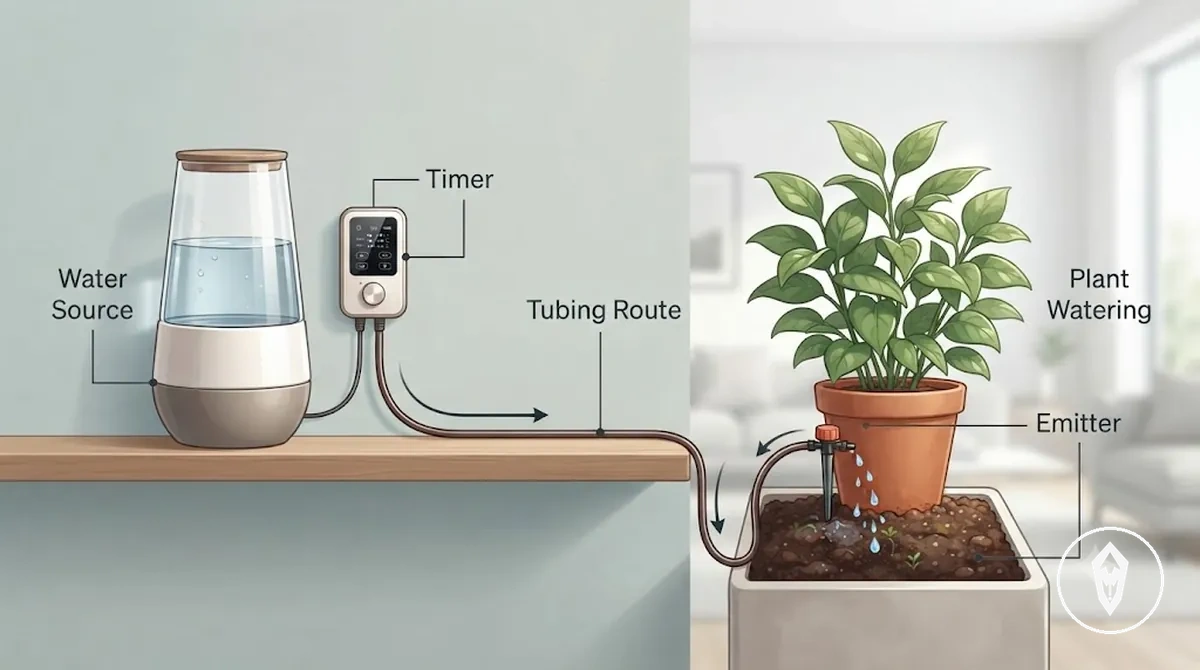
The control point, such as a timer or controller, manages when water enters the tubing route within the watering setup. The outlet path then directs water through emitters or drippers, with the final plant watering effect influenced by factors such as pressure, flow, emitter output, and kit design. Different automatic watering kits can use different outlet arrangements and control methods, so the exact water delivery result depends on the specific configuration.
The control point, such as a timer or controller, manages when water enters the tubing route within the watering setup.
Water source or reservoir → Control condition → Tubing route → Emitter output → Plant watering effect
Water source, control point, tubing, and outlet path
The water path in an automatic watering kit shows how each part moves water through the setup by function. The water source provides the starting supply, the control point manages water release, and the tubing route connects the flow path to outlets that deliver water toward plants. Understanding this path helps explain how the kit components work together.
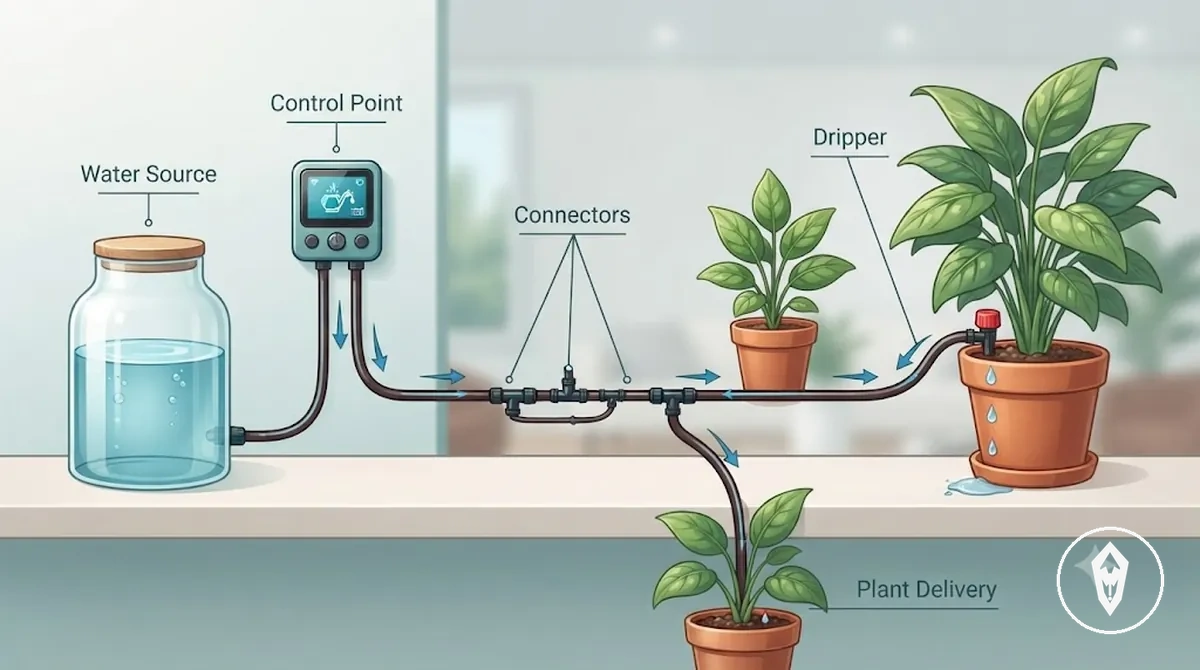
The functional path can be organized by the role of each part. Part names can differ between kits, but the main functions of supplying, controlling, routing, and delivering water remain similar. The parts inside a watering kit provide more detail about individual components.
| Entity or part | Attribute or function | Value or condition | Effect on water path |
|---|---|---|---|
| Water source | Water supply function | Provides the available water input for the setup | Starts the water path through the kit |
| Control point | Water release control | Uses a timer or controller when the kit supports controlled operation | Regulates when water moves into the tubing route |
| Main tubing | Water transport route | Connects the water source area with outlet locations | Moves water through the connected path |
| Connectors | Tubing connection function | Joins tubing sections within the kit layout | Keeps connected sections of the water path together |
| Branch lines | Water distribution route | Creates additional paths when the setup includes multiple outlet points | Directs water toward separate delivery areas |
| Emitters or drippers | Outlet delivery function | Releases water at the final outlet based on the kit design | Delivers water from the outlet path to the plant area |
Controlled drip delivery near the plant root zone
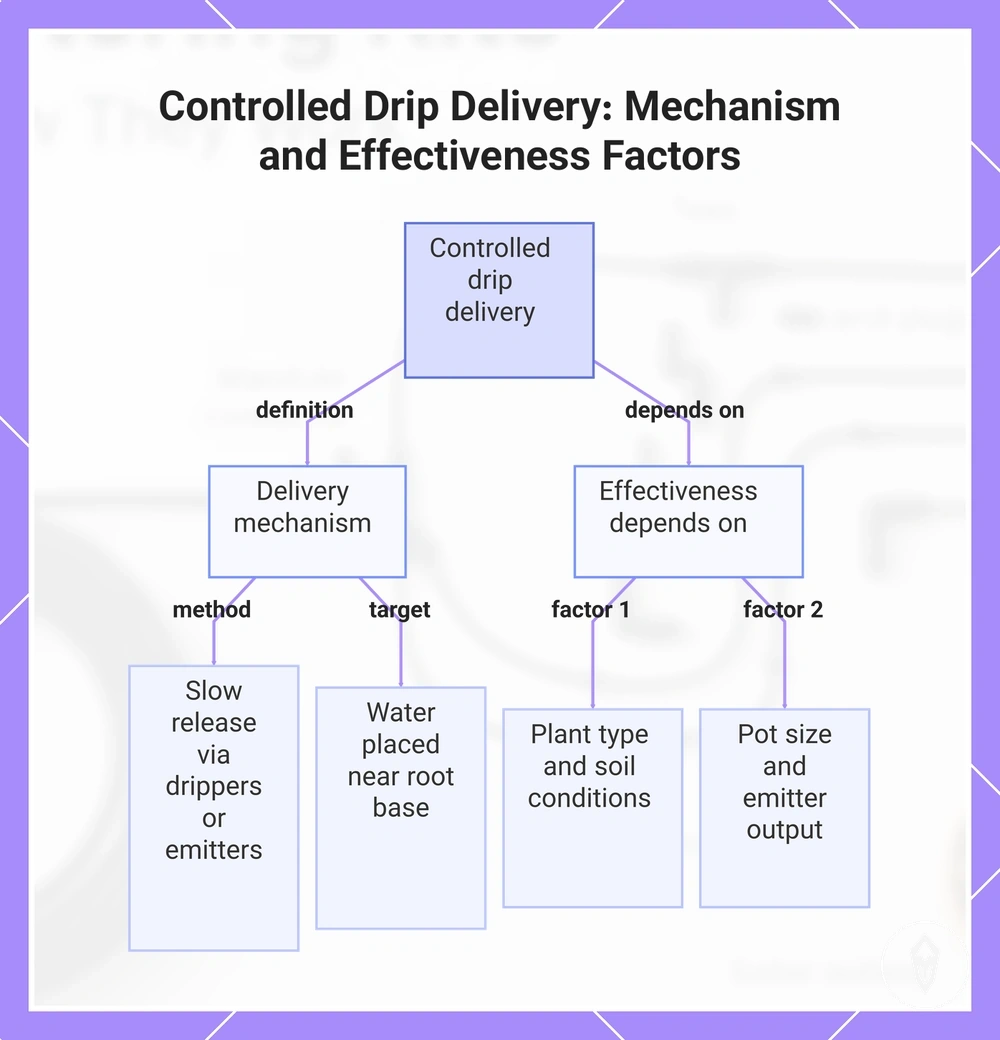
Controlled drip delivery delivers water close to the plant base through drippers, emitters, or small outlets that release water slowly near the plant root zone. The outlet placement helps target the root area, while emitter output influences how water reaches the soil around the plant. This type of delivery can support focused plant watering, but the watering effect depends on conditions such as plant type, soil, pot size, and emitter output.
The outlet placement helps target the root area, while emitter output influences how water reaches the soil around the plant.
This chart explains how controlled drip delivery works near the plant root zone and what factors affect its watering effectiveness.
Core components in a basic automatic watering kit
An automatic watering kit uses core components that each perform a specific watering role within the setup. The timer, tubing, connector, and emitter work together to control release, create the water path, join sections, and deliver water toward plants. These parts are understood by their functional roles within the kit.
These parts are understood by their functional roles within the kit.
Basic kit designs can vary, so the included components and their functions can differ between setups. A timer may provide schedule control, while tubing creates the water path, connectors support layout flexibility, and emitters manage output rate for plant delivery. Detailed component selection is beyond this definition-level section.
| Component | Main role | Condition or variation | Effect on the kit |
|---|---|---|---|
| Timer or controller | Schedule control | Controls watering frequency when the kit includes timed operation | Determines when water is released into the system |
| Tubing | Water path | Routes water through the kit layout | Moves water toward delivery points |
| Connector | Branching or joining | Connects tubing sections within the setup design | Provides layout flexibility by linking water paths |
| Emitter or dripper | Output rate and delivery | Releases water based on the kit design and outlet configuration | Directs water toward the plant delivery area |
| Flow control | Flow adjustment | Included only when the kit design provides this function | Influences water movement through the outlet path |
Timer or controller role
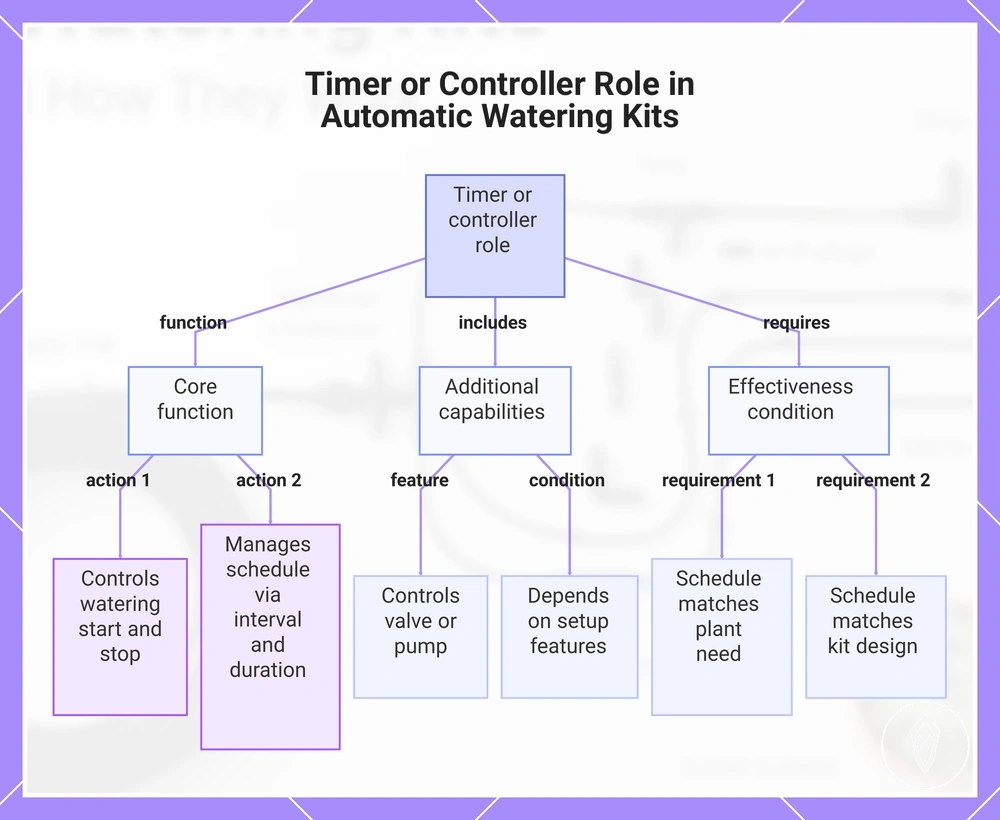
A timer or controller is the component that starts, stops, or schedules watering when an automatic watering kit supports automatic control. The timer manages a schedule through settings such as an interval and duration, while some controllers also manage a valve or pump control function when the setup includes those features. A timer can support watering consistency when the schedule matches the plant need and kit design, but its role and functions vary by setup.
A timer or controller is the component that starts, stops, or schedules watering when an automatic watering kit supports automatic control.
This chart explains the core functions, additional capabilities, and effectiveness conditions of a timer or controller in an automatic watering kit.
Tubing, connectors, emitters, and flow controls
Tubing, connectors, emitters, and flow controls distribute water after the control point by routing, branching, releasing, and adjusting the delivery path. Tubing creates the tubing path, connectors support connector branching, emitters manage emitter output, and flow controls provide flow adjustment when included in the kit design. These delivery parts affect plant delivery based on conditions such as emitter type and the way water moves through the setup.
| Part | Attribute | Condition | Watering effect |
|---|---|---|---|
| Tubing | Routing function | Creates a tubing path between connected delivery points | Moves water through the setup toward coverage areas |
| Connectors | Connector branching | Joins or branches tubing sections within the layout | Creates different paths for local water distribution |
| Emitters | Emitter output | Releases water according to emitter type and kit design | Directs water toward plant delivery points |
| Flow controls | Flow adjustment | Adjusts water movement when the kit includes this function | Affects delivery conditions based on the setup |
Drip watering kits within automatic plant watering
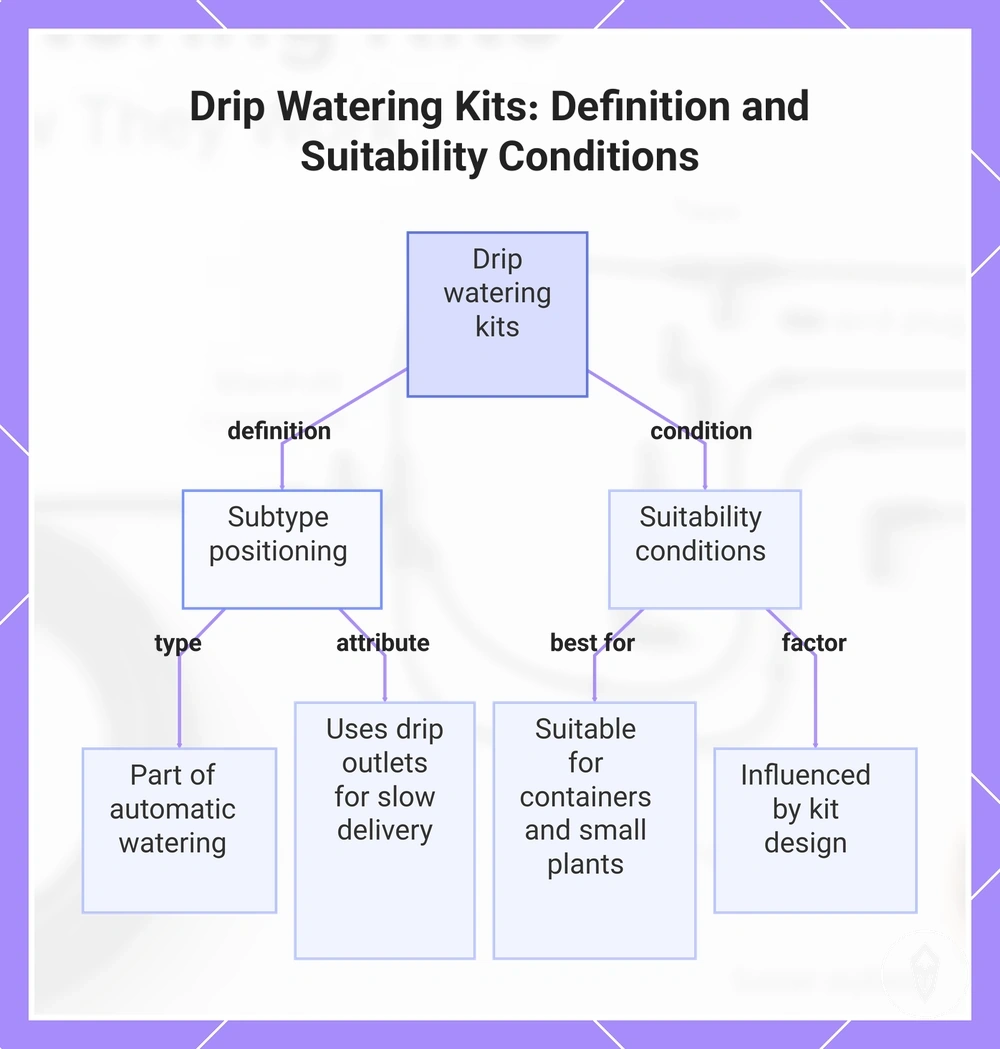
Drip watering kits are a subtype of automatic plant watering that uses drip outlets to deliver water through a slow delivery method near plants. They fit within the broader automatic watering concept by using controlled outlets and a kit design focused on directing water through a specific delivery format. Other delivery formats may exist, but drip watering kits represent one approach within automatic plant watering.
Other delivery formats may exist, but drip watering kits represent one approach within automatic plant watering.
Drip watering kits can suit containers and small plants when outlet placement supports the intended watering area. Their suitability depends on factors such as plant placement, water pressure, and kit design, because these conditions influence how drip outlets deliver water. This subtype positioning separates drip watering kits from a complete guide to choosing between delivery formats.
This subtype positioning separates drip watering kits from a complete guide to choosing between delivery formats.
For a broader overview of types of automatic watering kits, different delivery formats can be considered based on their design and use conditions.
For a broader overview of types of automatic watering kits , different delivery formats can be considered based on their design and use conditions.
This chart explains what drip watering kits are, their delivery method, and the conditions that affect their suitability for containers and small plants.
Why drip delivery is common in small watering kits
Drip delivery is common in small watering kits because it supports controlled delivery through compact layouts with simple tubing connections and targeted outlet placement. Drip outlets can release water near the plant base, while the setup can suit containers where small plants need a focused watering area. The effect on water volume, overspray risk, and delivery depends on outlet style, plant placement, and kit design.
- Controlled delivery: Drip outlets direct water through a controlled path, helping position delivery near the plant base.
- Simple tubing layout: Compact kits can use straightforward tubing arrangements to connect outlets within smaller setups.
- Container-friendly placement: Drip delivery can fit container setups when outlet placement matches the plant location and watering conditions.
How automatic watering kits differ from larger irrigation systems
Automatic watering kits and larger irrigation systems differ mainly in setup scale, component complexity, and use context. Automatic watering kits focus on kit-scale watering with connected parts for smaller coverage areas, while larger irrigation systems generally involve broader layouts and more complex arrangements. This comparison defines the boundary between a compact watering setup and a larger irrigation approach.
The boundary can overlap because configuration affects how a setup is classified.
The boundary can overlap because configuration affects how a setup is classified. A modular kit may resemble a small irrigation system when its water source, coverage area, and component arrangement expand beyond a simple kit context. The distinction depends on the configuration, installation burden, and user intent.
| Dimension | Automatic watering kit | Larger irrigation system | Boundary cue |
|---|---|---|---|
| Scale | Uses a smaller setup designed for kit-scale watering | Uses a broader arrangement designed for wider coverage | Setup scale and coverage area influence the distinction |
| Complexity | Uses connected components in a more compact arrangement | Can involve greater component complexity across the system | Complexity increases as configuration expands |
| Installation burden | Usually relates to a smaller watering setup | Can involve a more extensive installed arrangement | Installation burden depends on the configuration |
| Coverage area | Targets a more limited plant watering area | Supports broader watering coverage | Coverage needs help define the system boundary |
| Typical intent | Supports focused plant watering through a kit format | Supports broader irrigation needs through an expanded setup | User intent and configuration affect classification |
Kit-scale plant watering versus installed irrigation
Kit-scale plant watering and installed irrigation differ mainly in portability, permanence, and layout complexity. A kit-scale setup usually uses a portable layout or modular layout for focused plant watering, while installed irrigation uses a more fixed system structure with greater permanence. The boundary changes when configuration adds more complex layouts, broader coverage, or a setup that no longer behaves like a simple kit.
| Kit-scale plant watering | Installed irrigation |
|---|---|
| Permanence: Uses a portable layout or modular layout that can be adjusted within the watering setup. | Permanence: Uses a fixed system arrangement designed around a more lasting installation context. |
| Layout: Uses a modular layout with simpler arrangement needs for plant watering. | Layout: Uses a more structured layout where complexity can increase with the configuration. |
| Control: Provides water delivery control through components suited to the kit-scale setup. | Control: Provides water delivery control across a broader installed system arrangement. |
| Boundary: Stays closer to a simple kit when portability, limited layout complexity, and focused plant watering remain the main characteristics. | Boundary: Becomes closer to installed irrigation when permanence, layout complexity, or configuration changes the setup context. |
Where automatic watering kits are commonly used
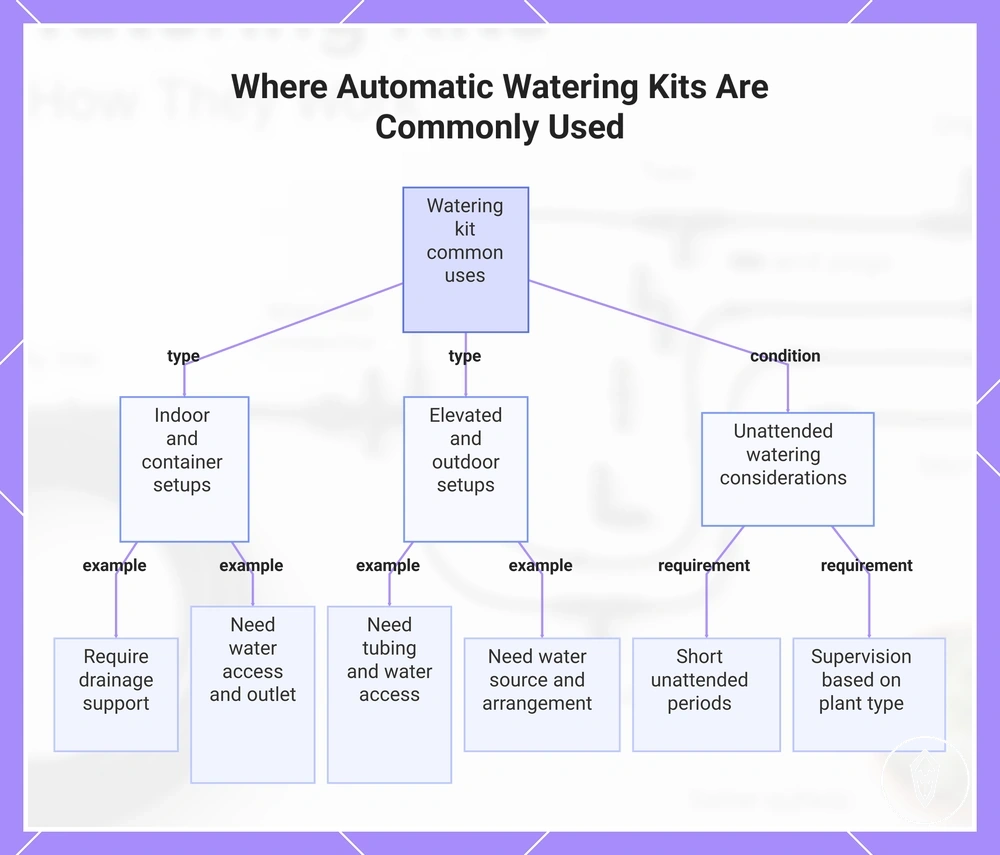
Automatic watering kits are commonly used in plant setups where the location supports controlled watering, including indoor plants, pots, containers, hanging baskets, balconies, and small garden beds. These common use contexts do not mean every setup will have the same watering requirements, because location conditions affect how the kit works. The setup location helps determine whether the available water access, drainage, and plant arrangement match the kit use.
Containers and hanging baskets can require attention to plant sensitivity and watering needs.
Automatic watering kits can support different plant setups when the surrounding conditions are considered. Indoor plants may require suitable drainage, while balcony and outdoor setups may depend on water source access and tubing placement. Containers and hanging baskets can require attention to plant sensitivity and watering needs. Short periods of unattended watering still require supervision based on the plant type, drainage conditions, and available water supply.
- Indoor plants: Commonly used for indoor plant setups when drainage and water collection conditions support the arrangement.
- Pots and containers: Used for container plants when water access and outlet placement match the plant setup.
- Hanging baskets: Used for elevated plants when tubing placement and water delivery access are practical.
- Balconies: Used in balcony setups when water source access, drainage, and placement conditions are suitable for the space.
- Small garden beds: Used in small garden areas when the water source and plant arrangement align with the kit design.
- Unattended watering: Used for shorter periods without manual watering when plant sensitivity, drainage, and supervision needs are considered.
This chart shows the typical locations and conditions for using automatic watering kits, including indoor, container, elevated, and outdoor setups, as well as unattended watering considerations.
Pots, containers, hanging baskets, and small garden areas
Pots, containers, hanging baskets, and small garden areas share similar automatic watering kit needs because each context involves local plant placement and controlled water delivery. The arrangement of plants, available water access, and layout of the area affect how tubing and emitter placement are used.
- Pots: Pots can use automatic watering kits when the container count and pot spacing allow emitter placement to match each plant location. The arrangement of pots affects how tubing reaches the watering points.
- Containers: Containers can use small kit layouts when plant containers are arranged around suitable emitter placement. Different container sizes and positions can change the delivery arrangement.
- Hanging baskets: Hanging baskets can use watering kits when hanging height and tubing placement allow water to reach the elevated plants. The basket position affects where emitters are placed.
- Small garden areas: Small garden areas can use compact watering setups when layout, water access, and emitter placement match the plant arrangement. The area shape can affect how delivery points are positioned.
Basic limits and common questions before using a kit
Can automatic watering kits fit different plant setups?
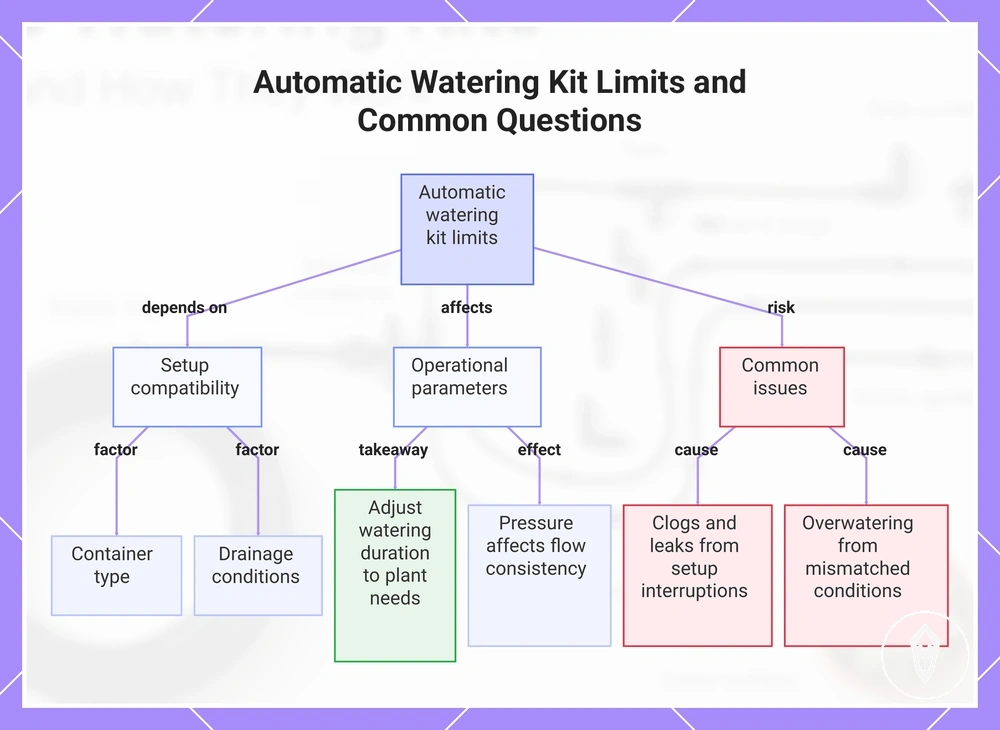
Automatic watering kits can fit different plant setups when the kit design matches the plant arrangement and watering needs. Plant fit depends on factors such as container type, drainage, plant sensitivity, and delivery setup conditions. A setup that works for one plant arrangement may need different conditions for another.
How does watering duration affect plant watering?
Watering duration affects how much water reaches plants during a watering cycle. The suitable duration depends on plant fit, drainage conditions, water delivery, and the setup environment. Adjustments should match the plant needs rather than relying on one fixed duration.
Does pressure affect automatic watering kits?
Pressure affects water flow and emitter output within an automatic watering kit. Changes in pressure can influence how consistently water reaches delivery points, depending on the kit design and water source conditions. The effect depends on the connected setup and its components.
Can clogs or leaks happen in automatic watering kits?
Clogs or leaks can happen when setup conditions interrupt normal water movement. Clogs can reduce water delivery through outlets, while leaks can affect the intended water path through connected parts. The cause depends on the condition of the setup and the affected components.
Can automatic watering kits cause overwatering?
Automatic watering kits can contribute to overwatering when watering duration, plant fit, or drainage conditions do not match the plant setup. Overwatering risk depends on water volume, plant sensitivity, and how the system is used. Automatic operation still requires suitable setup conditions for the plants.
Automatic operation still requires suitable setup conditions for the plants.
For users who need more detail about preparing a kit setup, how kits are installed explains the installation context separately.
For users who need more detail about preparing a kit setup, how kits are installed explains the installation context separately.
This chart shows the main factors and risks to consider when using an automatic watering kit, including setup compatibility, operational parameters, and common issues.
Watering duration, plant fit, and overwatering risk
Watering duration depends on plant and setup conditions rather than a single fixed setting. Plant fit and overwatering risk are affected by factors such as plant water needs, soil drainage, emitter output, and watering interval. These criteria help guide basic kit use without relying on an exact universal schedule.
- Plant water needs: Plant water needs affect watering duration because different plants require different moisture conditions. Higher sensitivity to water levels can increase overwatering risk when the setup does not match the plant.
- Pot size: Pot size affects how water is held and distributed around the plant area. The container size can change how watering duration influences plant fit.
- Soil drainage: Soil drainage affects overwatering risk because excess moisture can remain when water movement is limited. Drainage conditions help determine whether the watering approach matches the plant setup.
- Emitter output: Emitter output affects the amount of water delivered during a watering period. The effect depends on the emitter type and setup conditions.
- Watering interval: Watering interval affects plant fit because repeated watering periods interact with plant needs and environmental conditions. An unsuitable interval can increase overwatering risk.
Clogs, leaks, pressure, and setup errors
Common problems with automatic watering kits usually relate to the flow path, pressure conditions, or placement setup. Clogs, leaks, low flow, excessive flow, loose connectors, and poor emitter placement can signal different issue types, but the cause depends on the specific setup condition. This section identifies basic issue types and prevention cues rather than full repairs.
| Symptom | Likely attribute issue | Basic check | What it means |
|---|---|---|---|
| Clogs | Blocked emitter or restricted flow path | Check whether water movement is reduced at the emitter point | Clogs can reduce flow and affect water delivery through the outlet |
| Leaks | Loose connectors or disrupted water path | Check connection points where water leaves the intended path | Leaks can indicate a connection or flow path issue that needs attention |
| Low flow | Pressure condition or restricted water movement | Check whether the output is lower than expected for the setup | Low flow can signal reduced delivery caused by pressure or path conditions |
| Excessive flow | Pressure condition or emitter output mismatch | Check whether water delivery is higher than the plant setup requires | Excessive flow can increase overwatering risk when setup conditions are unsuitable |
| Loose connectors | Connection condition affecting the water path | Check whether connected parts remain properly positioned | Loose connectors can interrupt the intended water route |
| Poor emitter placement | Placement condition affecting delivery location | Check whether emitters are positioned for the intended plant area | Poor emitter placement can reduce how effectively water reaches the target area |
Persistent leaks or uncontrolled flow should be addressed before unattended use because these conditions can affect the reliability of the watering setup.