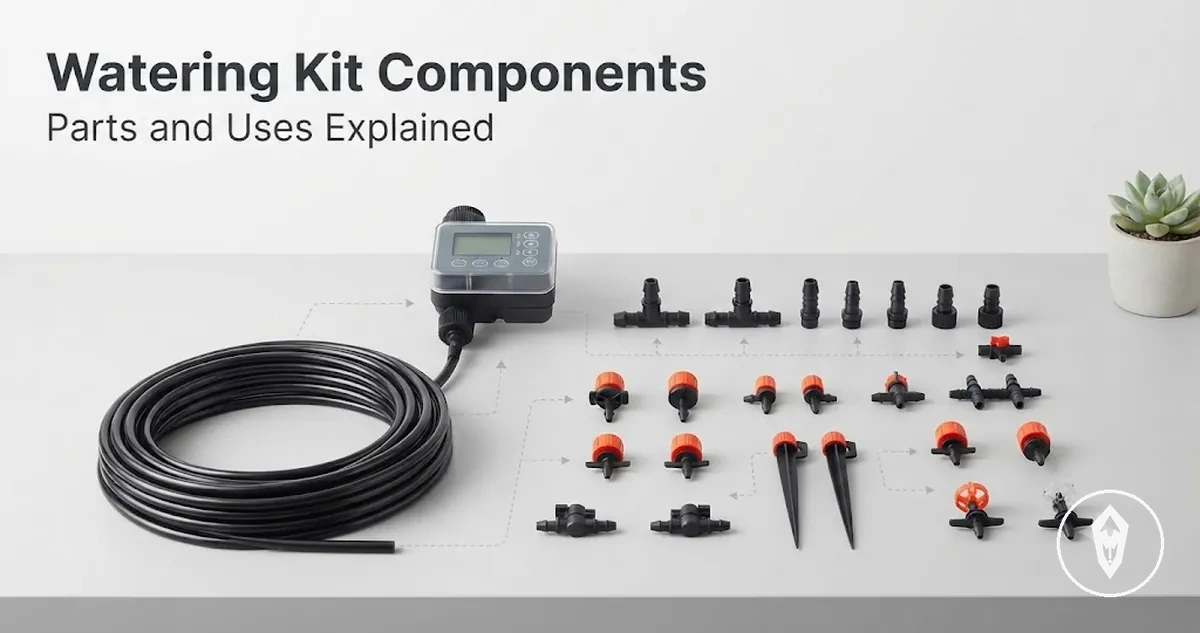
Automatic Watering Kit Components and Parts Explained
Automatic watering kit components are the physical and functional parts that control, carry, filter, divide, and release water through a plant watering system. These parts include control elements such as timers and valves, distribution elements such as tubing and connectors, and outlet elements such as emitters and drippers. Each part has a specific function, fit condition, and effect on water delivery, so automatic watering kit components are best understood by their role and compatibility within the kit.
An automatic watering kit moves water through a connected path from the water source to the plant outlet.
An automatic watering kit moves water through a connected path from the water source to the plant outlet. The timer or valve controls water movement, tubing carries the flow, connectors create the distribution path, filters help manage debris, and emitters deliver water near plants. Understanding how these parts connect helps separate core component functions from narrower installation, replacement, or troubleshooting contexts.

Automatic watering kit components differ from broader sprinkler hardware or DIY electronic circuit parts because this page focuses on packaged plant-watering system roles rather than full irrigation design or custom electronics. For a wider overview of kit types and selection context, see the automatic watering kits hub.
Evaluating watering kit parts starts with function, condition, and fit.
Evaluating watering kit parts starts with function, condition, and fit. A compatible component is one that matches the connection method, water movement requirements, and intended delivery role within the system.
Table of Contents
What Counts as an Automatic Watering Kit Part
An automatic watering kit part is a physical part or control part that performs a role in moving, controlling, filtering, dividing, or releasing water inside the kit. A part belongs to the watering system when its function connects to water movement or plant-side delivery. This function-based definition identifies kit hardware through its role rather than its appearance or general garden use.
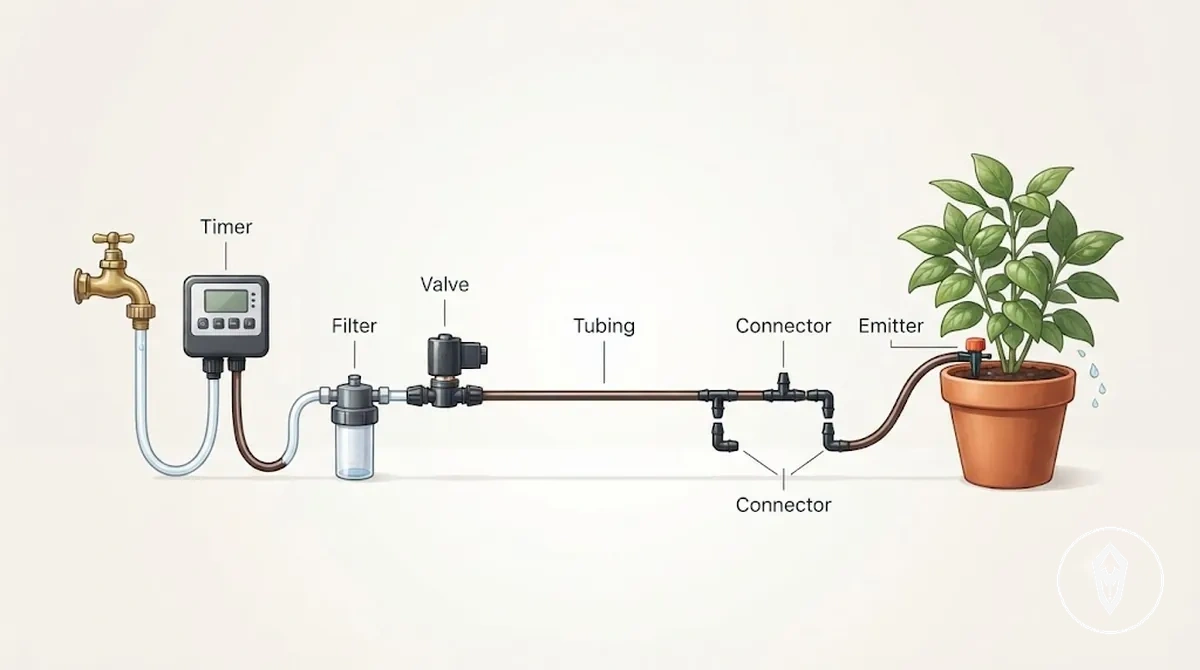
What usually counts as an automatic watering kit part is determined by the role the item performs inside the watering path. Control parts manage water timing or shutoff, distribution parts carry and connect water paths, and outlet parts release water near plants. The main part groups include:
- Water-source connectors: These connectors join the water supply side to the kit and create the starting connection for water movement.
- Timer and control parts: These control parts manage when water is released or stopped within the watering system.
- Filters and valves: Filters provide debris protection, while valves control water direction or shutoff functions.
- Tubing and fittings: These distribution parts carry water and connect sections through fittings that join or divide the water path.
- Emitters and outlet parts: These outlet parts release water through delivery points such as drippers or micro sprays.
- Stakes and support parts: These parts position outlets near the intended plant area.
Pumps, controllers, and additional accessories are only considered automatic watering kit parts when their role belongs to the specific kit configuration. An item that does not control, carry, filter, divide, or release water is outside the core watering path, even if it is used in a broader garden setup.
Automatic Watering Kit Parts Versus Sprinkler and DIY Circuit Components
Automatic watering kit parts are defined by their role inside a packaged plant-watering kit, while sprinkler hardware and DIY circuit components belong to broader system categories. Automatic watering kit parts focus on contained water delivery through kit components, sprinkler hardware focuses on broader irrigation hardware, and DIY circuit components focus on custom electronic control functions. Role and scope matter more than the label used for the component.
Role and scope matter more than the label used for the component.
Sprinkler hardware and DIY circuit components can appear in related searches because they share terms such as water delivery, connectors, pressure, and control. Sprinkler hardware usually belongs to larger irrigation layouts with different scale and distribution needs, while DIY circuit components relate to custom electronics and control complexity. These related meanings overlap with automatic watering kit topics but represent different component contexts.
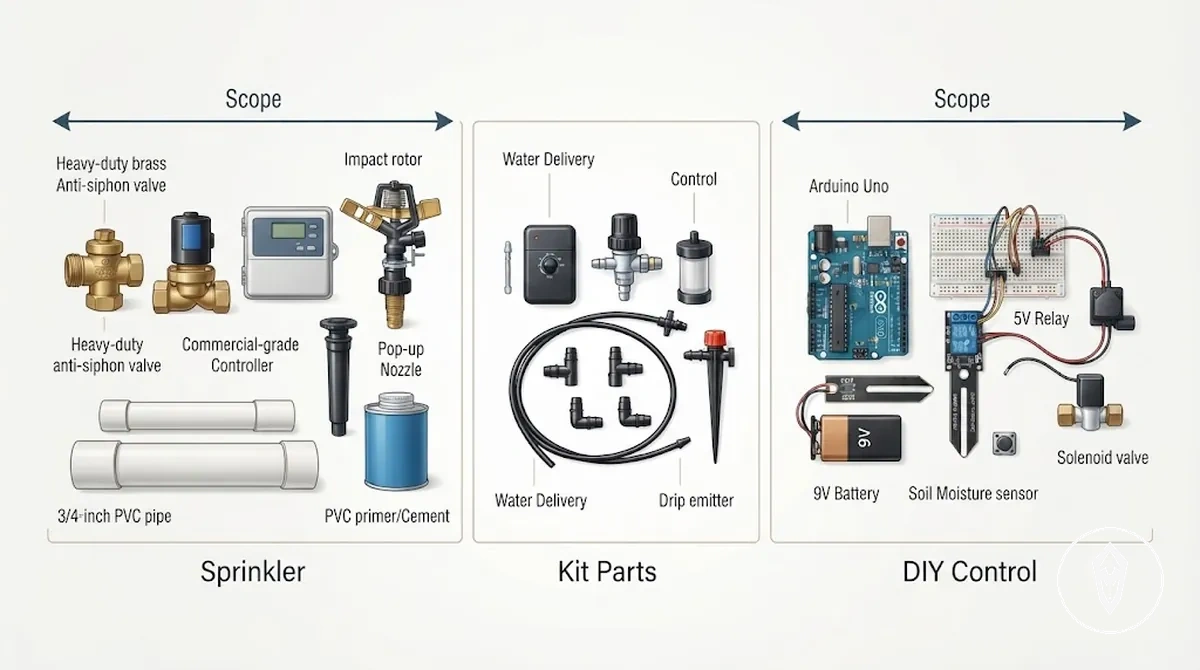
The comparison below organizes these categories by role, scale, connector standards, control complexity, pressure assumptions, and whether the component belongs inside a packaged plant-watering kit.
| Item type | Typical role | Why it may or may not belong here |
|---|---|---|
| Automatic watering kit parts | Support water delivery through control, carrying, filtering, dividing, or releasing functions inside a packaged kit | These components belong to the kit-focused context when their function is part of the plant-watering path. |
| Sprinkler hardware | Support broader irrigation hardware systems with different delivery scale and layout requirements | These parts relate to irrigation but may fall outside the automatic watering kit context when they belong to larger sprinkler systems. |
| DIY circuit components | Provide custom electronic control functions through separate circuit-based designs | These components may automate watering functions but are outside the packaged kit part group when they require custom electronic construction. |
A component belongs to the automatic watering kit context when its purpose connects directly to the kit’s water path. Components used for broader irrigation hardware or custom electronic systems require a different scope and should not replace the kit-component focus.
Core Parts That Control Water Movement
Water moves through an automatic watering kit from the source connection to the plant outlet through connected control, distribution, and outlet parts. Control-side parts manage water movement before it enters the distribution path, distribution-side parts carry and divide the water path, and outlet parts release water near plants. The core parts that shape this movement are the timer, valve, filter, tubing, connector, splitter, fitting, and emitter groups.
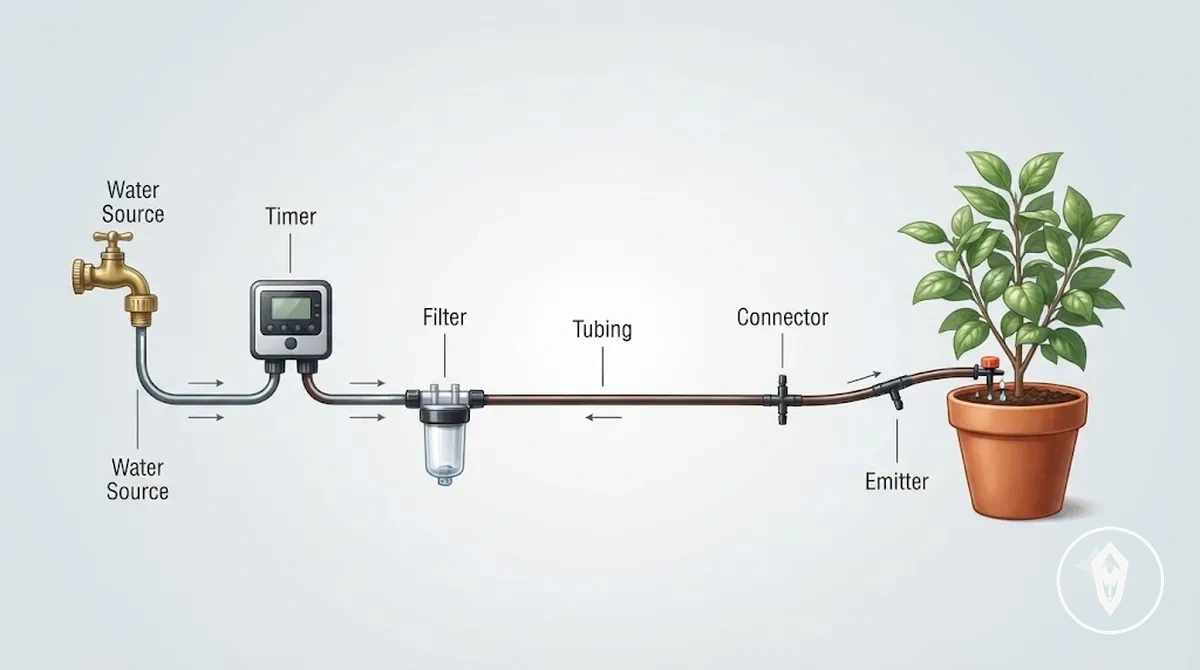
These core parts matter because each group has a specific function, condition, and effect on delivery. A timer or valve affects control function, tubing and connectors affect how water moves through the path, and emitters affect plant-level delivery. The table below connects each part group with its function and the conditions that influence its effect.
The table uses an entity-attribute-value view to show why each part belongs in the water path.
The table uses an entity-attribute-value view to show why each part belongs in the water path. The function explains the role of the part, the condition explains the relevant fit or operating factor, and the effect describes the possible influence on water delivery.
| Entity or part | Function attribute | Value or condition | Effect on water delivery |
|---|---|---|---|
| Timer and valve | Control function | Controls release timing, shutoff, or water direction within the kit configuration | Influences when water enters the path and how flow is managed. |
| Tubing, connector, splitter, and fitting | Distribution function | Carries water and joins branches through connected sections with suitable seals and fittings | Influences water movement through the path, with fit conditions affecting risks such as leaks or restrictions. |
| Filter | Protection function | Provides debris control before water reaches downstream parts | Helps maintain emitter performance when water conditions remain suitable. |
| Emitter or outlet | Release function | Releases water near the plant through the selected outlet type | Influences plant-level delivery, with flow and placement conditions affecting the final watering pattern. |
Timers, valves, filters, and pressure regulators
Timers, valves, filters, and pressure regulators are control-side parts that manage water before it reaches tubing and downstream emitters. A timer controls scheduling, a valve controls shutoff or water direction, a filter provides debris control, and a pressure regulator helps stabilize pressure conditions within the kit configuration. These control-side parts influence the water conditions that reach later distribution and outlet components.
These control-side parts influence the water conditions that reach later distribution and outlet components.
The role of these parts can change across tap-fed, pump-fed, gravity-fed, and battery-powered kits because the water source and control arrangement differ. A timer may coordinate release timing, a valve may manage flow direction, and a pressure regulator may address pressure conditions before water enters tubing. These variations should be evaluated by the control function and the effect on downstream emitters rather than by a single universal setup.
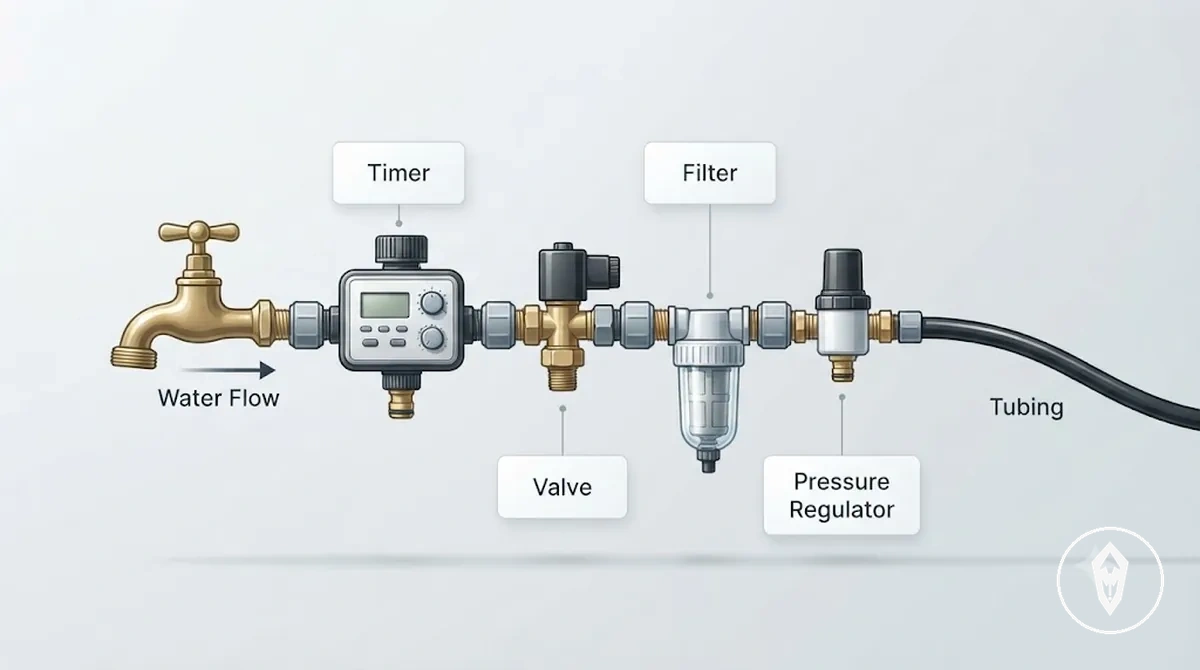
Timers, valves, filters, and pressure regulators affect the water before it reaches tubing and outlets. For deeper criteria about these control conditions, see timer, flow, and pressure requirements.
- Timer: Controls scheduling by managing when water release occurs, which influences the timing of downstream watering.
- Valve: Controls shutoff or direction of water movement, which influences whether water continues through selected parts of the path.
- Filter: Provides debris control before water reaches downstream components, which can influence emitter performance when debris affects flow conditions.
- Pressure regulator: Helps manage pressure conditions before water reaches tubing and downstream emitters, with the effect depending on the kit configuration and water delivery requirements.
Tubing, connectors, splitters, and fittings
Tubing, connectors, splitters, and fittings are distribution parts that carry water and create branches between the control side and plant outlets. Tubing carries water through the distribution path, while connectors and fittings join sections, splitters create branches, and elbows change direction. These parts must match physically because connection conditions can influence risks such as leaks, restrictions, or uneven water delivery.
A tee fitting supports branch connections, an elbow fitting changes the route direction, and seals help maintain joined sections.
In a container, balcony, or garden-bed layout, distribution parts create the connection path between control-side components and plant outlets. A tee fitting supports branch connections, an elbow fitting changes the route direction, and seals help maintain joined sections. The effect of a mismatch depends on the tubing, connector type, seal condition, pressure, and layout, which can influence how evenly water moves through the system.
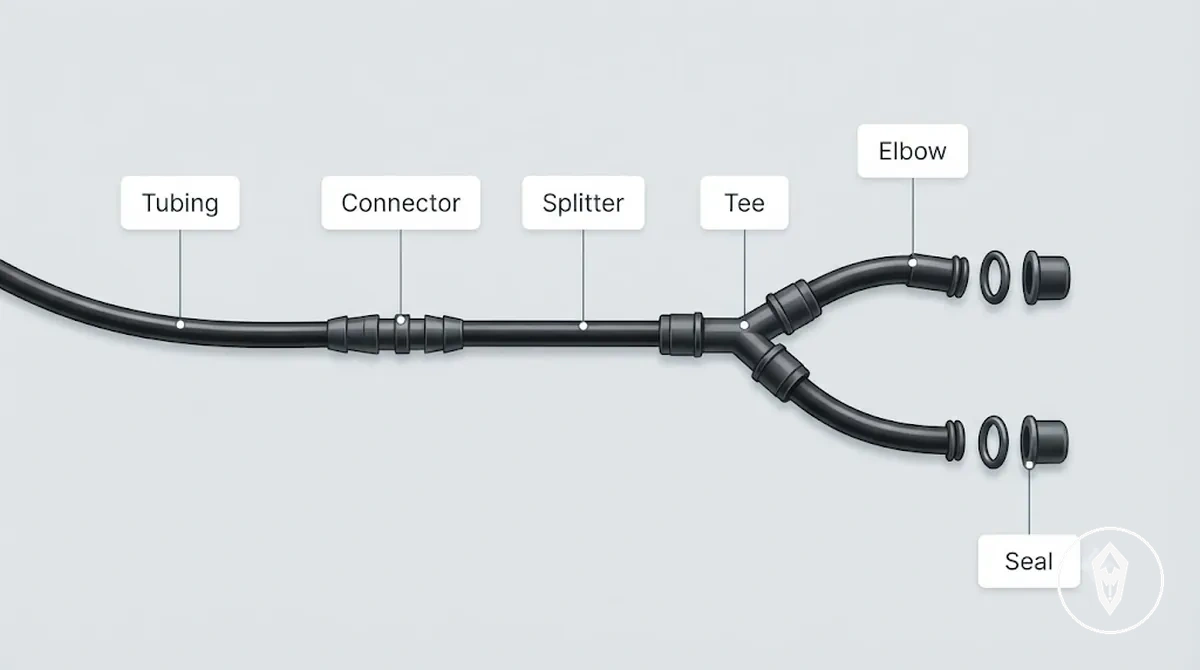
Tubing, connectors, splitters, and fittings must match physically before they can distribute water evenly. For deeper criteria about connection matching, see tubing and connector fit.
| Part type | Fit attribute | What mismatch can cause |
|---|---|---|
| Tubing | Diameter and wall flexibility | A mismatch can affect connection quality and may contribute to restrictions or uneven water movement. |
| Straight connectors | Barb or thread style and seal condition | An unsuitable connection can increase the risk of loose joins or leaks. |
| Splitters | Branch connection role and layout position | A branch arrangement that does not match the layout can affect water distribution between outlet paths. |
| Tee and elbow fittings | Branching or direction-change function | A mismatch can affect the connection path and may create restrictions in the water route. |
| Seals | Connection sealing condition | An unsuitable or worn seal can increase the chance of leaks at joined sections. |
Emitters, drippers, micro sprays, and outlet parts
Emitters, drippers, micro sprays, and outlet parts are the final delivery points that release water from an automatic watering kit to the plant area. Drippers release water through a local drip pattern, while micro sprays distribute water through a wider spray pattern. These outlet parts influence plant-level delivery by controlling how water reaches the growing medium or surrounding area.
Outlet behavior can change depending on pot size, plant spacing, and water sensitivity within the layout.
Outlet behavior can change depending on pot size, plant spacing, and water sensitivity within the layout. A dripper may suit a focused outlet position, while a micro spray may suit a wider local area where spray distribution is appropriate. Flow rate, pressure conditions, and outlet placement can influence delivery precision, clog risk, and overspray.
Emitters, drippers, micro sprays, and outlet parts differ by how they release water at the plant.
Emitters, drippers, micro sprays, and outlet parts differ by how they release water at the plant. The comparison below focuses on local outlet behavior rather than ranking one type above another.
| Outlet type | Delivery pattern | Best local use condition | Main caution |
|---|---|---|---|
| Emitters | Controlled water release at the outlet point | Used when water needs to be delivered through a defined outlet position | Clog risk can increase when debris affects the outlet path. |
| Drippers | Local drip pattern near the plant area | Suitable when water release needs to stay focused around a specific placement area | Delivery precision can be affected by pressure conditions and outlet condition. |
| Micro sprays | Spray pattern that distributes water across an area | Suitable when a wider local distribution pattern is needed | Overspray risk can increase when spacing or placement does not match the area. |
| Outlet stakes | Positions the outlet near the intended plant location | Useful when plant placement requires supported outlet positioning | Water delivery can be affected when outlet position does not match the layout. |
How Each Part Changes Water Delivery
Water delivery changes through component attributes, fit conditions, and connected part behavior rather than through part names alone. Filter condition, tubing length, tubing diameter, and pressure condition can influence emitter performance, flow consistency, leaks, or uneven watering. These delivery outcomes depend on how the component attributes interact with the water source, kit design, and layout.
These delivery outcomes depend on how the component attributes interact with the water source, kit design, and layout.
A filter with debris buildup can affect emitter performance when the water path becomes restricted before reaching the outlet. Tubing length and diameter can influence restriction levels and flow consistency when the distribution path conditions change. Valve and regulator pressure conditions can influence output stability or leaks when the pressure behavior does not match the system arrangement.
These cause-effect relationships describe possible delivery changes rather than fixed results.
These cause-effect relationships describe possible delivery changes rather than fixed results. Automatic watering kit performance depends on connected part conditions, water source characteristics, and layout factors.
| Part or attribute | Condition | Delivery effect | What to check |
|---|---|---|---|
| Filter condition | Debris capture and clogged or clean condition | Affected filter condition can influence emitter performance by changing water movement through the outlet path. | Check for debris buildup and conditions that may restrict the water path. |
| Tubing length and tubing diameter | Distribution path size and restriction level | Restrictions can reduce flow consistency through the connected tubing path. | Check tubing length, diameter, and connection conditions within the layout. |
| Valve and regulator pressure condition | Pressure control and system arrangement | Pressure changes can influence leaks or output stability when connected parts are affected. | Check pressure conditions and how downstream components respond. |
| Emitter condition | Outlet condition and flow behavior | Changes can influence dripping speed, overspray, or uneven watering at the plant area. | Check outlet condition, placement, and delivery behavior. |
Part Compatibility Inside an Automatic Watering Kit
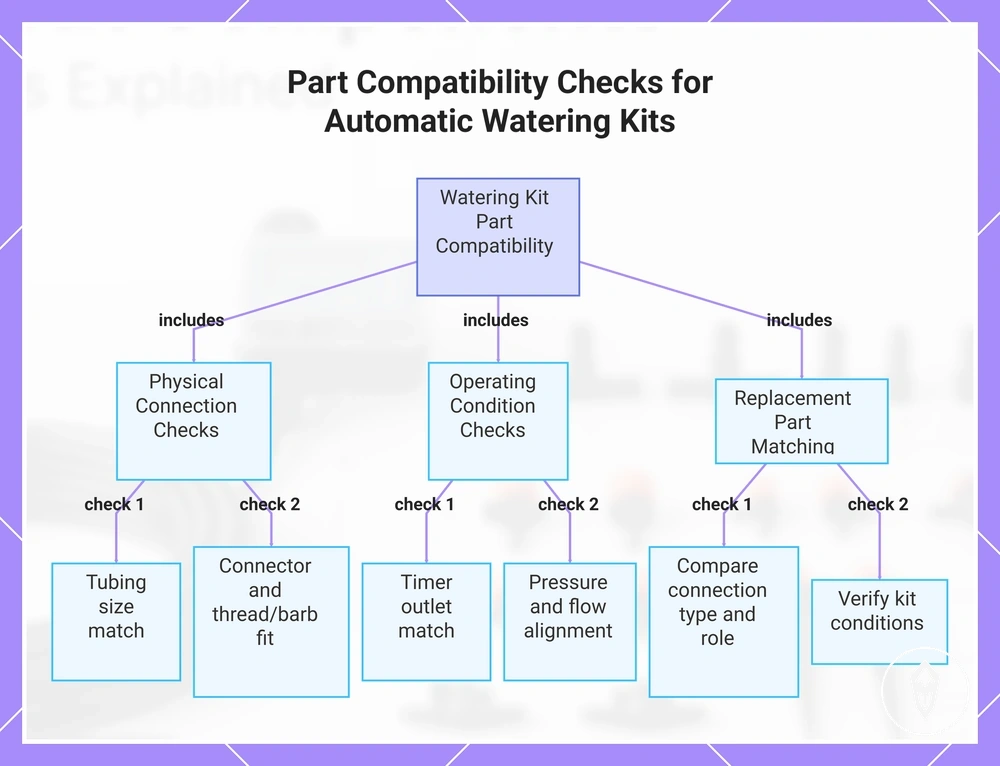
Compatibility inside an automatic watering kit is the fit relationship between parts that must connect, seal, regulate, and deliver water together. Compatible parts match the required physical connections and operating conditions within the same water path. The main compatibility variables include tubing size, connector type, thread fit, barb fit, timer outlet, pressure range, and emitter flow.
Part fit depends on how components connect and how they interact with water movement.
Part fit depends on how components connect and how they interact with water movement. Tubing size affects connection matching, connector type determines the joining method, and thread fit or barb fit affects how sections connect and seal. Timer outlet type, pressure range, and emitter flow also need consideration because connected parts can affect delivery conditions when their requirements do not match the kit arrangement.
The checklist below shows the main compatibility conditions to verify when matching automatic watering kit parts.
The checklist below shows the main compatibility conditions to verify when matching automatic watering kit parts. These checks help avoid assuming that one part will fit every configuration because kit brand, water source, pressure conditions, and tubing standards can differ.
- Tubing size: Verify that tubing dimensions match the connector and fitting requirements used in the watering path.
- Connector type: Check that joining parts use a compatible connection method and can create a suitable seal.
- Thread fit and barb fit: Confirm that threaded connections or barbed connections match the related component and tubing connection style.
- Timer outlet: Verify that the timer outlet connection matches the control-side components used in the kit.
- Pressure range: Check that connected parts suit the pressure conditions created by the water source and kit arrangement.
- Emitter flow: Confirm that outlet flow requirements align with the delivery conditions of the connected system.
- Replacement-part matching: Compare replacement parts with the existing connection type, component role, and kit conditions before using them as substitutes.
This chart shows the main compatibility checks for matching parts inside an automatic watering kit, covering physical connections, operating conditions, and replacement matching.
Tubing size, connector type, and thread fit
Physical fit between watering kit parts depends on tubing size and connection style rather than appearance alone. Inner diameter, outer diameter, connector type, thread fit, and barb size determine whether connected parts can join and seal correctly. A mismatch in these fit factors can increase the risk of loose connections, sealing problems, or leaks.
Visually similar parts may not be interchangeable because their connection details can differ.
Visually similar parts may not be interchangeable because their connection details can differ. A threaded connection requires a matching thread fit, while a barbed fitting requires a suitable barb size and tubing connection condition. Checking the connection style, gasket, washer, and seal condition helps verify whether parts are suitable for the same connection point.
The table below highlights the main physical fit factors to check at the connection point.
Tubing size, connector type, and thread fit determine whether connected parts seal properly. The table below highlights the main physical fit factors to check at the connection point.
| Fit factor | What to check | Risk if mismatched |
|---|---|---|
| Inner diameter and outer diameter | Check tubing dimensions against the connector or fitting connection area. | A mismatch can create a loose connection or affect sealing at the join. |
| Barb size | Check that the barbed fitting size matches the tubing connection. | An unsuitable barb fit can reduce connection tightness and increase leak risk. |
| Thread fit | Verify that threaded parts use a matching connection style. | A thread mismatch can prevent proper joining or create an unreliable seal. |
| Gasket or washer presence | Check whether the connection requires a gasket, washer, or seal component. | A missing or unsuitable sealing component can affect connection tightness. |
Flow, pressure, and emitter matching
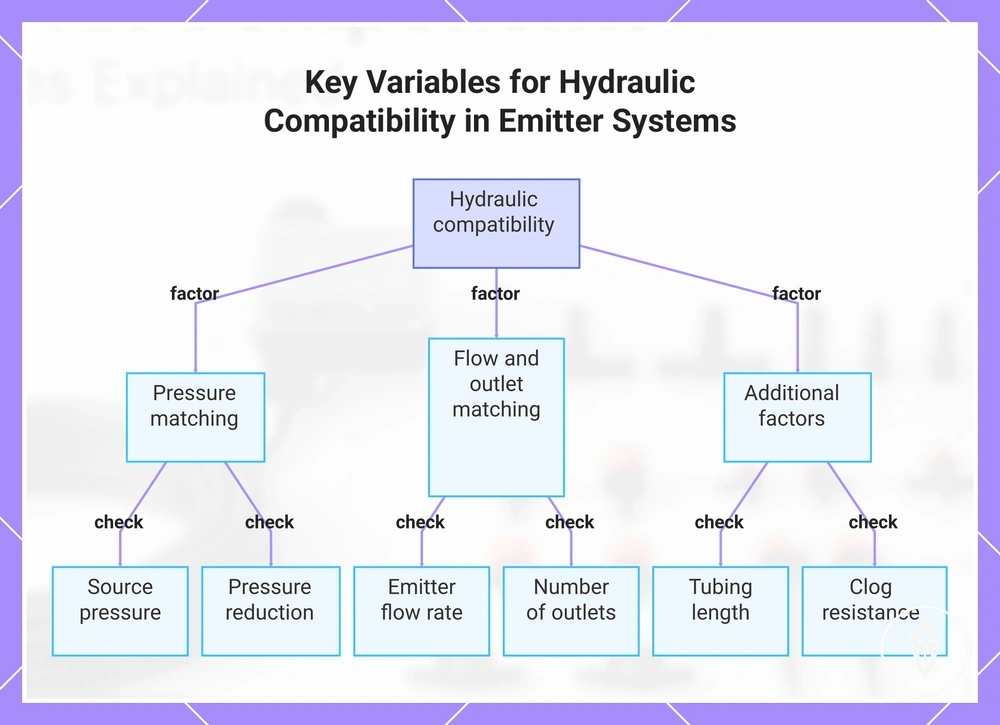
Flow and pressure matching describes how control parts, distribution parts, and outlet parts work together to provide suitable water conditions for emitters. Emitter matching requires consideration of source pressure, pressure reduction, emitter flow rate, and the number of outlets connected to the watering path. A mismatch in these conditions can affect flow balance and contribute to outcomes such as under-watering, leaks, or misting.
Hydraulic compatibility depends on the kit type, layout, and plant demand rather than a single fixed condition.
Hydraulic compatibility depends on the kit type, layout, and plant demand rather than a single fixed condition. Source pressure and pressure reduction influence the pressure conditions available to emitters, while tubing length and number of outlets can affect flow consistency across the distribution path. Clog resistance also influences emitter performance because restricted outlets can contribute to imbalance in watering output.
Flow, pressure, and emitter matching determine whether outlet parts receive suitable water conditions.
Flow, pressure, and emitter matching determine whether outlet parts receive suitable water conditions. The following checklist highlights the main variables to verify when evaluating hydraulic compatibility.
- Source pressure: Check the available pressure condition from the water source because unsuitable pressure conditions can affect emitter behavior.
- Pressure reduction: Verify pressure reduction components because pressure imbalance can influence output stability and connection conditions.
- Emitter flow rate: Match emitter flow requirements with the system conditions because unsuitable flow behavior can contribute to uneven watering.
- Number of outlets: Consider outlet count because connected outlets can affect flow balance across the watering path.
- Tubing length: Check tubing length because distribution path conditions can influence flow consistency.
- Clog resistance: Consider outlet resistance to debris because restrictions can affect emitter performance and watering output.
This chart highlights the main variables to verify when evaluating hydraulic compatibility for emitter systems.
Complete Kits, Add-On Parts, and Replacement Parts
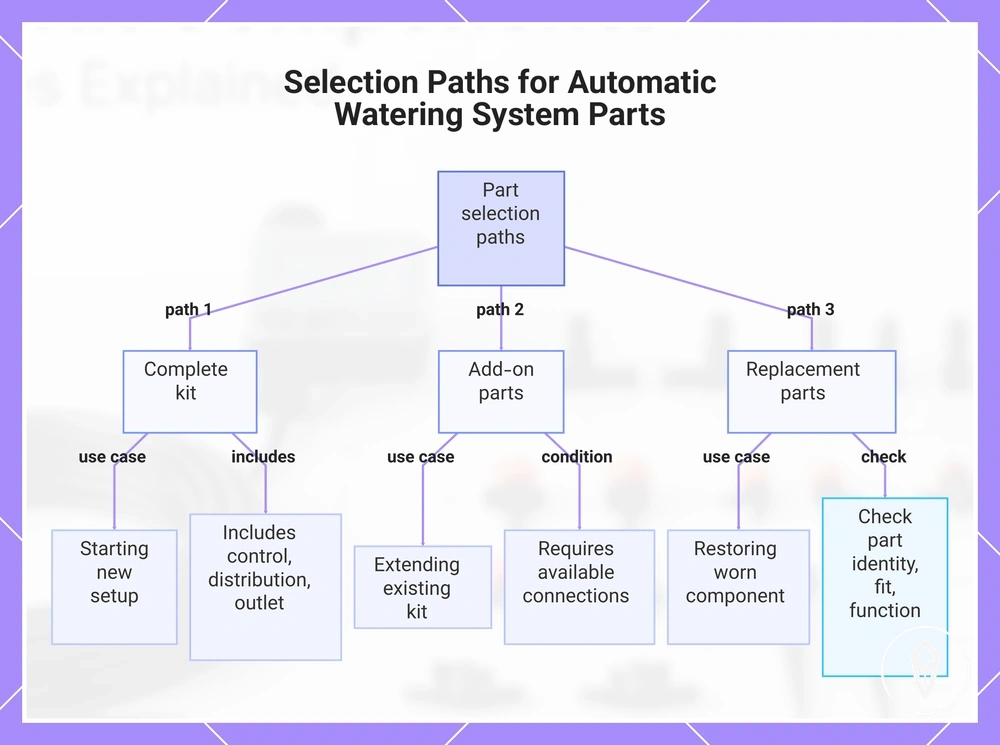
Complete kits, add-on parts, and replacement parts represent three different selection paths inside an automatic watering system. A complete kit is used when starting a new setup, add-on parts extend an existing arrangement, and replacement parts restore a missing or worn component. The selection path depends on part identity, fit, and function within the current watering system.
The selection path depends on part identity, fit, and function within the current watering system.
Complete kits include the included parts needed for the intended starter setup, such as control, distribution, and outlet components. The included parts should be considered together because their connection methods and roles determine how the kit functions as a system. Existing layouts and connection conditions can limit whether the included parts match a specific requirement.
Add-on parts are used when an existing kit needs expansion rather than replacement.
Add-on parts are used when an existing kit needs expansion rather than replacement. Add-on tubing, emitters, and related extension parts can support additional watering areas when their fit and function match the current system. The decision to add parts depends on available connections, expansion needs, and whether the existing components support the added arrangement.
A replacement choice should be based on the existing system condition rather than appearance alone.
Replacement parts are used when a specific component is missing, worn, or no longer performs its intended function. Replacement connectors, filters, valves, and stakes should be identified by part identity, fit, and function before selecting a matching component. A replacement choice should be based on the existing system condition rather than appearance alone.
Replacement parts are used when a specific component is missing, worn, or no longer performs its intended function.
Complete Kits, Add-On Parts, and Replacement Parts should be separated by whether the user is starting, extending, or restoring a kit. The checklist below highlights decision signals that help determine the appropriate path before comparing available options.
- Starting a new setup: Choose a complete kit path when the required included parts are not already available and a full system arrangement is needed.
- Extending an existing kit: Consider add-on parts when current connections and layout conditions support additional tubing, emitters, or outlet areas.
- Replacing a worn component: Consider replacement parts when a specific connector, filter, valve, stake, or other component needs restoration.
- Checking part identity: Verify the component type before selecting a replacement because similar-looking parts may differ in fit or function.
- Checking compatibility conditions: Confirm connection fit and operating requirements before combining existing parts with add-on or replacement components.
- Balancing reuse and replacement: Compare extending an existing kit with replacing components when current condition and future needs affect the decision.
The suitable path depends on whether the goal is to start with a complete kit, extend through add-on parts, or restore a system through replacement parts. Evaluating part identity, fit, and function before product options helps keep the decision focused on the existing watering system.
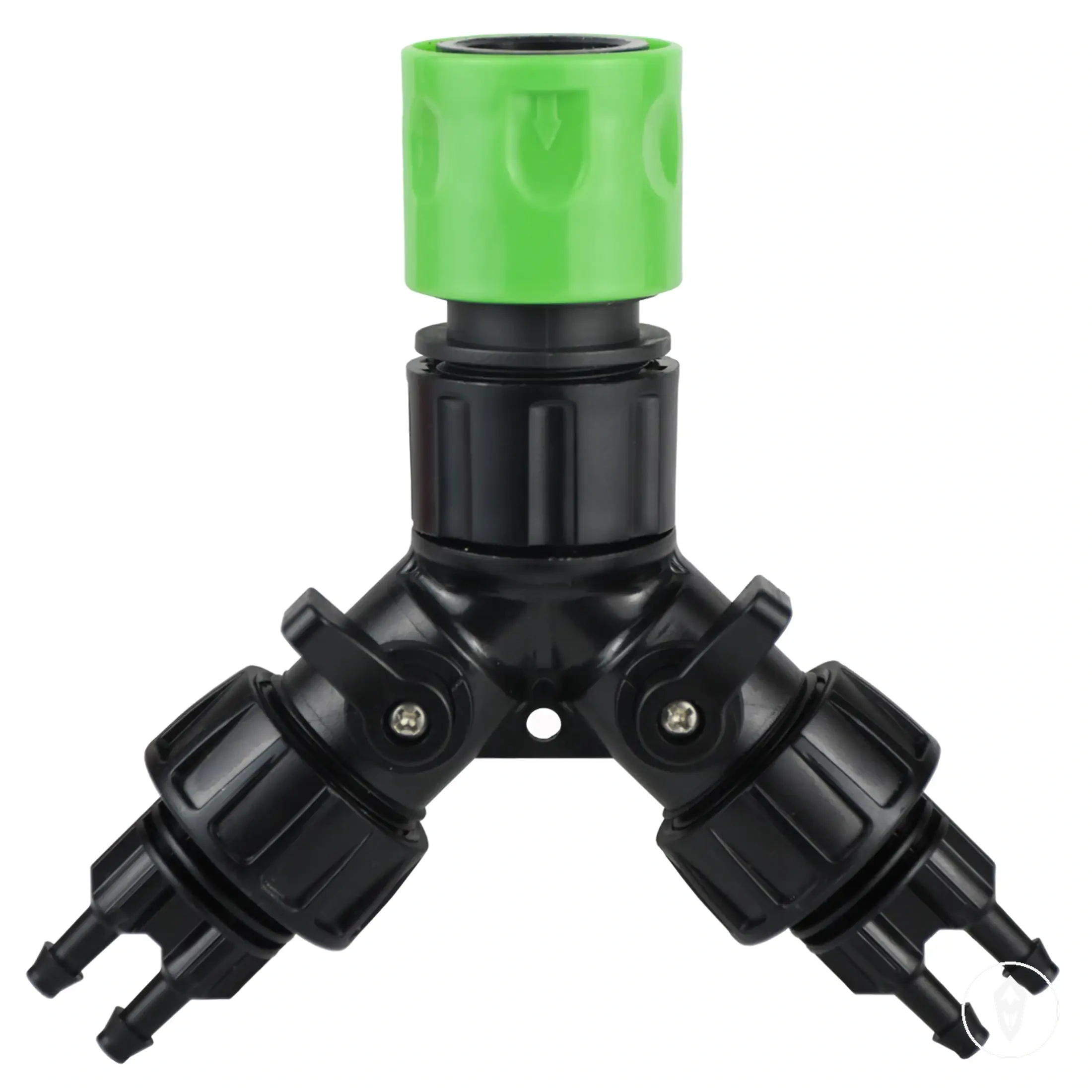
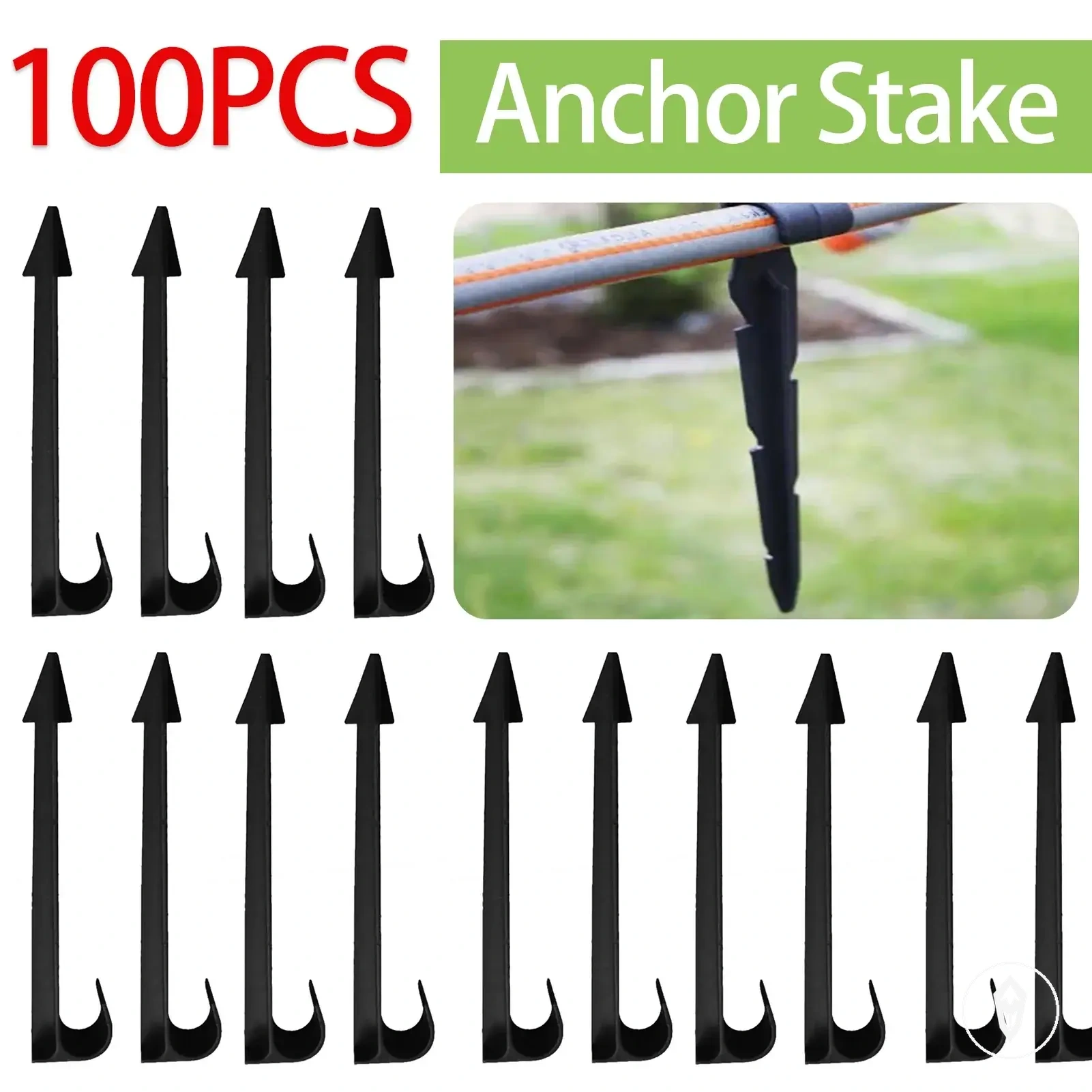
Here are product examples that may make comparison easier.
Here are product examples that may make comparison easier. Before buying, always review the compatibility criteria, essential features, and product details.
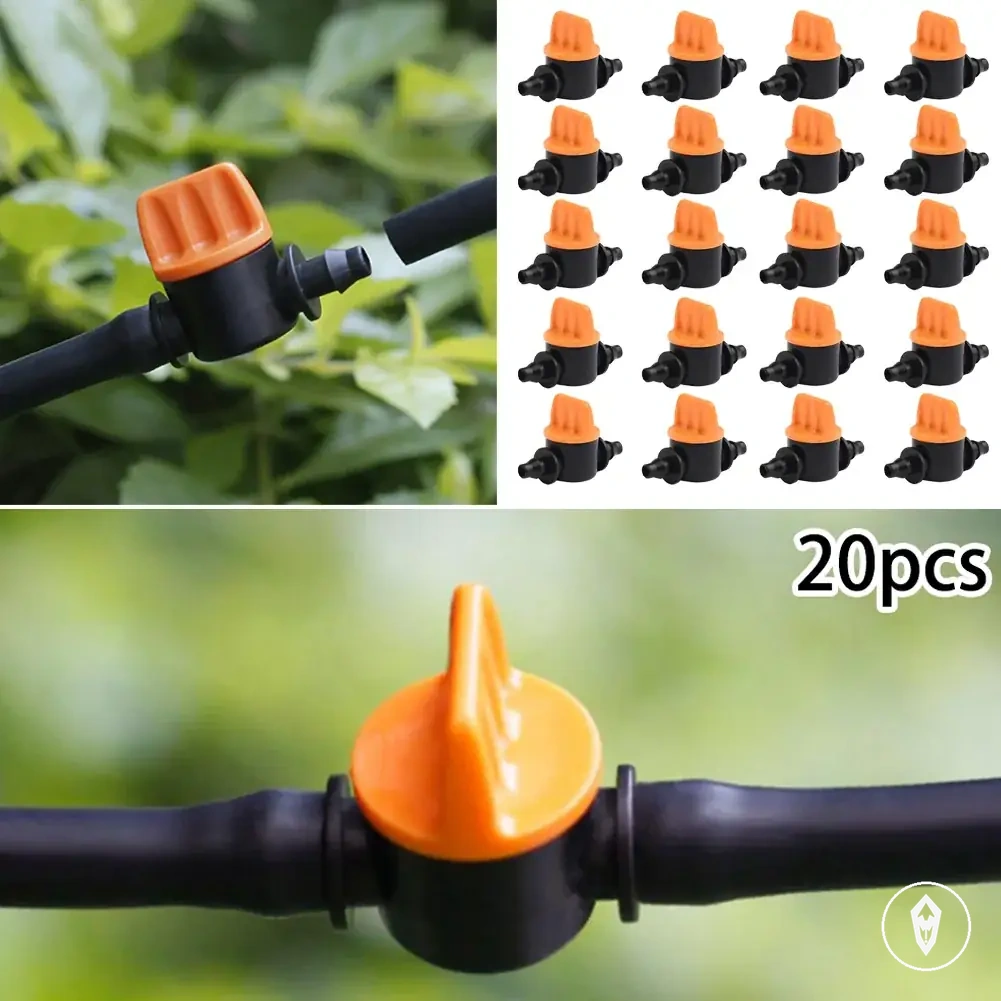
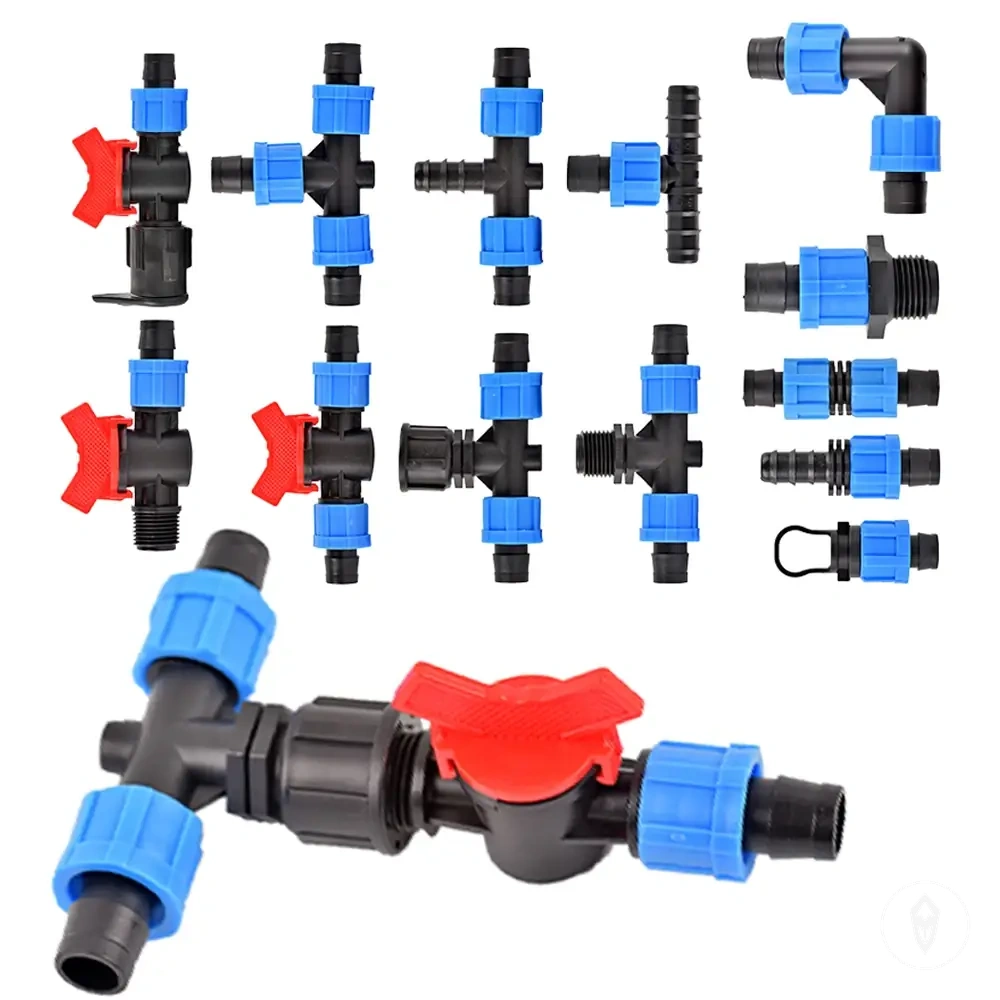
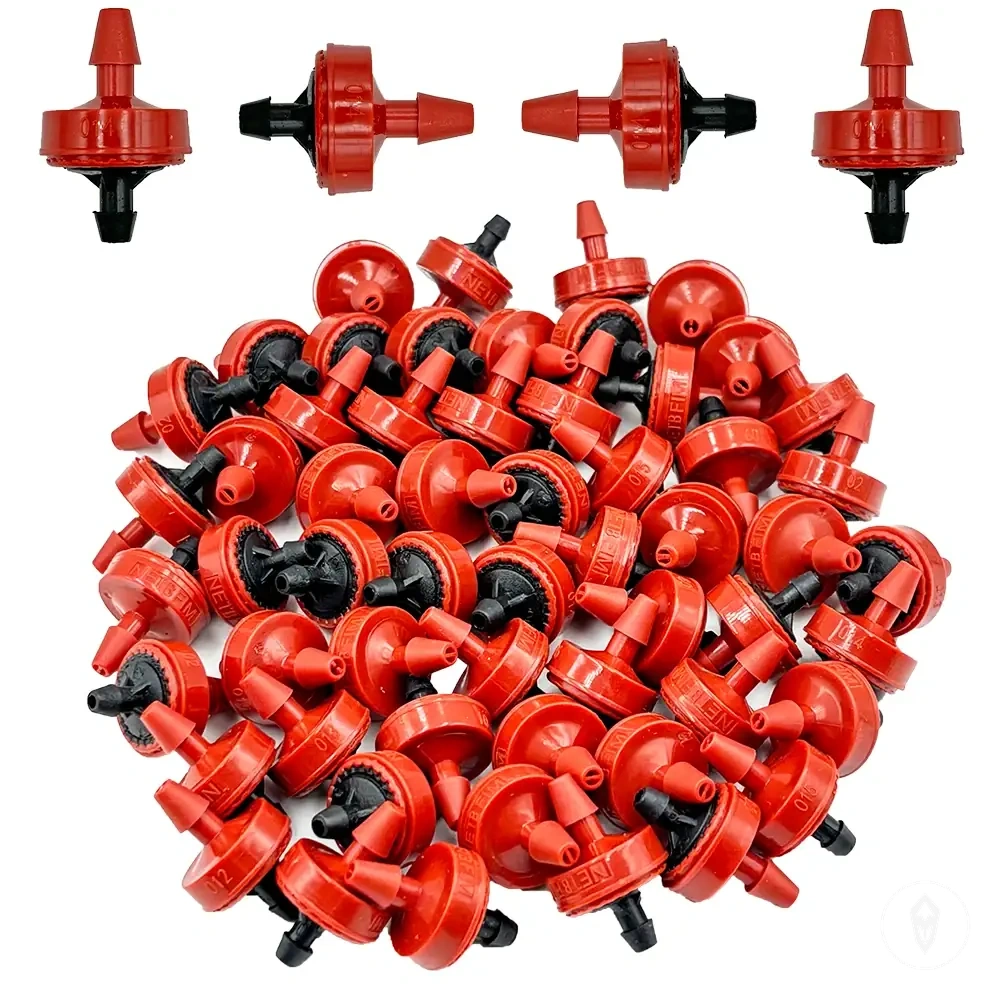
This chart shows the three main selection paths for automatic watering system components and their key decision factors.
Parts That Commonly Need Cleaning or Replacement
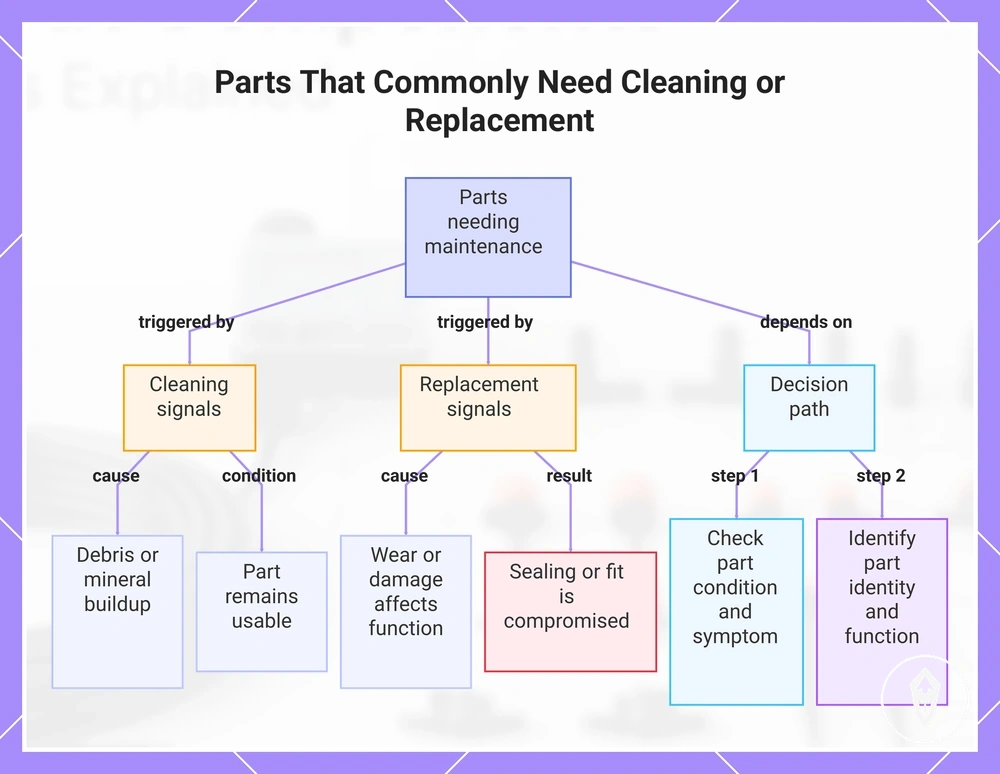
Filters, emitters, connectors, washers, valves, tubing ends, and stakes are among the parts that commonly need cleaning or replacement when their condition affects water delivery. Cleaning cues usually relate to clogging, debris, or buildup, while replacement cues relate to wear, damage, or sealing problems. The correct maintenance choice depends on the part condition, visible symptom, and the function the component performs in the watering path.
Cleaning needs often appear when debris, mineral buildup, or outdoor exposure affects a part’s condition.
Cleaning needs often appear when debris, mineral buildup, or outdoor exposure affects a part’s condition. Filters can collect debris that contributes to clogging, and emitters can develop blockages that affect flow at the outlet. These conditions are maintenance signals rather than fixed schedules because cleaning needs depend on water conditions, usage, and the surrounding environment.
Identifying part identity and function helps separate a replacement cue from a cleaning cue.
Replacement cues appear when wear or damage affects a part’s fit, function, or sealing ability. Connectors, washers, and valves may need replacement when wear affects connection quality or water control, while tubing ends and stakes may need attention when damage changes their role in the system. Identifying part identity and function helps separate a replacement cue from a cleaning cue.
For additional diagnostic guidance, see fix common kit problems .
Visible symptoms can have more than one cause, so checking the affected part condition helps separate cleaning needs from replacement needs. For additional diagnostic guidance, see fix common kit problems.
The checklist below separates common maintenance signals and the likely cleaning or replacement path.
Parts That Commonly Need Cleaning or Replacement can be recognized by condition, symptom, and likely action. The checklist below separates common maintenance signals and the likely cleaning or replacement path.
- Filters: Debris buildup or clogging condition → cleaning may be needed when filter condition affects water movement.
- Emitters: Blockage or restricted outlet condition → cleaning or replacement may be considered when flow behavior changes at the outlet.
- Connectors: Wear or damaged connection condition → replacement may be needed when sealing or joining function is affected.
- Washers: Worn sealing condition → replacement may be needed when the seal no longer supports a suitable connection.
- Valves: Wear affecting flow control or shutoff function → replacement may be needed when valve condition changes system behavior.
- Tubing ends: Damage from exposure or accidental impact → replacement may be needed when the connection area no longer supports a suitable fit.
- Stakes: Damage or weakened support condition → replacement may be needed when outlet positioning is affected.
Cleaning is considered when a part remains usable but has debris, mineral buildup, or a condition affecting delivery, while replacement is considered when wear or damage affects fit or function. The correct path depends on the component condition, system layout, and whether the part can continue performing its intended role.
Before buying, always review the compatibility criteria, essential features, and product details.
Here are product examples that may make comparison easier. Before buying, always review the compatibility criteria, essential features, and product details.
This chart shows the main signals for cleaning versus replacement in irrigation components, based on part condition, visible symptom, and likely action.
When Part Details Belong in Setup or Troubleshooting Contexts
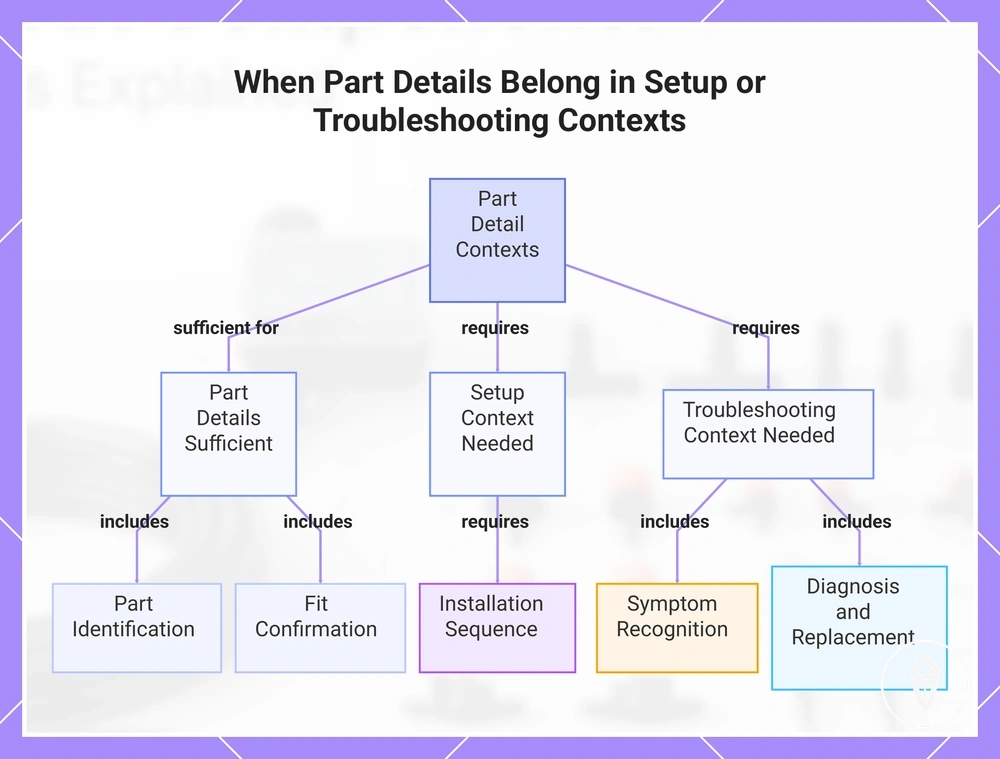
Part details are enough when the user needs part identification, fit confirmation, or an explanation of how a component affects the watering system. Setup context or troubleshooting context is needed when the user requires ordered actions, symptom interpretation, or a process for changing the system. The boundary depends on whether the need is explanation or action guidance.
The boundary depends on whether the need is explanation or action guidance.
In a setup context, part identification and fit confirmation help establish whether components are suitable before installation begins. Component knowledge can explain connection roles, fit conditions, and setup readiness, but it does not replace an installation sequence when the user needs ordered actions. When the user moves from understanding parts to assembling the system, the next context is installation guidance.
When the user needs the ordered setup process, see installation steps for kit parts .
In a troubleshooting context, symptom recognition helps connect visible conditions with possible causes, while leak diagnosis, clog diagnosis, and replacement readiness require action-focused guidance. Part details can explain constraints, such as how a seal relates to connection condition or how an emitter relates to water delivery, but they do not replace ordered fixes. When the user needs the ordered setup process, see installation steps for kit parts.
Part knowledge describes causes and constraints; action contexts describe ordered responses.
For example, knowing that a filter can collect debris explains a possible cause of reduced flow, while a troubleshooting context explains how to investigate the symptom and choose an action. Part knowledge describes causes and constraints; action contexts describe ordered responses.
The checklist below separates part-level explanation from installation or troubleshooting guidance.
When Part Details Belong in Setup or Troubleshooting Contexts depends on whether the user needs identification, fit, symptoms, or ordered action. The checklist below separates part-level explanation from installation or troubleshooting guidance.
- Part identification: Stay with part details when the goal is naming a component or understanding its role.
- Fit confirmation: Use part-level information when checking whether connected components match.
- Installation sequence: Move to setup guidance when the user needs ordered actions for assembling the system.
- Symptom recognition: Use troubleshooting context when visible conditions need interpretation beyond component description.
- Leak or clog diagnosis: Move to problem-focused guidance when identifying possible causes behind specific symptoms.
- Replacement readiness: Use condition and function checks when deciding whether a part detail suggests replacement consideration.
This chart shows when to use part-level explanation versus when to switch to setup or troubleshooting guidance based on the user's need for identification, fit, symptoms, or ordered actions.