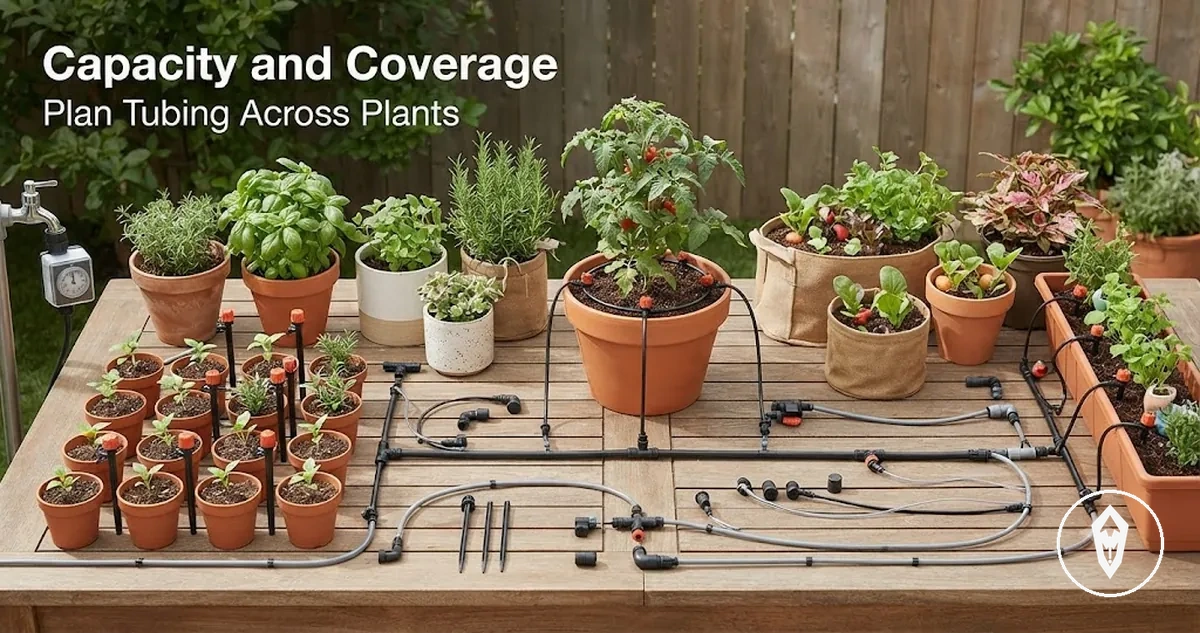
Automatic Watering Kit Capacity and Coverage Guide
An automatic watering kit’s capacity and coverage describe how effectively a watering kit supports plant watering points across a planned layout. Capacity refers to the supported distribution ability of the kit, while coverage refers to the reach created through plant count, tubing length, emitters, layout, flow, and pressure conditions. These attributes are decision factors rather than fixed guarantees because the practical result changes with the arrangement being watered.
Evaluating these factors helps separate a stated capacity claim from practical coverage needs.
The capacity of an automatic watering kit is shaped by the relationship between plant count, watering points, and outlet density. Tubing length and layout influence the reach of the watering kit across containers or planting areas, while emitters and drippers determine how water is delivered to individual points. Flow and pressure conditions influence whether the connected watering points receive suitable distribution throughout the layout. Evaluating these factors helps separate a stated capacity claim from practical coverage needs.
The capacity of an automatic watering kit is shaped by the relationship between plant count, watering points, and outlet density.
Capacity and coverage are related but distinct terms that need practical definitions before comparing automatic watering kit options. Capacity focuses on how the kit’s parts support watering points, while coverage focuses on how those points are arranged across the available space. Understanding this difference creates a foundation for evaluating plant count, tubing reach, emitter placement, layout limits, and water distribution conditions.
Table of Contents
What Capacity and Coverage Mean for Automatic Watering Kits
Capacity and coverage for automatic watering kits are the supported watering points and practical water-distribution reach of a kit. Capacity describes how a watering kit supports watering points through its available parts and arrangement. Coverage describes how that water distribution reaches plants through emitters, tubing length, and layout.

Automatic watering kits connect capacity and coverage through plant count, emitters, tubing length, and practical reach. A kit claim describes a possible arrangement, while practical capacity reflects the real setup limits created by watering points, outlet placement, and distribution reach. You can use automatic watering kits as the broader category context when understanding how these attributes relate. Capacity is not the same as full setup compatibility because the watering kit layout and parts must match the intended arrangement.
Plant Count Capacity in Multi Plant Watering Kits
Plant count in a multi plant watering kit is a conditional estimate based on the number of watering points a layout can support. The practical plant capacity changes with plant size, container type, dripper count, and emitter flow. A listed plant count should be treated as a guide because the real capacity depends on how water demand is distributed across the connected plants.
The practical plant capacity changes with plant size, container type, dripper count, and emitter flow.
Pots and containers affect plant count because different container sizes create different water demands. A multi plant watering kit with more watering points can support more plants when outlet allocation matches the arrangement. Plant spacing changes how emitters are positioned across the container group, while water demand determines whether the available distribution points are suitable for the plants being watered.
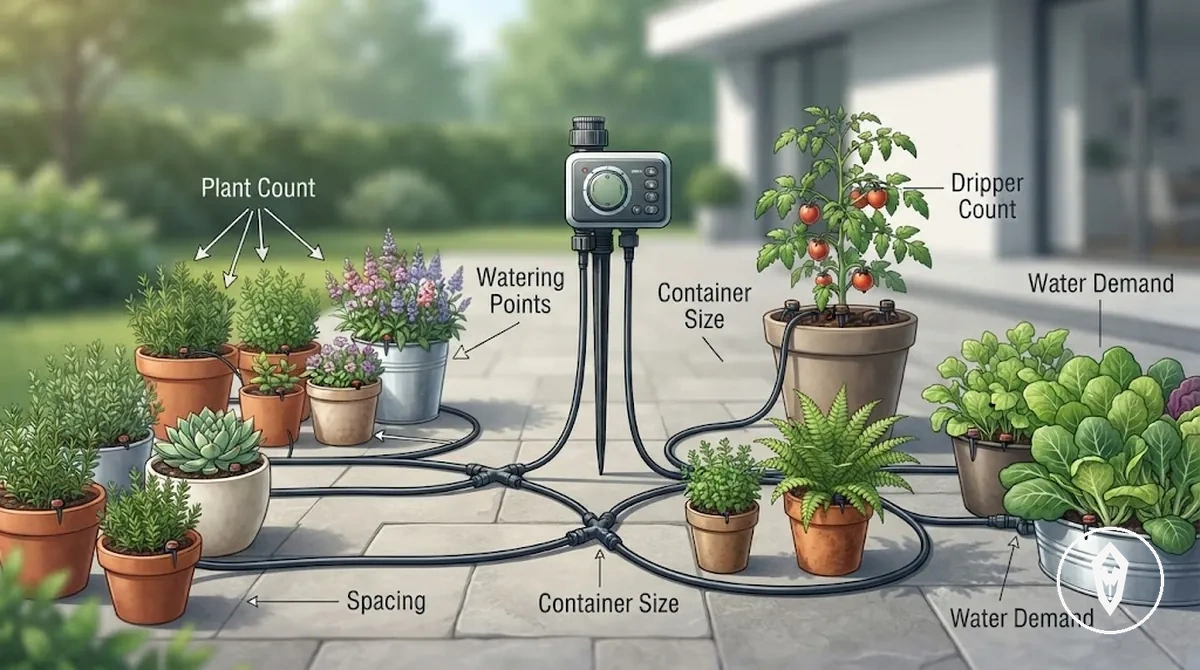
Dripper count and emitter flow help determine whether a watering kit layout remains within a practical capacity range. A container group with similar water needs can use watering points differently from a mixed layout with higher-demand plants. Use these checks to evaluate plant count capacity:
- Plant size: Larger pots and containers can require more water distribution than smaller planting containers.
- Spacing: Container spacing affects the arrangement of watering points and emitter placement.
- Outlet allocation: Watering points should match the number and arrangement of plants in the layout.
- Emitter flow: Emitter flow influences how water is distributed across connected plants.
- Mixed water demand: Different plant requirements can change whether a listed plant count is practical.
Capacity for Around 10 Plants
A kit marketed for around 10 plants is more likely to be adequate when the small plant group has suitable watering points, matching water demand, and an arrangement that fits the available outlets. Small pots with lower water demand may place different requirements on the layout than larger containers. The main condition for adequacy is whether the emitter count and outlet allocation match the plants being watered.
Small pots with lower water demand may place different requirements on the layout than larger containers.
Around 10 plants can represent different capacity needs depending on container size, spacing, and water demand. Small pots or grouped plants with similar needs may use watering points differently from medium containers that require additional distribution. Spacing influences emitter placement and the layout of outlets, while emitter count helps determine how water is distributed across the plants. A 10-plant kit should therefore be evaluated through the relationship between plant size, spacing, and outlet demand rather than a fixed plant number.
Capacity for Around 20 Plants
A kit marketed for around 20 plants requires more careful layout planning because higher plant counts increase the need for balanced watering points. A 20-plant kit should be evaluated through emitter count, branch lines, tubing branches, and plant spacing rather than treated as a fixed capacity level. As the number of outlets increases, layout complexity also increases.
As the number of outlets increases, layout complexity also increases.
Around 20 plants can create different capacity conditions depending on the multi-plant layout and water demand of the plants. Tubing branches divide the distribution path, while branch lines and outlets influence how water reaches different parts of the arrangement. Emitter count, plant spacing, and flow consistency affect whether the layout remains suitable for the intended watering points. Smaller pots with similar water needs may create different demands from larger containers with higher outlet requirements.
Capacity Ranges Beyond the Listed Plant Count
A capacity range beyond the listed plant count should be interpreted as a practical range shaped by layout conditions rather than a fixed expansion of supported plants. Conservative capacity, typical capacity, and stretched capacity describe different levels of allowance between the stated capacity and the real watering arrangement. The listed plant count is a reference point that requires evaluation against plant demand, emitter type, tubing run, and pressure condition.
The practical range changes when the watering kit parts interact with the growing layout.
The practical range changes when the watering kit parts interact with the growing layout. Plant demand influences required water distribution, emitter type affects outlet delivery, tubing run changes the distribution path, and pressure condition influences flow consistency across the watering points. A conservative capacity uses more allowance for changing conditions, a typical capacity reflects a balanced arrangement, and a stretched capacity has less margin when layout factors become more demanding.
A conservative capacity uses more allowance for changing conditions, a typical capacity reflects a balanced arrangement, and a stretched capacity has less margin when layout factors become more demanding.
Use this criteria split to interpret capacity ranges:
- Conservative capacity: A layout with lower plant demand and more allowance between the listed plant count and the practical arrangement.
- Typical capacity: A layout where plant demand, emitter type, tubing run, and pressure condition are reasonably aligned.
- Stretched capacity: A layout where higher demand or more complex distribution conditions reduce the available margin.
Tubing Length, Run Distance, and Layout Reach
A patio with nearby containers, a balcony with grouped pots, or a garden bed with dispersed plants can create different reach requirements for an automatic watering kit. Tubing length and run distance shape layout reach by defining the distribution path between the water source and watering points. The practical coverage of the kit depends on how the tubing arrangement matches the physical layout.
The practical coverage of the kit depends on how the tubing arrangement matches the physical layout.
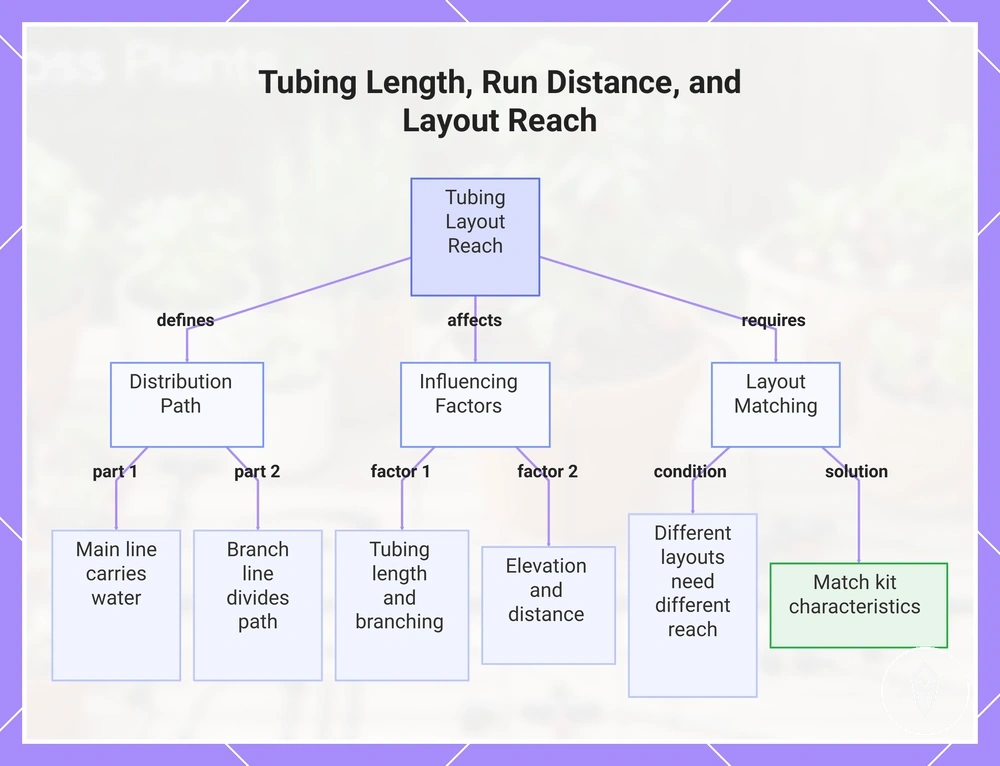
The main line carries water through the primary distribution path, while the branch line divides that path toward different watering areas. End-of-line reach is influenced by the tubing length, branching arrangement, and distribution conditions across the layout. A shorter tubing run with fewer branches creates a different coverage pattern from a layout with multiple branch tubing sections.
Elevation and distance from the water source can also affect the conditions across the tubing run.
Elevation and distance from the water source can also affect the conditions across the tubing run. Changes in elevation may influence flow conditions, while longer distances from the water source can create different distribution results toward end-of-line points. These factors help explain why patios, balconies, garden beds, and dispersed containers can require different layout reach considerations.
These factors help explain why patios, balconies, garden beds, and dispersed containers can require different layout reach considerations.
When reach considerations connect with broader setup requirements, you can match a kit to your setup by checking how the kit characteristics align with the intended arrangement.
This chart explains how tubing length, run distance, and layout reach interact to define the distribution path and coverage of an automatic watering kit.
This chart explains how tubing length, run distance, and layout reach interact to define the distribution path and coverage of an automatic watering kit.
Short Runs, Long Runs, and Main Line Limits
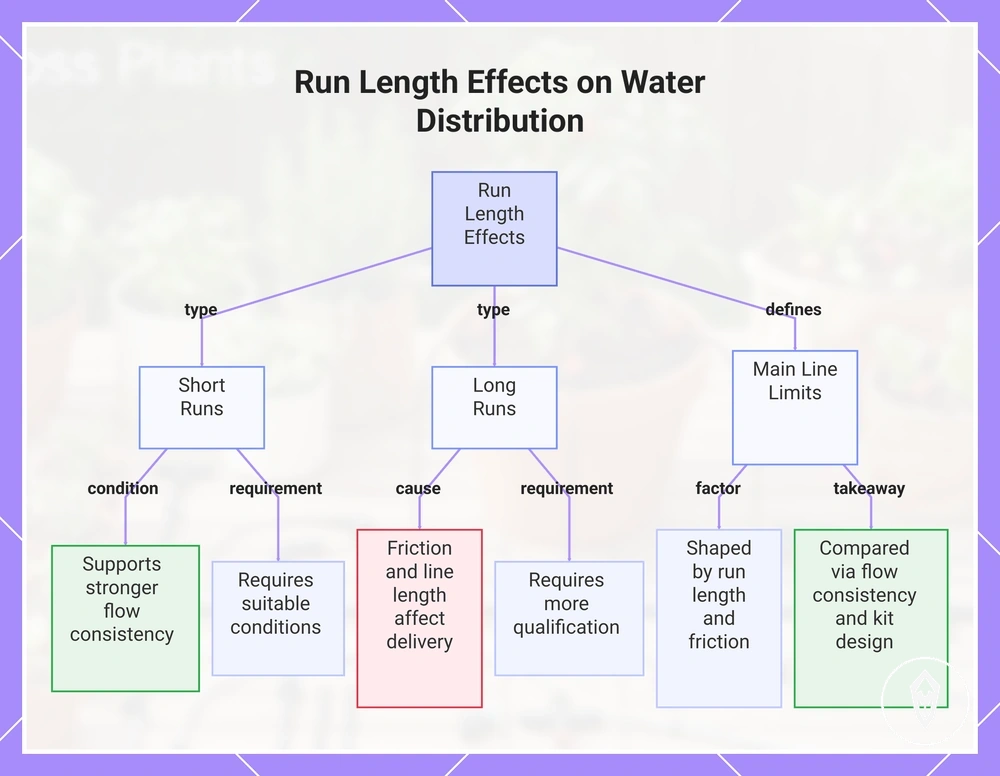
Short runs and long runs create different conditions for how an automatic watering kit distributes water through the main line. Short runs can support stronger flow consistency when the tubing arrangement, pressure condition, and kit design are suitable. Long runs require more qualification because friction and line length can affect end-point delivery.
Main line limits are shaped by run length, friction, and the conditions of the tubing path.
Main line limits are shaped by run length, friction, and the conditions of the tubing path. A longer tubing run can create more opportunity for flow changes before water reaches the end outlet, while pressure qualification and tubing characteristics influence the final coverage result. Short, moderate, and long runs should therefore be compared through flow consistency, end-point delivery, and the specific design of the watering kit rather than a universal distance rule.
This chart shows how short runs, long runs, and main line limits influence water distribution in automatic watering kits, focusing on flow consistency and end-point delivery.
This chart shows how short runs, long runs, and main line limits influence water distribution in automatic watering kits, focusing on flow consistency and end-point delivery.
Branch Lines, Splitters, and Container Spacing
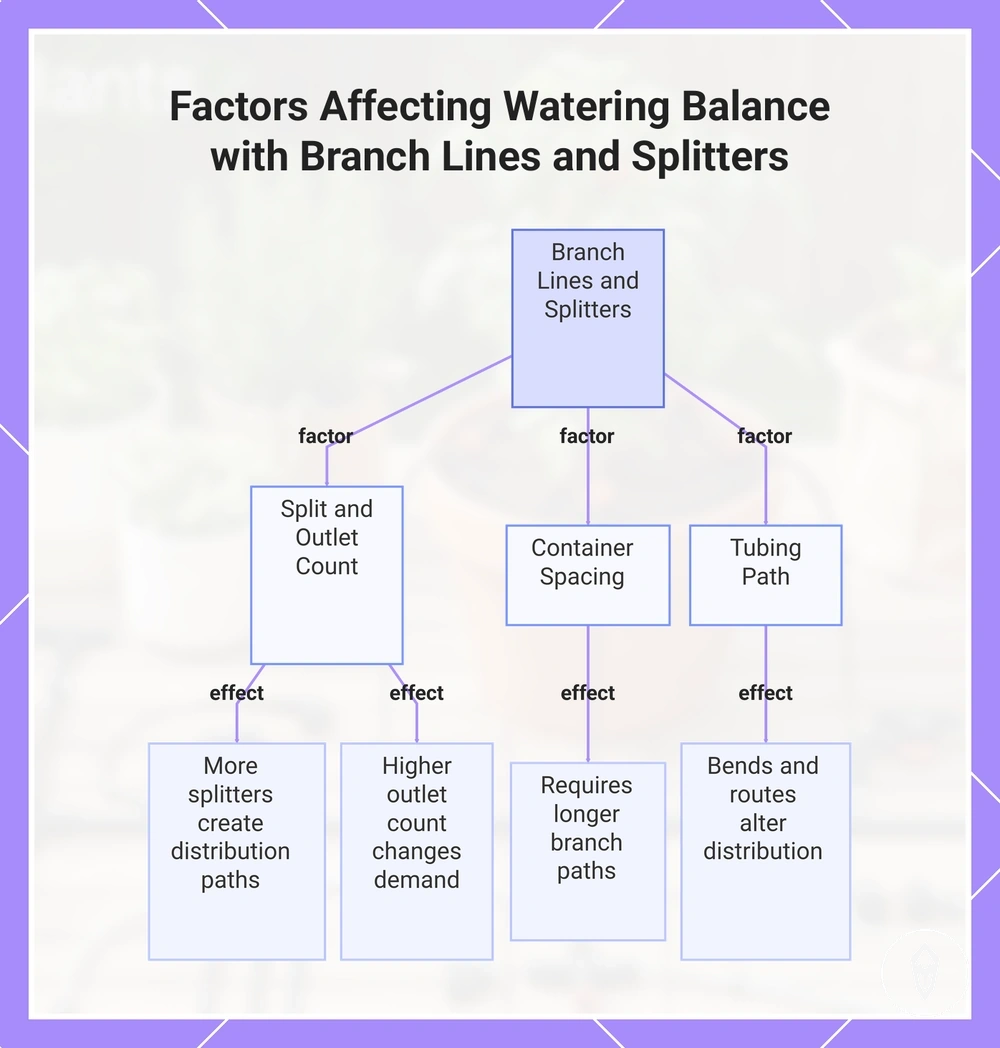
Separated containers on a patio, balcony, or garden area may require branch lines and splitters to distribute water across different locations. Branch lines change the distribution path because each splitter, bend, and branch arrangement can affect how water reaches individual containers. Balanced watering depends on how the tubing path, container spacing, and outlet count work together.
Balanced watering depends on how the tubing path, container spacing, and outlet count work together.
Branch lines and splitters distribute water across multiple containers, but the result is not always the same across every branch. Local branch conditions can influence whether the layout provides balanced watering or creates an uneven watering outcome.
- Split count: More splitters create additional distribution paths, which can change how outlets share the available water flow.
- Container spacing: Greater spacing can require longer branch paths to reach separated watering points.
- Tubing path: Additional bends and branch routes can alter the distribution conditions across the layout.
- Outlet count: A higher outlet count changes the demand placed on the branch arrangement and can affect watering balance.
This chart shows how split count, outlet count, container spacing, and tubing path affect watering balance for separated containers using branch lines and splitters.
Coverage Area for Containers, Beds, and Small Landscape Zones
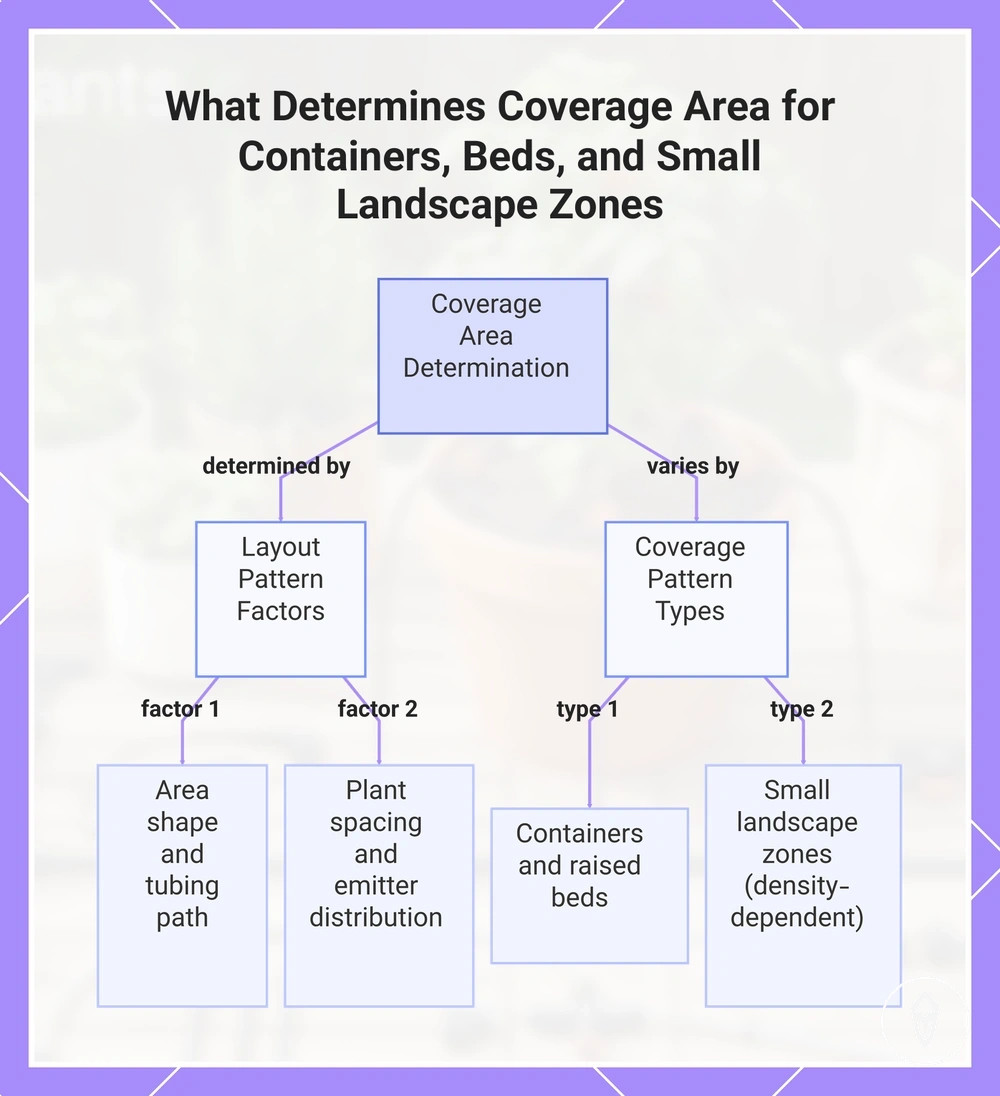
Coverage area for an automatic watering kit is determined by the layout pattern rather than a fixed physical area. Containers, raised beds, and small landscape zones require different coverage patterns because area shape, plant spacing, emitter distribution, and tubing path influence where water is delivered.
Coverage area for an automatic watering kit is determined by the layout pattern rather than a fixed physical area.
Containers usually organise coverage around individual pots or grouped planting areas, while raised beds create broader planting patterns where spacing and emitter distribution shape the watering zone. The tubing path affects how the distribution reaches each part of the layout, and the area shape determines how watering points are arranged. A container group, bed layout, or small landscape zone can therefore create a different practical coverage pattern even when the same kit category is used.
Small landscape zones require additional qualification because coverage area changes with layout density and water delivery style.
Small landscape zones require additional qualification because coverage area changes with layout density and water delivery style. A dense planting arrangement and a more spaced layout can use the same watering kit differently, making practical coverage dependent on emitter distribution, plant spacing, and the physical shape of the zone.
This chart shows the key factors and application types that determine coverage area for automatic watering kits.
This chart shows the key factors and application types that determine coverage area for automatic watering kits.
Emitter Count, Dripper Placement, and Outlet Density
Emitter count affects the usable capacity of an automatic watering kit because watering points determine how water is distributed across the intended plant arrangement. A higher emitter count alone does not define coverage quality because dripper placement, flow rate, adjustability, and root zone targeting influence the practical result. The relationship between delivery points and plant demand helps determine whether watering is balanced across the layout.
The relationship between delivery points and plant demand helps determine whether watering is balanced across the layout.
Dripper placement directs water delivery toward the root zone by positioning emitters according to plant location and container arrangement. Flow rate and adjustability influence how each watering point delivers water, while placement conditions can contribute to dry spots or overwatered spots when the distribution does not match the plant requirements.
Dripper placement directs water delivery toward the root zone by positioning emitters according to plant location and container arrangement.
Outlet density affects how watering points are spread across a layout, especially when different containers require different delivery patterns. Compare these emitter conditions when evaluating coverage quality:
| Entity/part | Attribute/criterion | Value/condition | Effect/decision |
|---|---|---|---|
| Emitter count | Watering point quantity | Matched to the planned plant arrangement | Influences how water delivery is distributed across the layout |
| Dripper placement | Root zone target | Positioned according to plant location and delivery needs | Helps determine coverage quality at the intended watering points |
| Outlet density | Delivery point distribution | Changes with the number and arrangement of outlets | Can influence balanced watering or uneven watering outcomes |
Large Containers and Multiple Watering Points
A large container may need multiple watering points when one outlet does not adequately match the container size, water demand, and root-zone spread. The decision depends on factors such as pot diameter, soil volume, and how the root zone extends through the container rather than the visible plant count alone.
Large containers require evaluation of emitter placement against the physical distribution area.
Large containers require evaluation of emitter placement against the physical distribution area. Pot diameter influences the width of the root-zone spread, soil volume affects the amount of growing area being supplied, and wider root zones may require additional watering points to improve delivery coverage. A one-outlet arrangement may suit a smaller distribution area, while multiple drippers or extra outlets may be considered when the container size and layout require broader water distribution.
Flow Capacity and Pressure Limits That Reduce Coverage
An automatic watering kit can contain enough physical parts but still provide reduced coverage when the hydraulic capacity does not support the layout. Flow capacity and pressure limits determine whether the water source, pump strength, and system conditions can support the required watering points. Having enough emitters and tubing does not guarantee enough hydraulic capacity for the arrangement.
Having enough emitters and tubing does not guarantee enough hydraulic capacity for the arrangement.
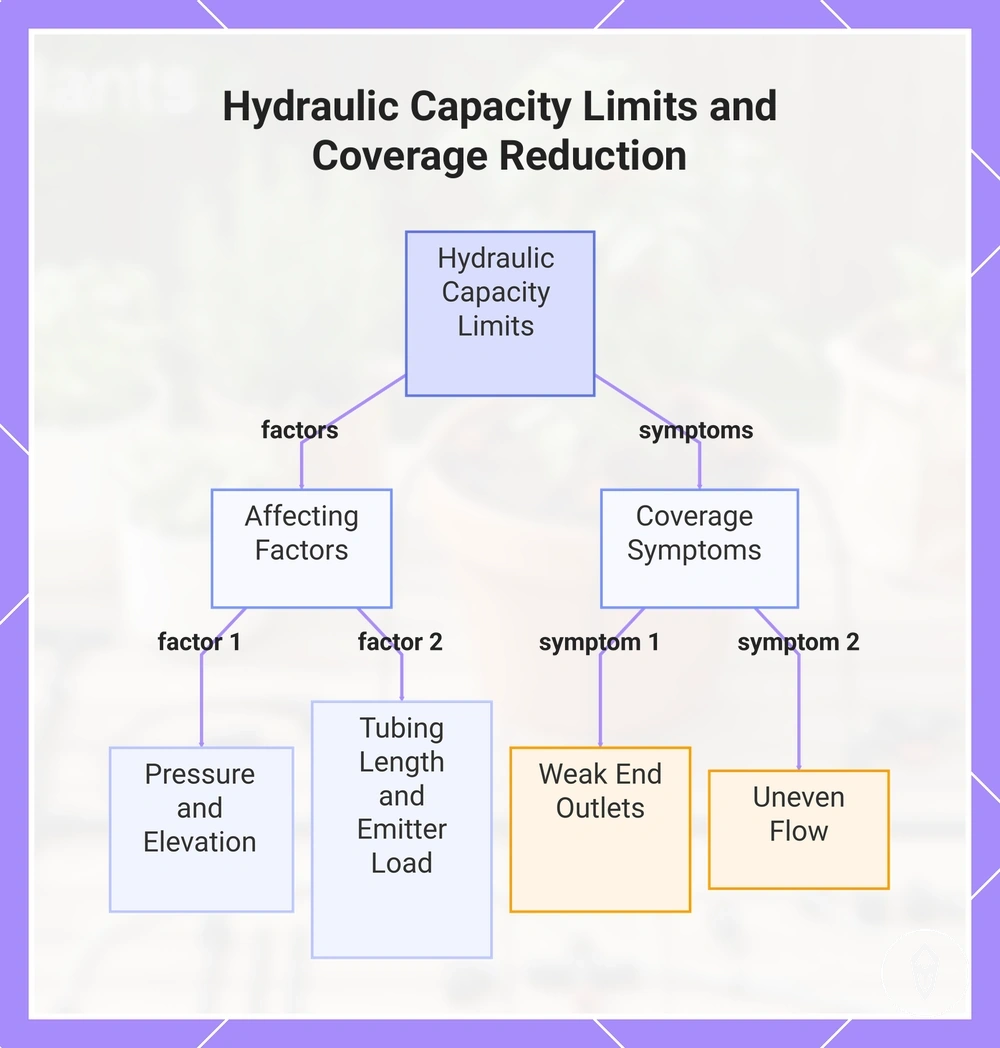
Flow capacity is affected by pressure conditions created by the water source or pump, elevation changes, tubing length, and emitter load across the layout. When these factors create limits, the available flow rate can become less consistent across watering points. The result may include reduced reach, weak outlets, or uneven watering depending on the specific pressure condition and layout demand.
When these factors create limits, the available flow rate can become less consistent across watering points.
Reduced reach and weak outlets can occur when the layout requires more hydraulic capacity than the water source and pump can provide under the existing conditions. Detailed system evaluation should consider the flow and pressure requirements alongside factors such as elevation, tubing length, and emitter load.
Detailed system evaluation should consider the flow and pressure requirements alongside factors such as elevation, tubing length, and emitter load.
Use this checklist to assess possible coverage limitations:
- Weak end outlets: May occur when flow capacity is insufficient for the demand at distant watering points.
- Uneven flow: Can appear when pressure conditions create different delivery conditions across the layout.
- Long runs: Can increase the effect of tubing length on available hydraulic capacity.
- Elevation: Can change pressure conditions between the water source and watering points.
- Emitter load: Higher delivery demand can reduce flow consistency across the arrangement.
This chart shows the key factors affecting hydraulic capacity and the resulting coverage symptoms in automatic watering systems.
How to Choose Kit Capacity Without Overextending Coverage
Choose kit capacity conservatively by matching the setup conditions with a suitable capacity tier rather than selecting only by plant count. A conservative kit size considers plant count, container size, tubing route, emitter demand, and flow condition together to avoid overextending coverage across the layout.
Choose kit capacity conservatively by matching the setup conditions with a suitable capacity tier rather than selecting only by plant count.
Use these criteria to organize the final capacity decision:
| Setup signal | What it changes | Capacity decision |
|---|---|---|
| Plant count and container size | Changes the number of watering points and delivery demand | Choose a suitable capacity tier that matches the arrangement |
| Tubing route | Changes the distribution path across the layout | Consider extra tubing when the layout requires additional reach |
| Emitter demand | Changes the number and delivery requirements of watering points | Consider extra outlets when the layout needs more delivery points |
| Flow condition | Changes the available hydraulic capacity for coverage | Size up when the layout conditions require more capacity margin |
Choosing an appropriate capacity tier can also support water efficiency with automatic watering kits by matching delivery conditions to the intended watering layout. The selection should consider how coverage control, water distribution, and plant requirements interact.
The selection should consider how coverage control, water distribution, and plant requirements interact.
Size up to a larger kit, extra tubing, or additional outlets only when the layout conditions justify the change. A larger capacity tier may be considered when plant count, container size, tubing route, emitter demand, or flow condition creates a higher distribution requirement.
Size up to a larger kit, extra tubing, or additional outlets only when the layout conditions justify the change.
Use the final setup details as a buying checklist before making a capacity decision, then compare the selected kit characteristics against the intended arrangement.
The products below are useful examples for comparing available options.
The products below are useful examples for comparing available options. Before buying, check that the compatibility criteria, key features, and product details match your needs.