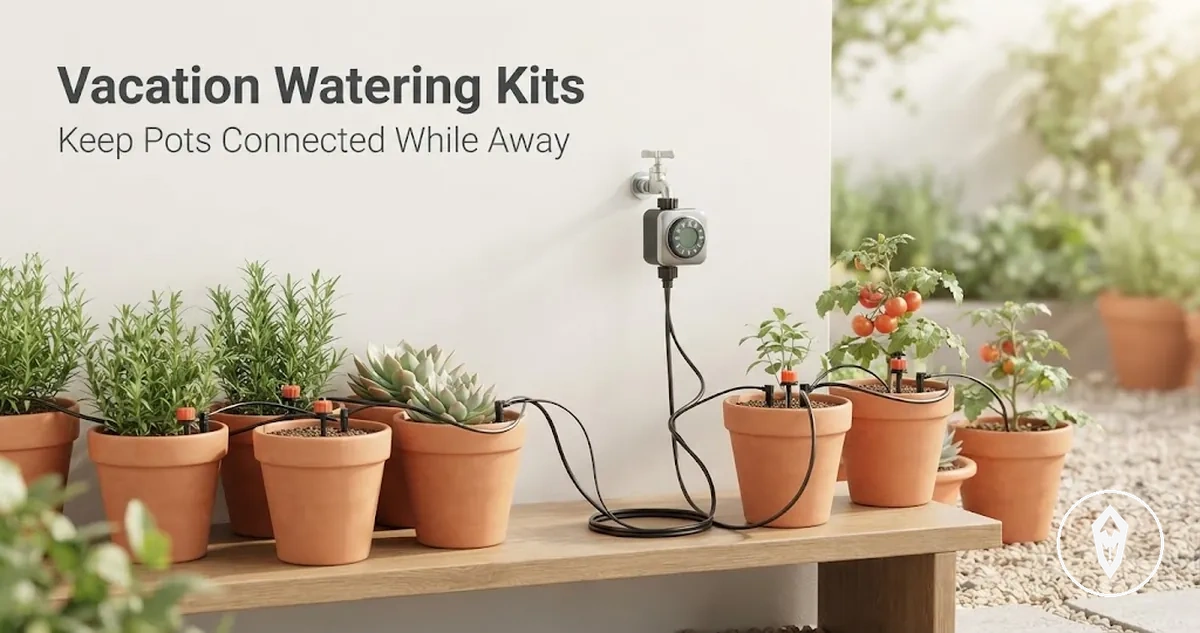
Automatic Watering Kits for Vacation Plant Watering
Automatic watering kits support vacation plant watering by delivering water from a reservoir or connected water source to potted plants through tubing and drip emitters controlled by a timer. They can maintain unattended watering only when the kit is matched to plant demand, pot size, drainage, water supply, and the planned absence length, so the result remains conditional rather than assured.
This makes setup testing the required basis for vacation plant care rather than relying on an untested schedule.
During travel, indoor plants and balcony pots continue to use water at different rates, while an unattended system cannot correct a blocked emitter, empty reservoir, flat battery, leak, or unsuitable timer setting by itself. A plant with higher water demand needs a stronger or more frequent delivery pattern than a plant that prefers drier soil, and each pot needs drainage that allows excess water to escape. This makes setup testing the required basis for vacation plant care rather than relying on an untested schedule.
Plant type, pot size, trip length, and tested delivery determine whether the kit is suitable, which leads into the specific requirements for reliable unattended watering.
Choosing a vacation watering kit starts with a compatible water source, enough drip control for the connected plant pots, and a timer or controller that can repeat the tested watering pattern throughout the trip. Watering reliability is acceptable only when a complete test cycle confirms that each emitter flows, the reservoir remains stable, the tubing stays connected, the battery or power source is ready, and no water collects around the pots. Plant type, pot size, trip length, and tested delivery determine whether the kit is suitable, which leads into the specific requirements for reliable unattended watering.
Choosing a vacation watering kit starts with a compatible water source, enough drip control for the connected plant pots, and a timer or controller that can repeat the tested watering pattern throughout the trip.
An automatic plant waterer may not be sufficient when plant needs differ sharply, the available reservoir cannot cover the absence, or nobody can respond to a leak, blockage, power loss, or depleted water supply.
Table of Contents
What Vacation Watering Requires From an Automatic Kit
What vacation watering requires from an automatic kit is a matched chain of water storage, timing, delivery, and plant coverage. The kit must store or access enough water and deliver it at a controlled rate for the full absence length. Higher plant demand requires greater water availability or more frequent delivery, while broader coverage requires consistent flow to every pot. Suitability remains conditional on the available backup margin and the setup's failure tolerance.
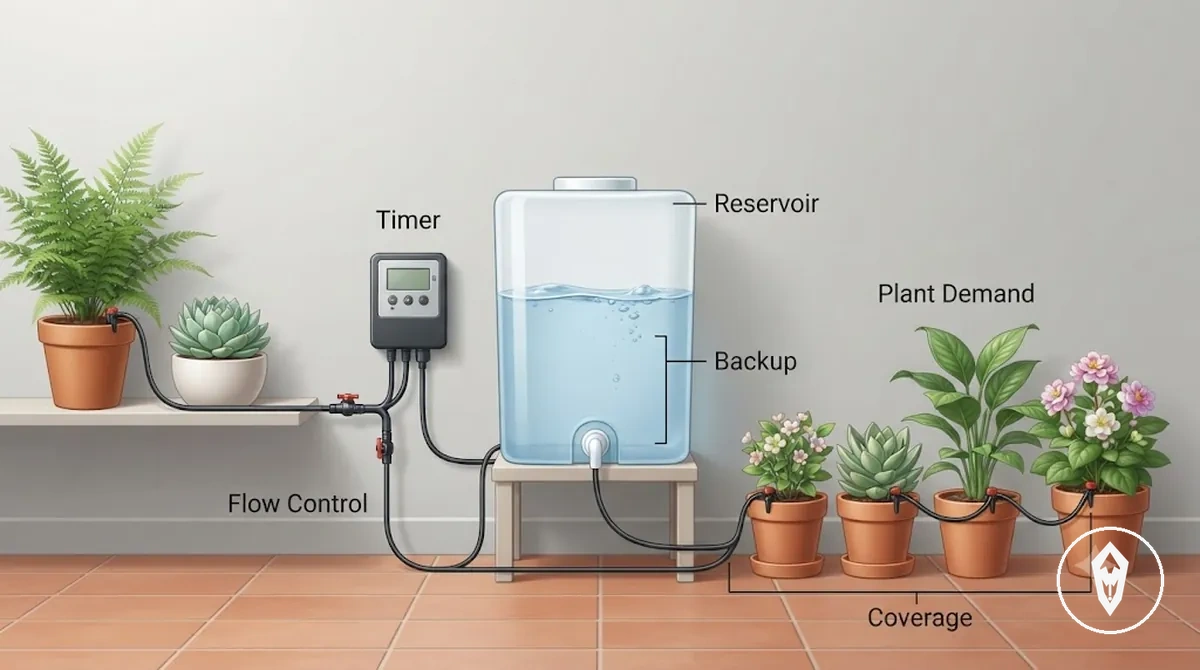
The main requirement categories for automatic watering kits are water storage, timing, flow control, coverage, and test margin. Reservoir capacity or a continuous water source sets the available supply, while the timer sets when delivery starts and how often it repeats. Flow control determines whether drip output suits lower-demand or higher-demand plants, and coverage is complete only when each connected pot receives its intended delivery. These conditions organise the table below.
| Requirement | What to check | Why it matters for vacation watering |
|---|---|---|
| Absence length | Confirm that the programmed schedule and available water cover the complete trip, including a backup margin. | Longer trips expose the setup to more watering cycles and leave less room for an undersized supply or interrupted delivery. |
| Plant water demand | Group plants by lower, moderate, or higher water demand and assign flow accordingly. | High-water plants need greater or more frequent delivery than plants that require the potting mix to dry between waterings. |
| Reservoir or water source | Check whether the source is a finite reservoir or a continuous connection and whether it remains stable throughout the absence. | A finite reservoir limits total available water, while a continuous source reduces storage limits but increases the importance of leak control. |
| Timer control | Verify that the timer supports the tested watering frequency and duration and has a ready power source. | Timer control determines when each cycle runs and whether the planned delivery pattern is repeated consistently. |
| Coverage | Confirm that every intended pot has connected tubing and a working dripper with flow suited to its plant-demand category. | Incomplete coverage leaves unconnected or low-flow pots outside the planned watering pattern. |
| Test margin | Run the complete setup before travel and retain extra water, power, and response capacity where practical. | A backup margin improves failure tolerance when plant demand is higher than expected or a minor delivery problem occurs. |
Read the table as a set of connected conditions rather than independent features. Short trips may place less demand on storage, while longer trips and high-water plants require more supply, tighter flow control, and a wider backup margin. Final watering reliability still depends on testing the complete system under the same arrangement planned for travel.
Plant Setups That Fit Vacation Watering Kits
Vacation watering kits are most compatible with stable container-based plant setups that provide reliable water access and secure emitter placement. Container plants allow tubing to remain fixed and direct water into the potting mix with less risk of displacement. Compatibility is strongest when the plant setup keeps the reservoir accessible, the tubing route protected, and the emitters positioned consistently throughout the watering period.
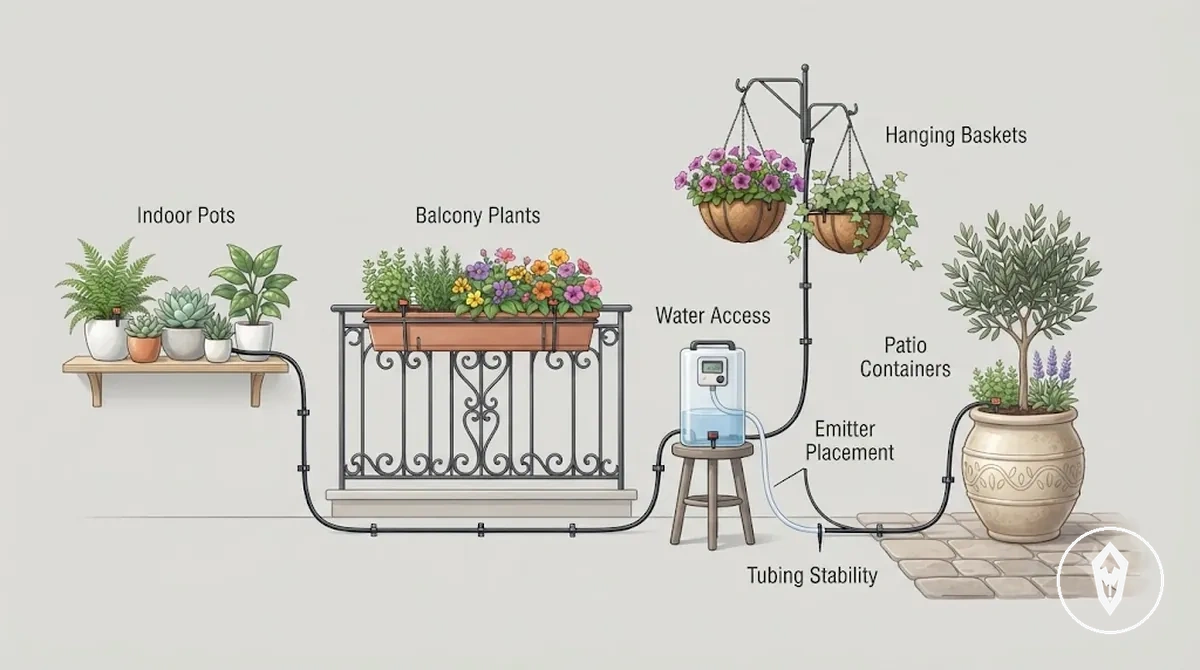
Indoor pots are suitable when drainage is available, the reservoir is positioned safely, and leak-sensitive surfaces are protected. Balcony plants can suit a vacation watering kit when wind exposure is managed with a secure tubing route and stable emitter placement. Patio containers work well when tubing remains fixed between containers, while hanging baskets require securely supported tubing because elevation and faster drying increase the importance of accurate drip outlet positioning. Across indoor pots, patio containers, balcony plants, hanging baskets, and outdoor containers, tubing stability remains the shared compatibility requirement.
In those cases, match a kit to your setup before selecting components or installation methods.
When a plant setup extends beyond container plants into garden beds or other layouts requiring broader distribution, this vacation-focused guidance is no longer sufficient because water access and placement conditions change. In those cases, match a kit to your setup before selecting components or installation methods.
- Verify that each pot or container remains stable throughout the watering period.
- Confirm that a nearby reservoir or water source can stay accessible.
- Secure the tubing path to reduce movement, snags, or disconnection.
- Position every emitter directly over the intended potting mix.
- Ensure container drainage allows excess water to leave safely.
- Group plants with similar watering demand on the same watering schedule where practical.
- Keep the complete setup accessible for testing before travel.
Indoor Potted Plants and Houseplants
Indoor potted plants and houseplants are compatible with vacation watering when each container has effective pot drainage, stable tubing, and an emitter positioned securely over the potting mix. The image below demonstrates safe indoor placement by showing reservoir placement, protected surfaces, and tubing stability in a typical indoor arrangement. Indoor suitability should be confirmed by testing the complete setup with the plant's pot size, soil moisture retention, and light exposure before leaving.
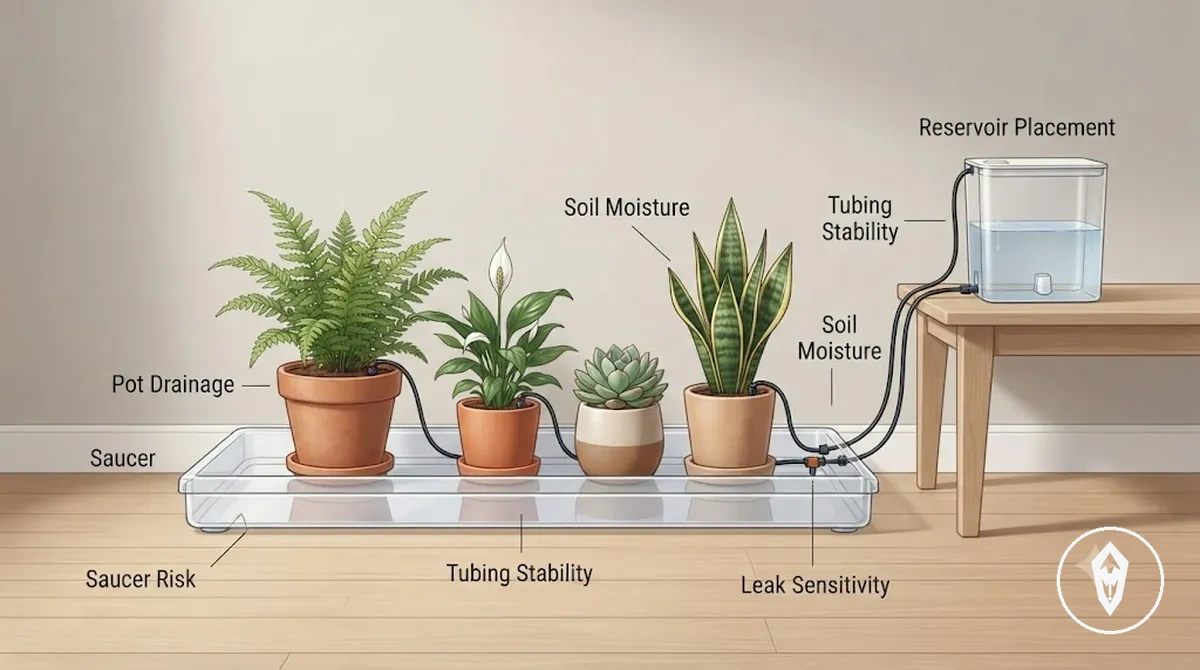
Indoor leak sensitivity increases when pot drainage is restricted, saucer risk is overlooked, or reservoir placement allows unintended water movement, so each condition should be checked before unattended operation. Houseplants with higher watering demand may require more frequent watering than low-water houseplants, while soil moisture retention changes with pot size, potting mix, and indoor light exposure. Secure tubing stability and accurate emitter placement help keep water directed into the container and reduce the risk of water reaching surrounding indoor surfaces.
- Check that pot drainage allows excess water to leave the container.
- Confirm that saucer overflow is unlikely during the planned watering cycle.
- Place the reservoir on a stable surface away from areas sensitive to leaks.
- Secure the tubing route so it remains stable throughout the watering period.
- Match plant water demand with soil moisture retention before completing a test cycle.
Patio Containers, Hanging Baskets, and Balcony Plants
Patio Containers, Hanging Baskets, and Balcony Plants are compatible with vacation watering when exposed conditions such as sun exposure, evaporation, wind, and water-source distance are considered before leaving. The image below compares these exposed container setups and shows how secure tubing stability and stable drip delivery support unattended watering under semi-exposed conditions.
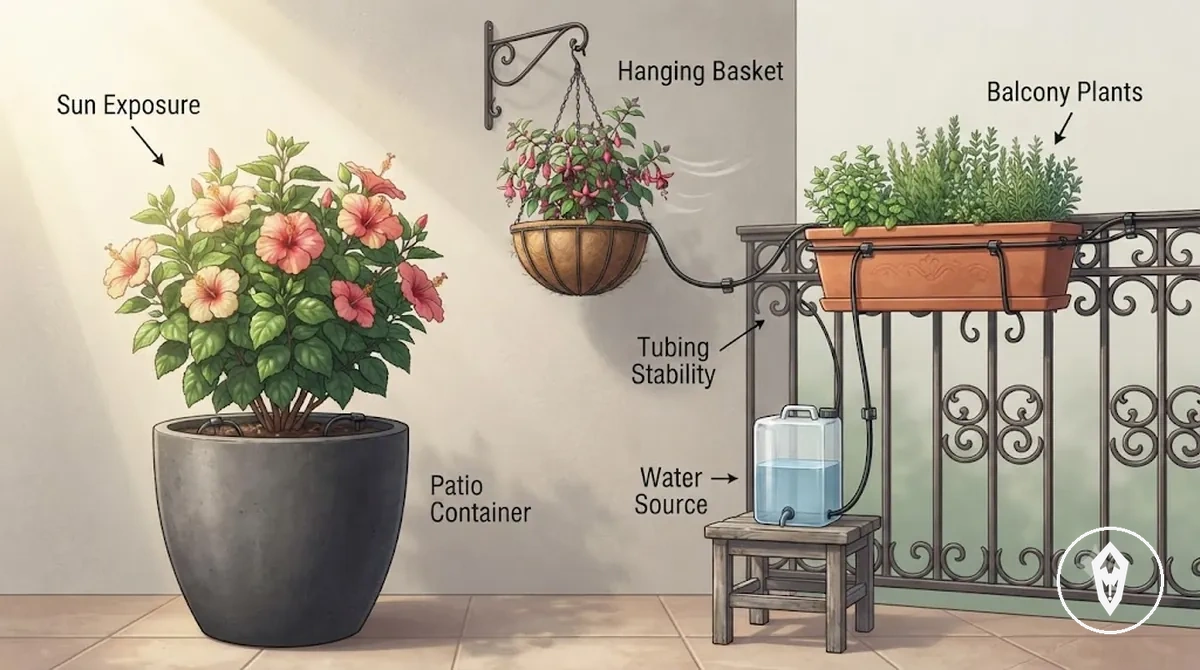
Patio containers are suitable when sun exposure, weather exposure, and pot size are considered during setup, while hanging baskets require additional care because elevation and wind can increase evaporation and move unsecured tubing. Balcony plants are better suited when the water-source distance allows a stable tubing route and the reservoir remains protected from weather exposure. The comparison below highlights the main differences between these exposed container types.
| Setup type | Main constraint | Watering adjustment | Risk to check |
|---|---|---|---|
| Patio containers | Sun exposure and evaporation | Adjust drip delivery to container size and drying conditions | Rapid soil drying between watering cycles |
| Hanging baskets | Elevation and wind | Secure tubing and emitter position before travel | Tube movement and faster moisture loss |
| Balcony plants | Water-source distance and weather exposure | Maintain a stable tubing route with protected reservoir placement | Interrupted flow caused by tubing movement or exposed routing |
Choosing a Kit for Unattended Plant Care
Choosing a Kit for Unattended Plant Care starts by matching the watering system to the conditions it must handle during your absence. The image below organizes the main selection elements by showing how trip length, plant count, water source, timer control, and failure tolerance influence the decision. Use these conditions first, then compare kit features against them.
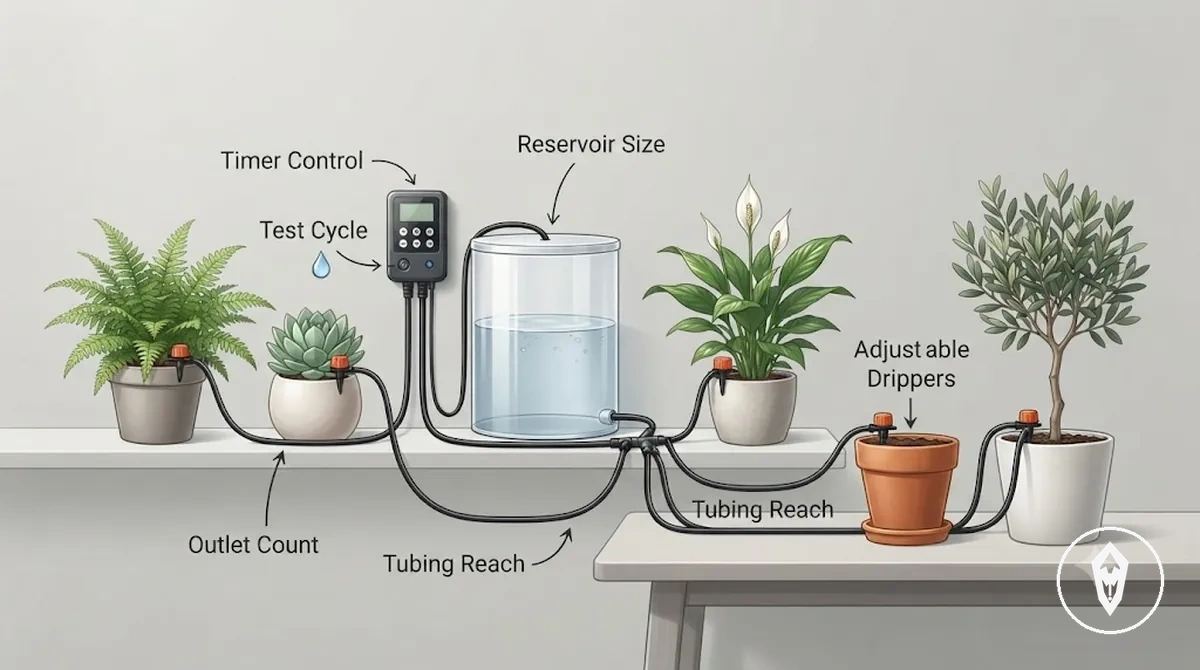
A suitable kit type should solve the watering task rather than reflect product popularity. For shorter absences, an automatic plant waterer with an appropriate reservoir size may be sufficient when the refill margin covers the expected water demand. For longer absences, a timer watering kit may provide more consistent scheduling, while mixed-plant setups benefit from an outlet count that serves every pot, adjustable drippers that allow different flow rates, and tubing reach that covers all containers without unstable routing.
The checklist below provides a practical final review.
Avoid selecting a system by feature count alone because each feature should match the unattended plant care conditions. Before you choose a reliable kit, confirm that the timer, reservoir size, tubing reach, adjustable drippers, and refill margin suit your watering needs, then complete a full test cycle. The checklist below provides a practical final review.
- Match the kit type to the planned trip length.
- Confirm the outlet count covers the total plant count.
- Check that the available water source supports the required tubing reach.
- Select a timer when scheduled watering is needed.
- Leave sufficient reservoir margin for the planned absence.
- Verify adjustable drippers and complete a full test cycle before leaving.
Trip Length and Watering Frequency
Trip length changes watering frequency because the programmed interval should match the expected absence length and normal plant moisture demand. A suitable programmed interval also requires reservoir capacity that supports the planned watering duration for the selected timer schedule. If pot size, soil type, or indoor climate increase moisture loss, watering frequency should be adjusted to those conditions instead of following a fixed routine.
The table below summarizes how trip length and plant moisture demand influence watering-frequency checks before leaving.
The table below summarizes how trip length and plant moisture demand influence watering-frequency checks before leaving. Use it as a selection guide rather than a fixed schedule because plant species, pot size, reservoir capacity, and indoor climate can change the most suitable watering interval.
| Trip condition | Watering-frequency check | Why it matters |
|---|---|---|
| Short absence | Confirm the programmed interval matches the normal watering demand. | Helps maintain routine soil moisture without unnecessary watering. |
| Longer absence | Check that reservoir capacity covers the planned watering duration and programmed interval. | Reduces the risk of the reservoir running empty before the trip ends. |
| High-demand plants | Review plant moisture demand together with pot size and adjust the watering frequency when needed. | Plants that dry more quickly may need a different timer schedule than lower-demand plants. |
Plant Count, Pot Size, and Coverage Range
Plant count and pot size determine the minimum coverage range an unattended watering kit should support. More plants require enough outlets and emitter count for every watering point, while larger container volume may require higher dripper output than smaller pots with lower water demand. If the planned layout approaches the kit's coverage limit, a separate coverage calculation is more appropriate.
Plant count and pot size determine the minimum coverage range an unattended watering kit should support.
Uneven watering often results from mixing plants with different water demand or overlooking tubing reach and spacing. Group plants with similar water demand, then confirm that tubing length reaches every container without unnecessary routing; for more complex layouts, see coverage and capacity for unattended watering because larger setups may require a broader capacity assessment beyond vacation-specific selection.
- Outlets: Match the outlet count to the plant count or planned watering groups.
- Tubing length: Ensure tubing reach covers the intended layout with practical spacing between containers.
- Emitter count: Provide one emitter for each required watering point, with additional emitters only where the kit supports them.
- Pot size: Consider container volume because larger pots may need greater dripper output than smaller containers.
- Grouping: Place plants with similar water demand on the same watering group to simplify flow adjustment.
- Coverage margin: Leave spare coverage capacity for routing changes or small layout adjustments instead of using every outlet and tubing length available.
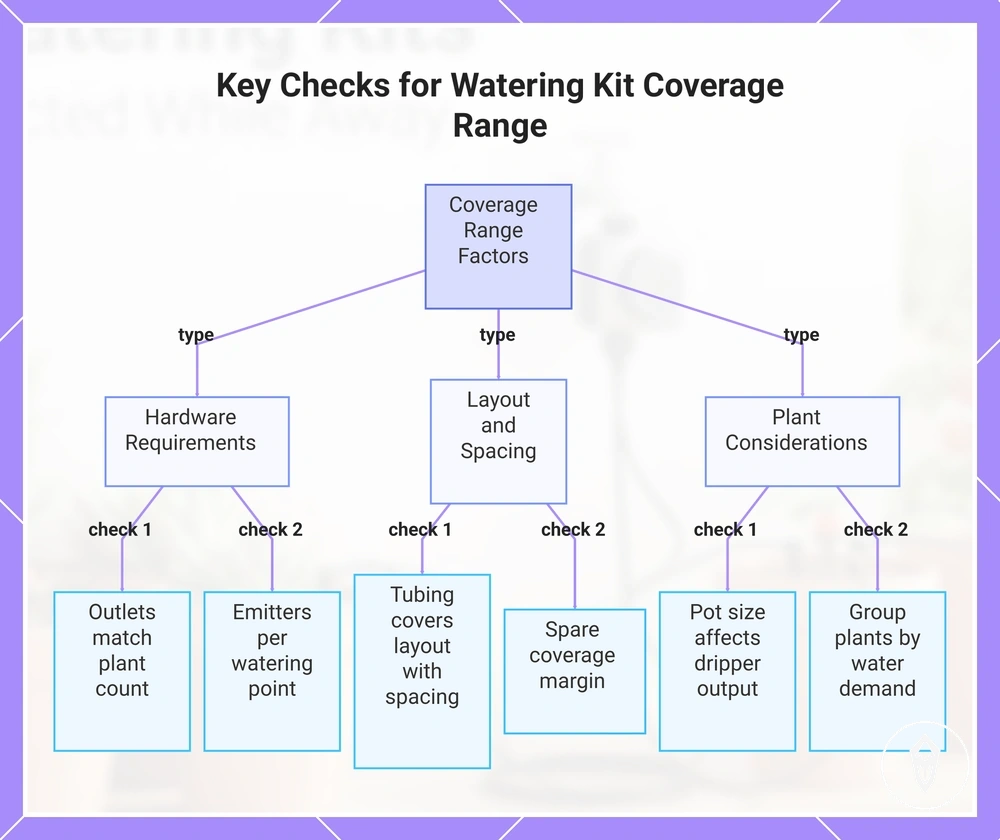
This chart shows the essential checks to ensure your unattended watering kit covers the intended plant layout, covering hardware, layout, and plant factors.
Timer, Reservoir, and Drip Control Reliability
Timer, reservoir, and drip control reliability determine whether an automatic watering kit can continue operating without supervision. Reliable vacation watering requires consistent timer control, an adequate water supply, and stable water delivery, while battery condition, clogging, or installation quality can reduce dependable operation. Checking each control before departure provides a more reliable outcome than assuming any component will continue working unattended.
Checking each control before departure provides a more reliable outcome than assuming any component will continue working unattended.
A timer controls watering through its programmability, so the programmed interval, power source, and battery status should all be verified before travel. The reservoir provides the available water storage, making reservoir volume and a practical refill margin important for the planned absence length. Drip control combines emitter adjustability, pump or gravity delivery, anti-siphon behavior, and clog resistance to support consistent drip output, although each should be confirmed under the intended setup because operating conditions can differ.
The table below summarises the main reliability checks before leaving.
The table below summarises the main reliability checks before leaving. For a broader explanation of controller behaviour and water delivery, see timer and flow reliability, then complete a test cycle, confirm spare reservoir capacity, and use a conservative flow setting before departure.
| Part or control | Attribute to check | Safe condition | Effect on vacation watering |
|---|---|---|---|
| Timer | Programmability | Watering program matches the intended interval and completes a successful test cycle. | Supports consistent watering during the planned absence. |
| Power source | Battery status | Battery has sufficient remaining capacity or external power remains stable. | Reduces the risk of interrupted timer operation. |
| Reservoir | Reservoir volume | Available water includes a practical reserve beyond expected use. | Reduces the chance of the water supply running out before return. |
| Pump or gravity feed | Water delivery | Water flows consistently through the selected delivery method during testing. | Helps maintain predictable watering when the setup remains unchanged. |
| Emitter | Emitter adjustability | Drip output is adjusted to suit the connected plants without excessive flow. | Improves watering consistency across different containers. |
| Tubing | Anti-siphon behavior | Tubing layout prevents unwanted siphoning after each watering cycle. | Reduces unintended water loss between watering events. |
| Clog resistance | Flow path condition | Emitters and tubing remain clear during the pre-travel test. | Helps maintain steady drip control throughout the trip. |
Setting Up Vacation Watering Before You Leave
A vacation watering setup should prove reliable water delivery before you leave rather than after the trip has begun. Testing the setup in advance helps identify uneven watering, loose tubing, or incorrect timer settings while adjustments are still practical. The goal is to confirm vacation readiness instead of completing a full installation tutorial.
Complete the following steps before departure to verify the setup.
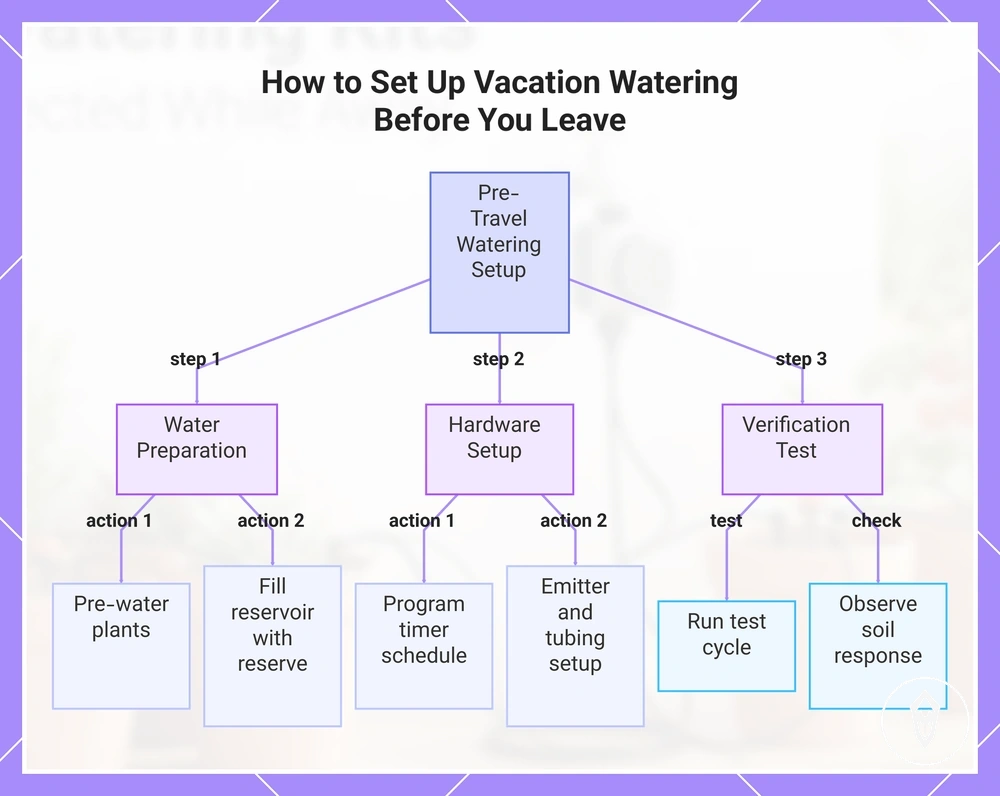
Before travelling, prepare the pre-travel setup under normal watering conditions so plants and equipment begin from a stable starting point. Pre-watering, reservoir filling, timer programming, emitter placement, tubing security, plant grouping, and a short observation period all contribute to unattended watering readiness. Complete the following steps before departure to verify the setup.
- Pre-water the plants so soil moisture begins at an appropriate level before the automatic watering schedule starts.
- Complete reservoir filling and confirm the available water includes a practical reserve for the planned absence.
- Finish timer programming by checking that the intended watering schedule is saved and ready to run.
- Position emitters for each plant grouping so water reaches the root area, then secure the tubing to reduce movement or accidental disconnection.
- Run a test cycle to verify that every emitter delivers water and that no obvious leaks or uneven watering appear.
- Observe the soil response during a short observation period and make conservative adjustments only if the test shows overwatering or insufficient watering.
This chart shows the three main steps to verify your vacation watering setup before departure, including preparation, hardware setup, and final testing.
Testing Water Delivery Across Every Plant
Testing water delivery across every plant is necessary before relying on unattended watering. One successful drip from a single emitter is not enough because a dry emitter, uneven flow, or placement mistake may affect another plant. Testing every plant provides better evidence that the complete setup is ready for travel.
Testing every plant provides better evidence that the complete setup is ready for travel.
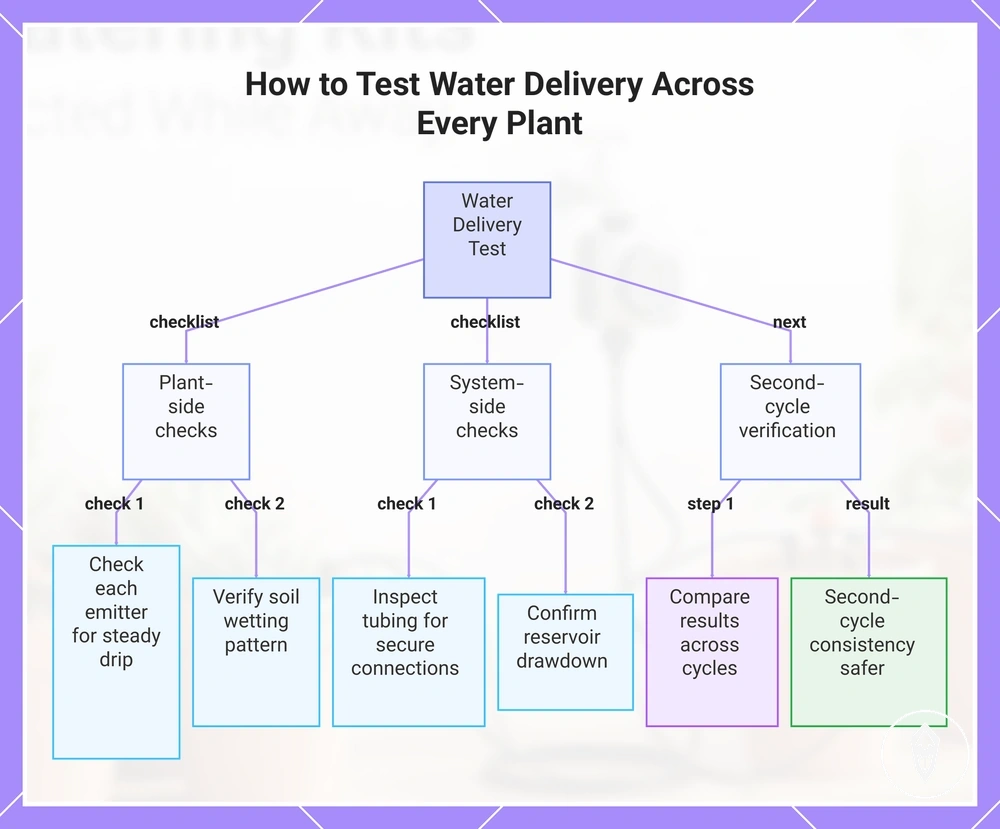
Use the checklist below to verify each outlet, emitter, tubing run, and soil response before leaving. Repeat the delivery check through a repeated cycle because soil, pot size, and cycle length can influence the results, making second-cycle consistency the safer check.
- Confirm every outlet delivers water through its connected tubing run during the watering test.
- Check every emitter for a steady drip and identify any dry emitter or obvious uneven flow.
- Verify emitter position so water reaches the root area of every plant instead of missing the soil.
- Observe the soil response for each plant and confirm the wetting pattern is suitable before making adjustments.
- Inspect each tubing run for secure connections, stable routing, and no visible movement that could interrupt water delivery.
- Confirm the reservoir shows expected drawdown after the test cycle, indicating water is moving through the complete setup.
- Repeat the watering test through a repeated cycle and compare results across every plant instead of treating one successful cycle as confirmation for the whole setup.
This chart shows the essential steps to verify that every plant receives water, including checks on emitters, soil, tubing, and reservoir, plus a second-cycle confirmation.
Adjusting Flow to Prevent Dry Soil or Overwatering
Adjust flow when the vacation watering setup leaves dry soil or causes runoff, persistent saturation, or waterlogging. Moisture consistency changes with emitter output, watering duration, soil absorption, pot drainage, and plant demand. Increase or reduce delivery only when the observed soil response shows that the current setting is insufficient or excessive.
Use an observe-adjust-retest pattern instead of applying a fixed prescription.
Use an observe-adjust-retest pattern instead of applying a fixed prescription. Compare soil moisture, drainage behaviour, and reservoir drawdown after each change, then retest under the same setup conditions.
- Observe the soil after watering: dry areas indicate insufficient delivery, while runoff or prolonged saturation indicates overwatering risk.
- Adjust emitter output gradually when one plant receives less or more water than its soil can absorb.
- Lengthen watering duration when the root area remains dry, and shorten it when water runs off or collects faster than the pot can drain.
- Check pot drainage and plant demand before changing flow, because restricted drainage increases waterlogging risk while higher-demand plants require comparatively greater delivery.
- Retest the adjusted setup and compare soil response with reservoir drawdown to confirm that the change improves moisture consistency without excessive water use.
Leak, Power, and Water-Supply Risks During Travel
Leak risk, power status, and water-supply risk should be checked before leaving a watering kit unattended during travel. Loose fittings, interrupted power, or an unstable water source can stop irrigation or allow unwanted water release. Risk severity changes with setup location, water source, and power design, so each condition requires verification before departure.
Connector tightness reduces leak risk when every tubing joint remains secure throughout a test cycle.
Connector tightness reduces leak risk when every tubing joint remains secure throughout a test cycle. Confirm the timer battery or power status, reservoir stability, hose pressure, and pump position before travel because each condition affects continued operation. Indoor setups need extra protection where indoor spill exposure could damage nearby surfaces, while outdoor setups need weather-exposed components and the water source checked for movement or disruption.
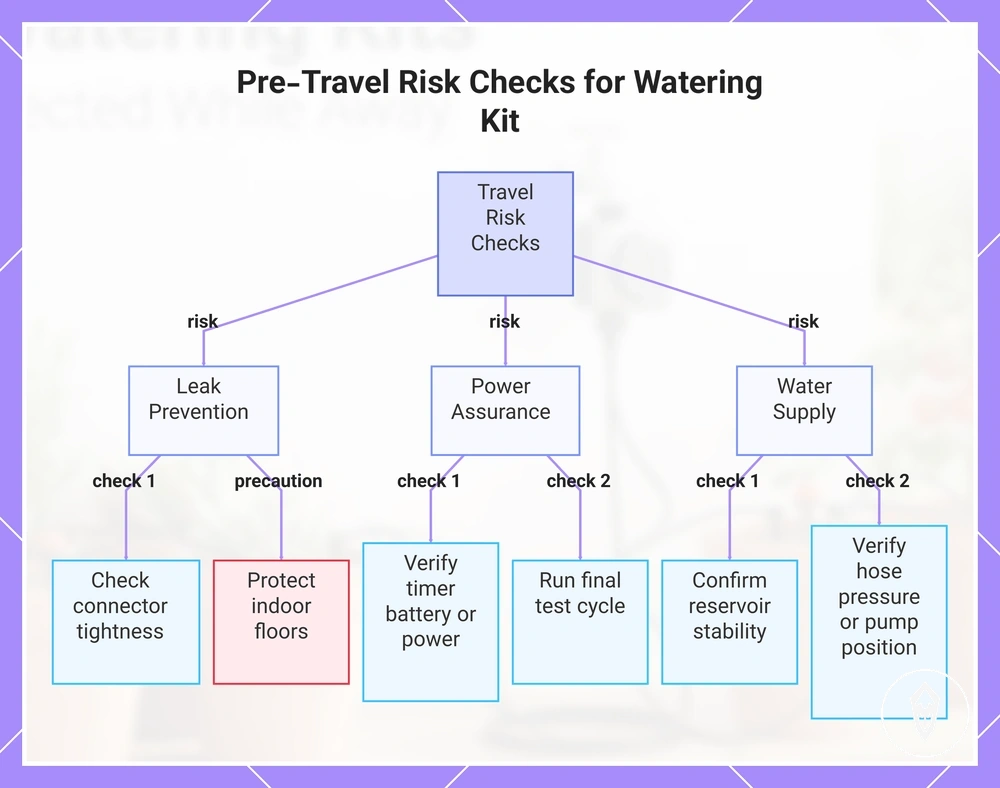
Use the safety checklist below to verify the main travel-specific risks before leaving.
Use the safety checklist below to verify the main travel-specific risks before leaving. After completing these checks, continue with maintenance before travel to keep the setup ready between trips.
- Check connector tightness at every tubing joint and fitting to reduce leak risk.
- Protect indoor floors or nearby surfaces where indoor spill exposure could cause damage if a connection loosens.
- Verify the timer battery or power status so the unattended setup can follow its configured schedule.
- Confirm reservoir stability so the water source remains upright and accessible during the watering period.
- Check hose pressure or pump position so water can reach the emitters under the intended setup conditions.
- Ensure each overflow path directs excess water away from sensitive indoor or outdoor areas if overflow occurs.
- Run a final test cycle after all adjustments to verify that connectors, power, and water delivery remain stable before travel.
This chart groups the three main travel risks—leak, power, and water supply—and shows the essential checks to perform before leaving a watering kit unattended.
When a Vacation Watering Kit Is Not the Right Option
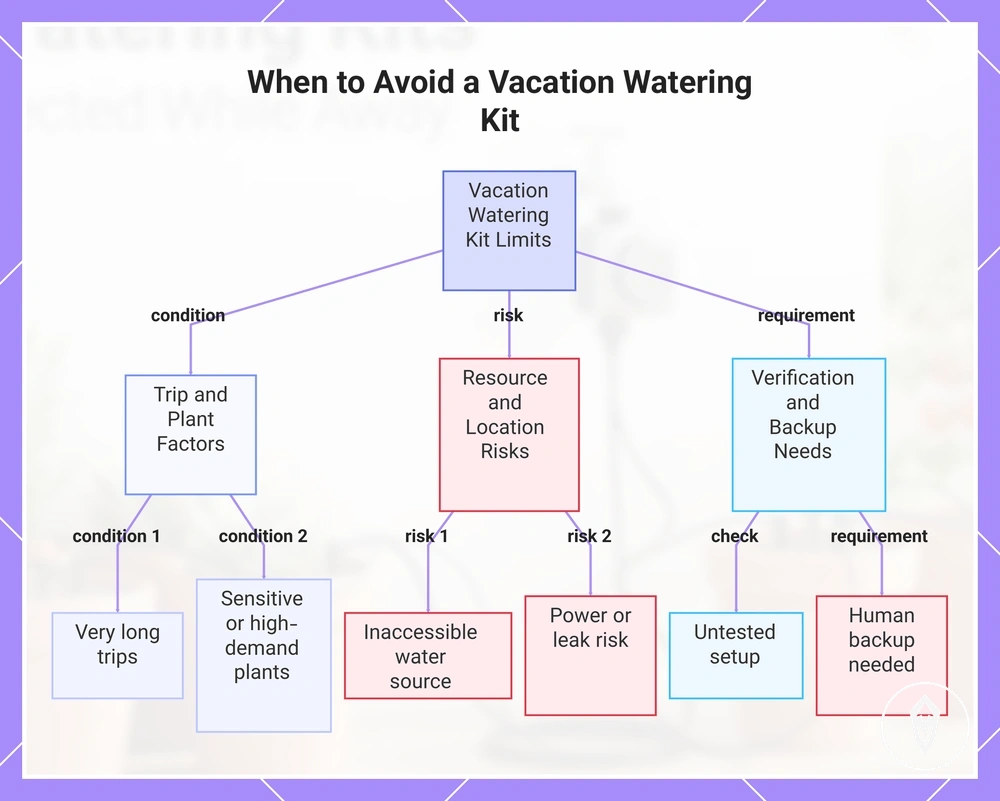
A vacation watering kit is not always the right option when plant, trip, or location conditions exceed what an unattended setup can safely manage. If any clear stop-signal applies, choose a safer care plan before departure.
- The trip involves very long trips that may exceed the prepared water supply or practical monitoring period.
- Sensitive plants or plants with high water demand require closer observation than the setup can provide.
- The setup relies on an inaccessible water source during the travel period.
- Unstable power could interrupt a timer or pump-based watering cycle.
- The installation is in a leak-intolerant indoor area where reservoir, connector, or spill risk is unacceptable.
- The watering system remains an untested setup before departure.
- Human backup is needed because the plant or location requires intervention if conditions change.
Very long trips can extend beyond the prepared water supply or the period for which the setup has been tested. Sensitive plants and plants with high water demand leave less tolerance for interrupted watering or changing conditions. When those plants require observation or adjustment, a kit alone is not sufficient.
When those plants require observation or adjustment, a kit alone is not sufficient.
An inaccessible water source, unstable power, or a leak-intolerant indoor area creates a failure condition that the kit cannot correct during the trip. An untested setup is also a stop-signal because water delivery, reservoir stability, and connector performance have not been verified in advance. When these limits apply, relying on unattended watering adds avoidable uncertainty.
When these limits apply, relying on unattended watering adds avoidable uncertainty.
If the limiting condition is trip length or plant sensitivity, plant-sitter support may provide the required observation. If the limiting condition is water demand or location, reduced light, plant grouping, or a different watering method can form an alternative watering plan without treating another product as a fix for every problem.
When one or more stop-signals remain unresolved, use a safer care plan with human backup or another appropriate method.
Choose the vacation watering kit only when water access, power, leak tolerance, and advance testing are suitable for unattended use. When one or more stop-signals remain unresolved, use a safer care plan with human backup or another appropriate method.
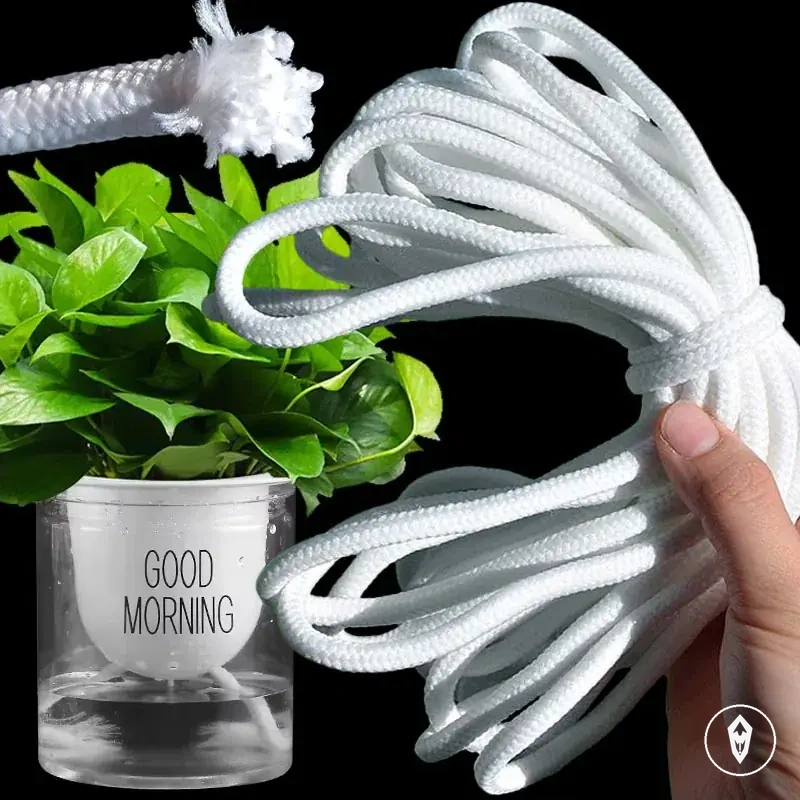
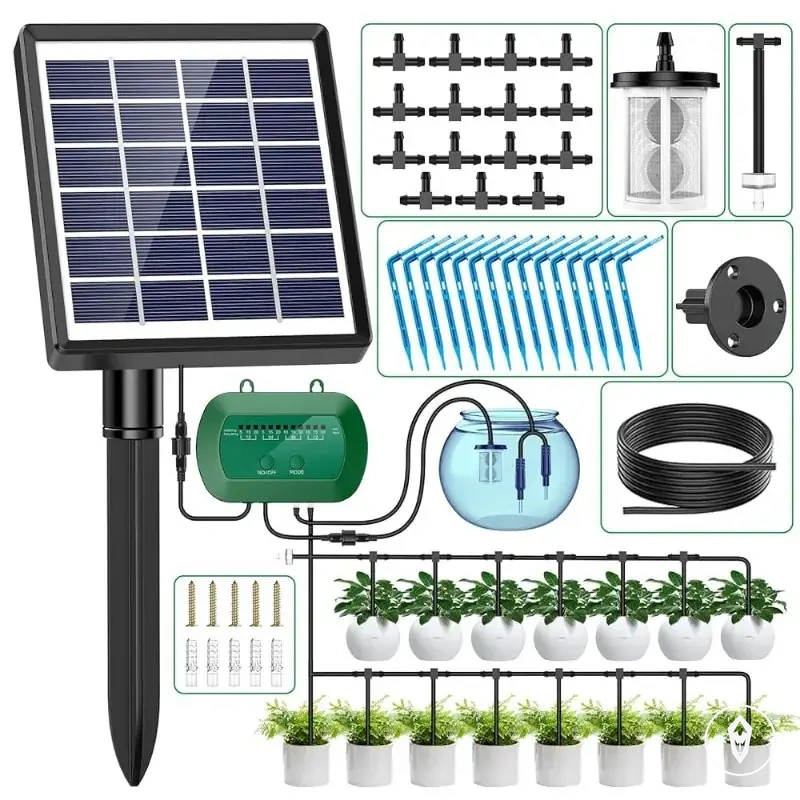
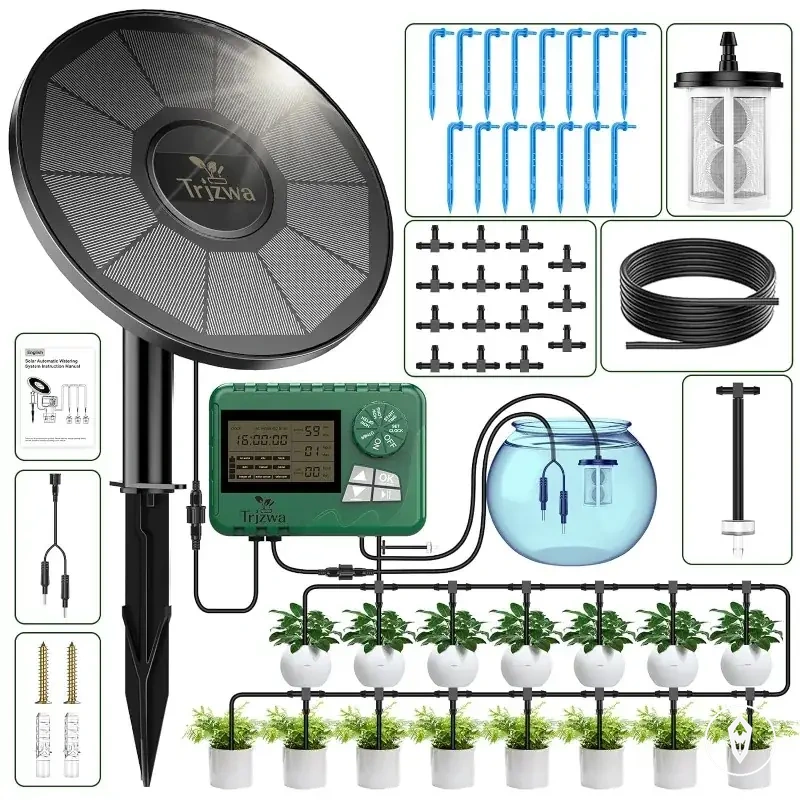
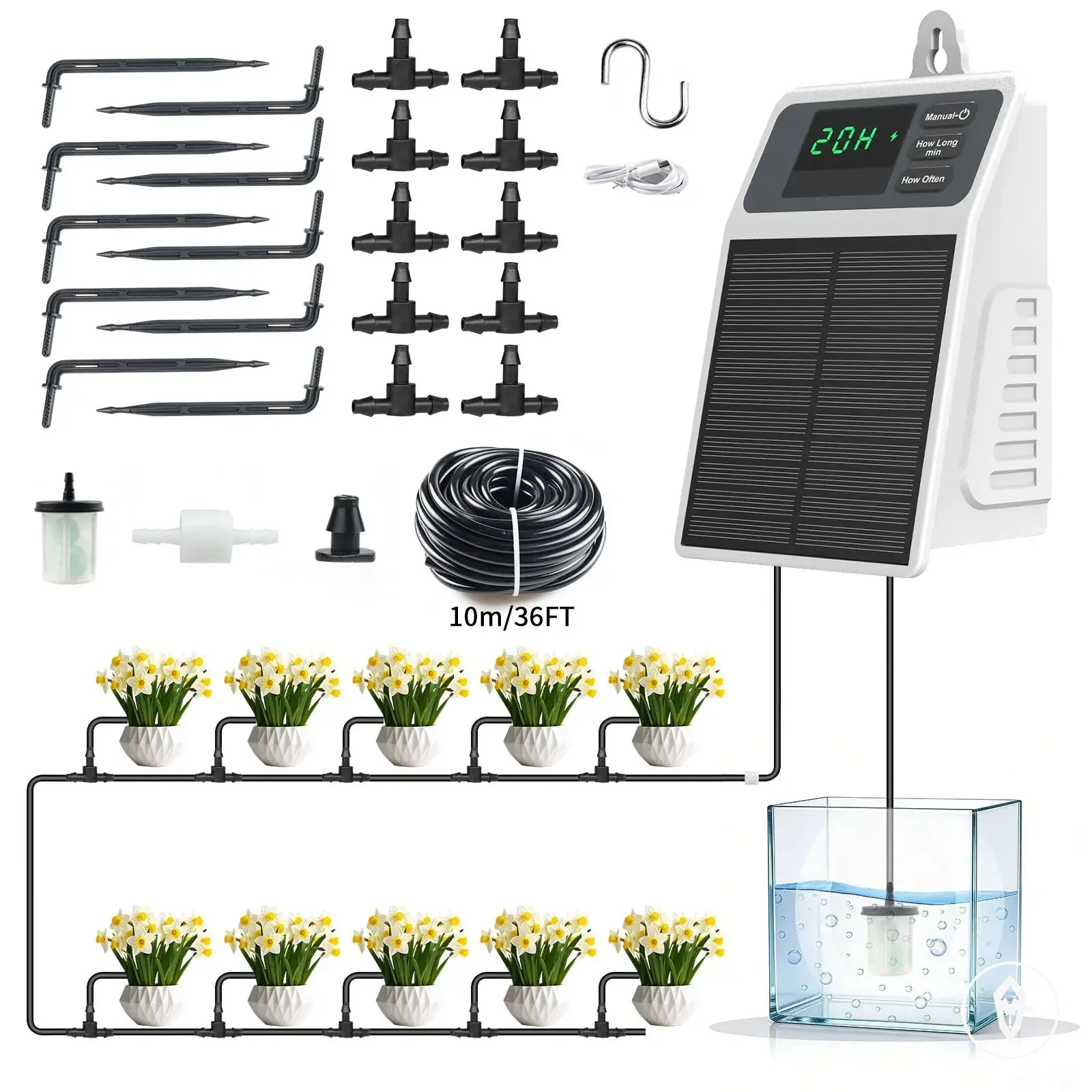
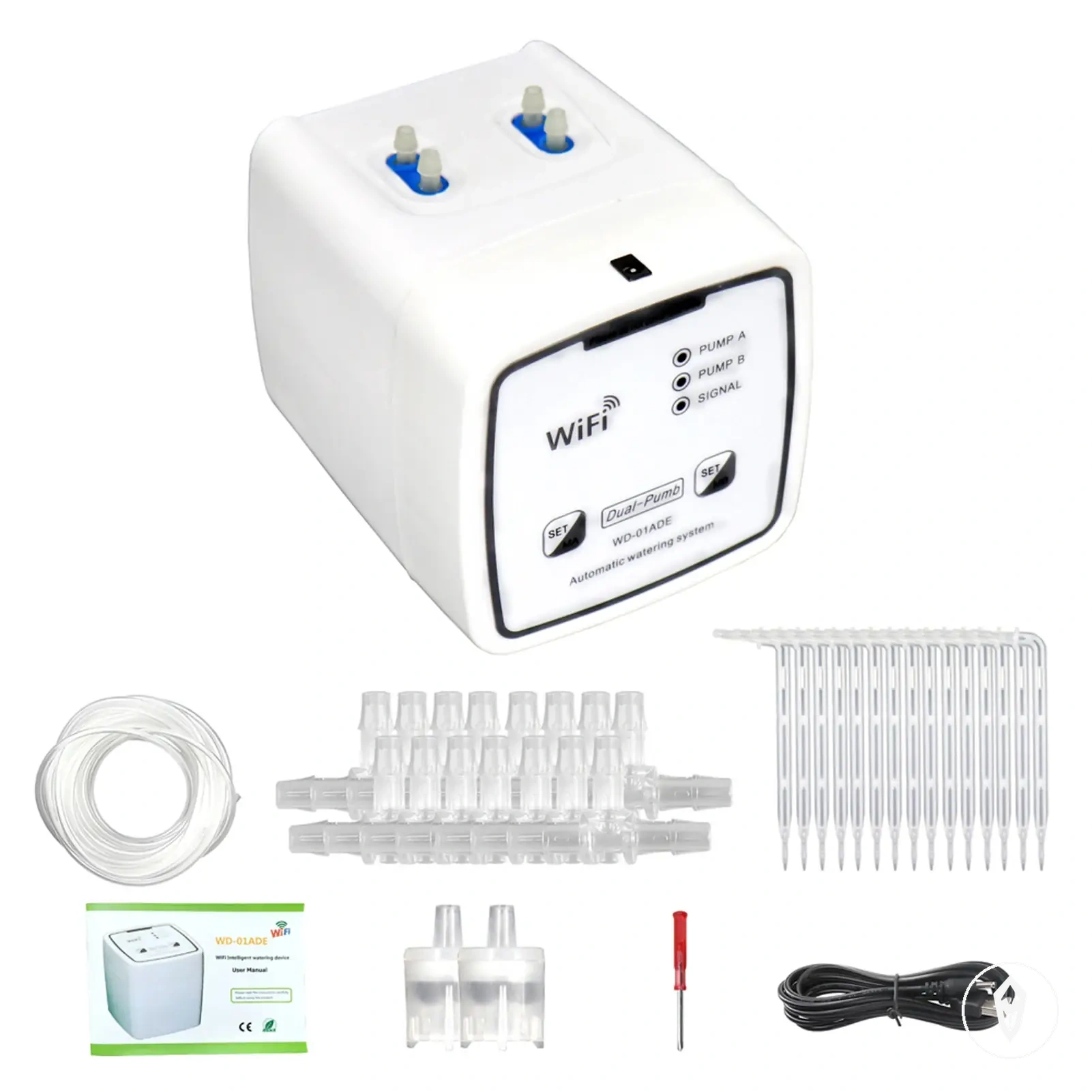
The products below are useful examples for comparing available options.
The products below are useful examples for comparing available options. Before buying, check that the compatibility criteria, key features, and product details match your needs.
This chart shows the key stop-signals that indicate a vacation watering kit is not a safe option, guiding the reader to choose a different care plan.